14.2 Wages and Employment in an Imperfectly Competitive Labor Market

🛒Principles of Microeconomics Unit 14 Review
14.2 Wages and Employment in an Imperfectly Competitive Labor Market
🛒 Principles of Microeconomics
Imperfectly Competitive Labor Markets
Not all labor markets work the way the basic supply-and-demand model predicts. When employers hold significant power over workers, wages end up lower and fewer people get hired than in a competitive market. This unit focuses on monopsony, the key model for understanding employer-side market power, and compares it to the competitive labor market you already know.

Top images from around the web for Labor Market Power
Putting It Together: Supply and Demand | Microeconomics View original
Is this image relevant?
Labor Market Power by Employers | Microeconomics View original
Is this image relevant?
The Demand for Labor | Microeconomics View original
Is this image relevant?
Putting It Together: Supply and Demand | Microeconomics View original
Is this image relevant?
Labor Market Power by Employers | Microeconomics View original
Is this image relevant?
Labor Market Power
In a competitive labor market, each employer is too small to affect the going wage. But a monopsony is a market with one dominant employer (or very few). Think of a single hospital in a rural town: nurses in that area don't have many other options, so the hospital has leverage over wages.
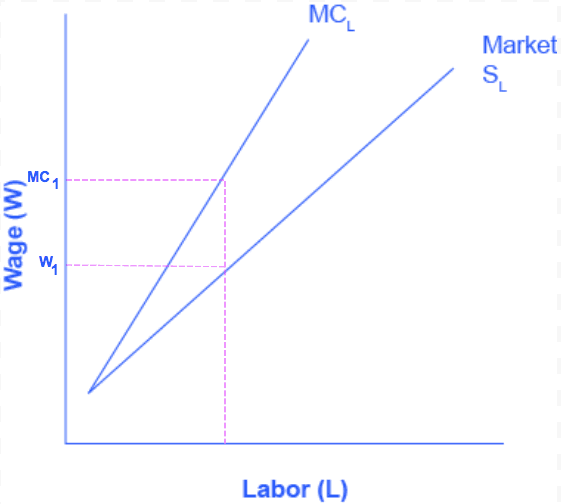
Because a monopsonist is the main buyer of labor, it faces an upward-sloping labor supply curve. To attract more workers, it must raise the wage, and that higher wage applies to all workers, not just the new hire. This means the marginal cost of labor (MCL) is greater than the wage for each additional worker.
Here's how the monopsonist decides how many workers to hire:
- Calculate the marginal revenue product (MRP) of labor, which is the extra revenue from hiring one more worker.
- Compare MRP to the marginal cost of labor (MCL), which includes the higher wage paid to all existing workers.
- Hire workers up to the point where .
- Set the wage by reading down from that employment level to the labor supply curve, not the MCL curve.
The result: the monopsonist pays a wage that is below both the MRP and the wage that would prevail in a competitive market. The gap between MRP and the wage is sometimes called monopsonistic exploitation, because workers are paid less than the value of what they produce.

Monopsony Impact
Compared to a competitive labor market, monopsony creates three distinct problems:
- Lower wages. The employer pays below MRP because it has the power to set wages rather than accept a market-determined price.
- Lower employment. The employer deliberately hires fewer workers than the competitive quantity. Restricting hiring is what allows it to keep wages down.
- Deadweight loss. Workers who would have been hired at the competitive wage, and who would have produced output worth more than their cost, are left out. The marginal benefit of their labor exceeds its marginal cost, so society loses potential output. This is allocative inefficiency.
On a graph, deadweight loss appears as the triangle between the supply curve, the MRP curve, and the monopsony employment level. It represents mutually beneficial trades (hiring) that don't happen.

Competitive vs. Monopsony
| Feature | Competitive Market | Monopsony |
|---|---|---|
| Number of employers | Many | One or very few |
| Labor supply curve facing each firm | Perfectly elastic (horizontal) | Upward-sloping |
| Wage determination | Firm is a wage-taker; | Firm sets wage below MRP |
| Employment level | Higher (efficient quantity) | Lower (restricted to hold down wages) |
| Efficiency | Allocatively efficient | Deadweight loss present |
In a competitive market, no single employer can influence the wage. Each firm hires until , and the wage equals the value of the last worker's output. That's the efficient outcome.
In a monopsony, the employer exploits its position by hiring fewer workers and paying less. The wage sits below MRP, employment is below the competitive level, and the market produces less total surplus than it could.
The core takeaway: employer market power in labor markets leads to wages that are too low and employment that is too small relative to the competitive benchmark. Policies like minimum wages (set carefully) or encouraging competition among employers can potentially move a monopsony market closer to the efficient outcome.
See Fiveable more often in Google
Mark Fiveable as a preferred source and Google is more likely to show you our guides in Top Stories, with a "preferred" badge in AI Mode and AI Overviews.