5.3 Elasticity and Pricing

🛒Principles of Microeconomics Unit 5 Review
5.3 Elasticity and Pricing
🛒 Principles of Microeconomics
Elasticity and Pricing
Elasticity measures how quantity demanded or supplied responds to price changes. Understanding elasticity is what separates "knowing supply and demand" from actually being able to predict what happens to a firm's revenue, who pays a tax, and how markets adjust over time.
This section connects elasticity to three practical questions: How should firms think about pricing? How do elastic vs. inelastic markets respond to shocks? And who really bears the burden of a tax?

Top images from around the web for Price elasticities and firm revenue
Profit Maximization under Monopolistic Competition | Microeconomics View original
Is this image relevant?
Elasticity – Introduction to Microeconomics View original
Is this image relevant?
Elasticity, Costs, and Customers | Microeconomics View original
Is this image relevant?
Elasticity – Introduction to Microeconomics View original
Is this image relevant?
Elasticity – Introduction to Microeconomics View original
Is this image relevant?
Profit Maximization under Monopolistic Competition | Microeconomics View original
Is this image relevant?
Elasticity – Introduction to Microeconomics View original
Is this image relevant?
Elasticity and Its Effects
Price Elasticities and Firm Revenue
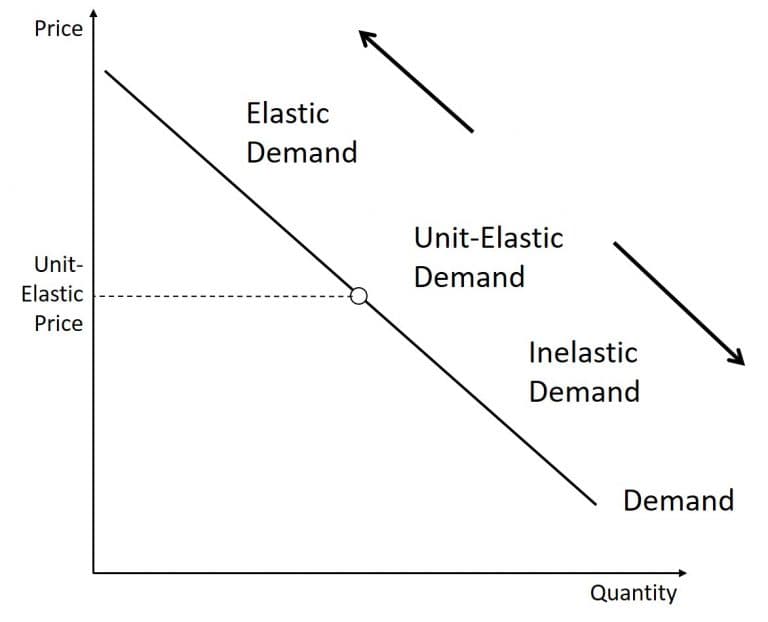
Price elasticity of demand () measures how responsive quantity demanded is to a price change. The key relationship to internalize is how elasticity determines what happens to total revenue () when price changes.
- Elastic demand (): Quantity demanded changes by a larger percentage than the price change.
- A price increase lowers total revenue because the drop in quantity more than offsets the higher price. Think electronics on sale: a small discount pulls in so many extra buyers that revenue climbs.
- A price decrease raises total revenue for the same reason.
- Inelastic demand (): Quantity demanded changes by a smaller percentage than the price change.
- A price increase raises total revenue because buyers don't cut back much. Gasoline is the classic example: prices spike, but people still need to drive.
- A price decrease lowers total revenue because you're charging less without gaining many new sales.
- Unit elastic demand (): Quantity demanded changes by the same percentage as the price change.
- Price changes have no effect on total revenue; the quantity and price effects exactly cancel out.
The practical takeaway: firms with inelastic demand have pricing power (they can raise prices profitably), while firms facing elastic demand need to compete on price or volume.
Marginal revenue is the additional revenue gained from selling one more unit. When demand is elastic, marginal revenue is positive (selling more adds to total revenue). When demand is inelastic, marginal revenue is negative (selling more actually reduces total revenue because the price cut needed to sell that extra unit drags down revenue on all units).

Elasticity's Impact on Market Changes
Elasticity determines how dramatically a market reacts to any shift in supply or demand.
- Elastic demand or supply: A small price change causes a large change in quantity. Restaurant meals are a good example on the demand side. If your favorite place raises prices 15%, you'll probably just eat somewhere else.
- Inelastic demand or supply: A large price change causes only a small change in quantity. Insulin is the textbook case. Diabetic patients need it regardless of price, so quantity demanded barely budges.
Factors that make demand more elastic:
- Close substitutes are available (Coke vs. Pepsi: easy to switch)
- The good takes up a large share of the buyer's income (a 10% rent increase hurts more than a 10% increase in the price of salt)
- The good is a luxury rather than a necessity (diamonds vs. water)
- More time has passed since the price change (long-run demand is more elastic than short-run)
Factors that make supply more elastic:
- Producers have flexible production processes (a bakery can shift from muffins to cookies more easily than an oil refinery can switch products)
- Firms hold larger inventories
- More time has passed, giving producers room to adjust capacity
Elasticity and Market Equilibrium

Short-Run vs. Long-Run Elasticity Effects
Both demand and supply tend to be more inelastic in the short run and more elastic in the long run. The reason is simple: adjustment takes time.
On the demand side, consumers are locked into habits and commitments in the short run. If gas prices double tomorrow, you still drive to work. But over a year or two, you might buy a fuel-efficient car, move closer to work, or switch to public transit.
On the supply side, producers can't instantly change their capacity. A factory can't expand overnight. But over months or years, firms can build new facilities, adopt new technology, or enter and exit the market entirely.
This matters for equilibrium:
- Short-run equilibrium reflects these limited responses. Price absorbs most of the shock because neither buyers nor sellers adjust quantity much.
- Long-run equilibrium reflects fuller adjustments. Quantities shift more, and price changes moderate as the market adapts.
Elasticities in Tax Burden Distribution
Tax incidence refers to who actually bears the economic burden of a tax, which is not necessarily who writes the check to the government. The rule is straightforward: the more inelastic side of the market bears the larger share of the tax.
- Elastic demand + inelastic supply: Producers bear most of the tax. Consumers can easily walk away, so producers can't pass the tax along. Example: a tax on luxury yachts falls mostly on yacht makers because wealthy buyers have plenty of other ways to spend their money.
- Inelastic demand + elastic supply: Consumers bear most of the tax. Buyers can't easily reduce their purchases, so producers pass the tax through to higher prices. Example: a cigarette tax falls mostly on smokers because addiction makes demand highly inelastic, while tobacco companies can shift production.
The intuition: whichever side has fewer alternatives gets stuck with the bill.
Market Efficiency and Pricing Strategies
- Consumer surplus is the difference between what consumers are willing to pay and the price they actually pay. On a graph, it's the area below the demand curve and above the market price.
- Producer surplus is the difference between the price producers receive and the minimum they'd accept. It's the area above the supply curve and below the market price.
- Deadweight loss is the lost surplus that occurs when a market doesn't reach its efficient equilibrium. Taxes, price controls, and monopoly pricing all create deadweight loss by preventing some mutually beneficial trades from happening.
- Price discrimination is the practice of charging different prices to different consumers based on their willingness to pay. Student discounts, airline pricing, and senior rates are all examples. Firms do this to capture more consumer surplus as revenue. It works best when the firm can segment buyers and prevent resale between groups.
See Fiveable more often in Google
Mark Fiveable as a preferred source and Google is more likely to show you our guides in Top Stories, with a "preferred" badge in AI Mode and AI Overviews.