6.2 How Changes in Income and Prices Affect Consumption Choices

🛒Principles of Microeconomics Unit 6 Review
6.2 How Changes in Income and Prices Affect Consumption Choices
🛒 Principles of Microeconomics
Consumer decisions shape demand in the market. Income, prices, preferences, and opportunity costs all determine what people buy and how much. Understanding these factors explains why demand curves slope downward and how they shift.
This section covers how changes in income and prices affect consumption through substitution and income effects, the law of demand, elasticity, and how consumers maximize utility with limited budgets.
Consumer Decisions and Demand

Top images from around the web for Factors shaping consumer decisions
Factors Affecting Demand | Introduction to Business View original
Is this image relevant?
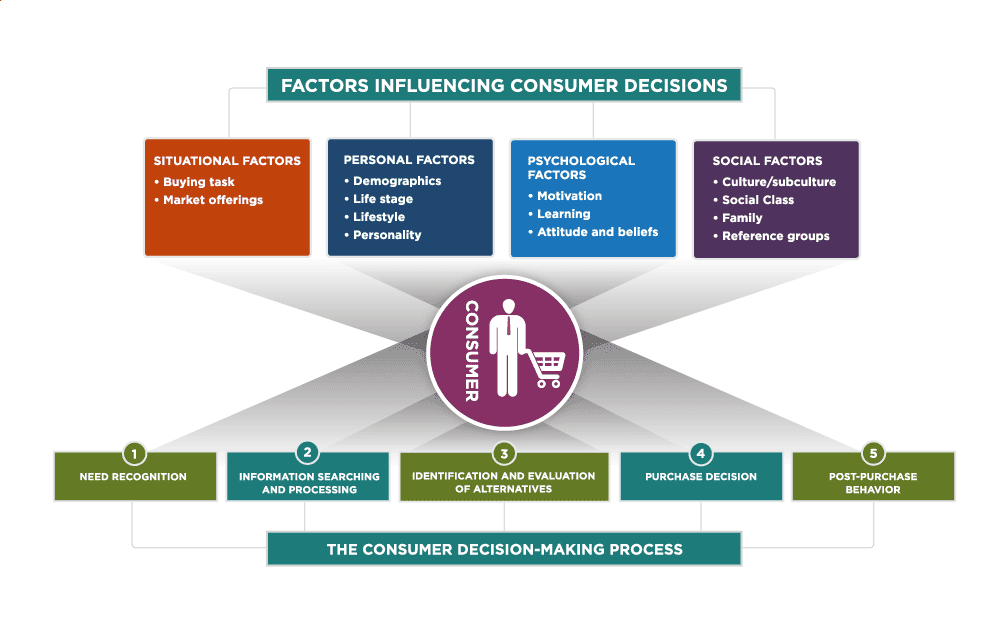
Reading: Influences on Consumer Decisions | Principles of Marketing View original
Is this image relevant?
Reading: The Foundations of Demand Curve | Microeconomics View original
Is this image relevant?
Factors Affecting Demand | Introduction to Business View original
Is this image relevant?
Reading: Influences on Consumer Decisions | Principles of Marketing View original
Is this image relevant?
Factors Shaping Consumer Decisions
Income directly affects what you can buy. Higher income increases purchasing power and raises demand for normal goods like luxury cars or organic food. But inferior goods work in reverse: when income drops, demand for things like generic store brands or public transportation actually goes up, because people substitute away from pricier alternatives.
Prices determine how much of a good you'll buy. Higher prices decrease quantity demanded (think gasoline or concert tickets), while lower prices increase it. A price change causes movement along the demand curve, not a shift of the curve itself.
Preferences reflect your tastes and can shift the entire demand curve. Growing preference for a product shifts demand to the right (smartphones, eco-friendly products), while declining interest shifts it left (CDs, fur coats).
Opportunity cost is the value of the next best alternative you give up when making a choice. Every purchase means forgoing something else, and rational consumers weigh these trade-offs constantly.
Substitution vs. Income Effects
When a good's price changes, two separate forces affect your behavior:
- Substitution effect: A price increase makes that good relatively more expensive compared to alternatives, so you shift spending toward substitutes. If beef prices rise, you buy more chicken instead.
- Income effect: A price increase reduces your real purchasing power. Even though your paycheck hasn't changed, your dollars buy less overall, so you tend to cut back.
The total effect of a price change is the sum of both effects.
- For normal goods, the two effects reinforce each other. A price increase triggers both substitution away from the good and reduced purchasing power, so quantity demanded falls.
- For inferior goods, the effects work in opposite directions. The substitution effect still pushes you away from the more expensive good, but the income effect (you're now effectively poorer) actually pushes you toward the inferior good. In most cases, the substitution effect dominates, so quantity demanded still falls, preserving the law of demand.

Demand Concepts in Consumer Choices
The law of demand states that there's an inverse relationship between price and quantity demanded, ceteris paribus (all else equal). As price goes up, quantity demanded goes down.
Factors that shift the demand curve (as opposed to movement along it):
- Changes in income (a job promotion vs. a recession)
- Changes in prices of related goods (substitutes and complements)
- Changes in preferences (health trends, fashion shifts)
- Changes in expectations (if you expect prices to rise next month, you buy more now)
- Changes in the number of consumers (population growth, immigration)
Elasticity of demand measures how responsive quantity demanded is to a change in some variable. There are three main types:
- Price elasticity of demand measures the percentage change in quantity demanded divided by the percentage change in price.
- Elastic demand (elasticity > 1): quantity responds more than proportionally to price changes. Common for luxury goods with many substitutes.
- Inelastic demand (elasticity < 1): quantity barely budges when price changes. Think necessities like insulin, where consumers have few alternatives.
- Unitary elastic demand (elasticity = 1): quantity changes by exactly the same percentage as price.
- Income elasticity of demand measures how quantity demanded responds to changes in income. Positive for normal goods, negative for inferior goods.
- Cross-price elasticity of demand measures how quantity demanded of one good responds to a price change in another good. Positive for substitutes, negative for complements.
Utility Maximization in Decision-Making
The concept of utility maximization isn't just academic. Both governments and businesses use it.
Governments aim to maximize social welfare through policies that account for consumer utility. A carbon tax, for example, raises the price of pollution-heavy goods to shift consumption toward cleaner alternatives. Education subsidies lower the effective price of schooling to encourage more of it.
Businesses use consumer behavior insights to maximize profits:
- Market research (surveys, focus groups) reveals what consumers value
- Pricing strategies leverage elasticity: firms charge more where demand is inelastic and compete on price where demand is elastic (this is the logic behind price discrimination and bundling)
- Product design targets consumer preferences to maximize the utility customers get, which drives willingness to pay

Utility Maximization and Consumer Equilibrium
How Consumers Maximize Utility
Consumers aim to get the most total satisfaction (utility) possible given their limited budget. Two key principles govern this:
Marginal utility (MU) is the additional satisfaction from consuming one more unit of a good. The law of diminishing marginal utility says that MU decreases as you consume more. Your first slice of pizza might give you 10 units of satisfaction, but by the fifth slice, you're barely enjoying it.
Consumer equilibrium occurs when you've allocated your budget so that the marginal utility per dollar spent is equal across all goods:
If this condition isn't met, you can increase total utility by reallocating spending. For example, if the last dollar spent on good A gives you more utility than the last dollar spent on good B, you should buy more of A and less of B until the ratios equalize.
Consumer Choice Analysis
- Indifference curves represent all combinations of two goods that give a consumer the same level of satisfaction. Higher curves (farther from the origin) represent greater utility.
- Budget constraints show every combination of goods a consumer can afford given their income and current prices. When income rises or a price falls, the budget line shifts outward, expanding your options.
- Consumer surplus is the difference between the maximum price you'd be willing to pay for a good and the actual market price. If you'd pay $5 for a coffee but it costs $3, your consumer surplus on that purchase is $2.
See Fiveable more often in Google
Mark Fiveable as a preferred source and Google is more likely to show you our guides in Top Stories, with a "preferred" badge in AI Mode and AI Overviews.