5.2 Polar Cases of Elasticity and Constant Elasticity

🛒Principles of Microeconomics Unit 5 Review
5.2 Polar Cases of Elasticity and Constant Elasticity
🛒 Principles of Microeconomics
Polar Cases and Constant Elasticity
Elasticity measures how sensitive quantity demanded is to a change in price. Most demand curves have elasticity that varies along the curve, but there are special cases where elasticity stays constant everywhere. Understanding these polar and constant-elasticity cases gives you a framework for thinking about all the demand behavior in between.

Top images from around the web for Infinite vs zero elasticity
Reading: Elasticity, Costs, and Customers | Microeconomics View original
Is this image relevant?
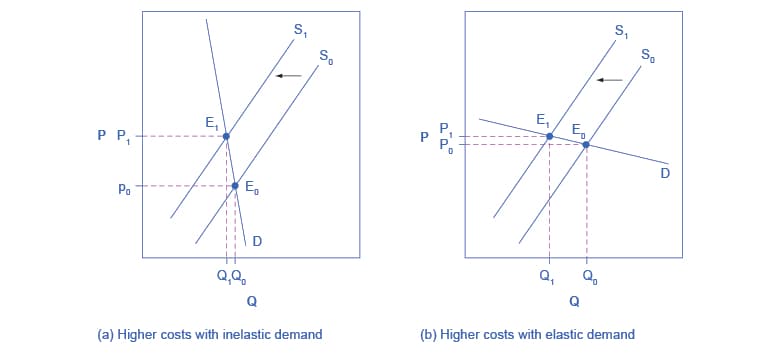
Reading: Elasticity, Costs, and Customers | Microeconomics View original
Is this image relevant?
Elasticity – Introduction to Microeconomics View original
Is this image relevant?
Changes in Supply and Demand | Microeconomics View original
Is this image relevant?
Reading: Polar Cases of Elasticity | Microeconomics View original
Is this image relevant?
Reading: Elasticity, Costs, and Customers | Microeconomics View original
Is this image relevant?
Reading: Elasticity, Costs, and Customers | Microeconomics View original
Is this image relevant?
Infinite vs. Zero Elasticity
These are the two extremes of the elasticity spectrum.
Perfectly elastic demand () means consumers are infinitely sensitive to price. Even a tiny price increase causes quantity demanded to drop to zero, because buyers can switch to a perfect substitute instantly. On a graph, this shows up as a horizontal demand curve.
Think of a single wheat farmer selling in a competitive market. If that farmer raises the price even one cent above the market price, no one buys from them. Buyers just go to the next farmer selling identical wheat.
Perfectly inelastic demand () is the opposite. Quantity demanded doesn't change at all when price changes. Consumers buy the same amount no matter what. On a graph, this is a vertical demand curve.
A classic example is a life-saving medication with no substitutes. A patient who needs insulin will purchase the same quantity whether the price goes up or down, because there's no alternative and going without isn't an option.
Quick visual shortcut: Horizontal curve = perfectly elastic. Vertical curve = perfectly inelastic. If you forget which is which, remember that a flat (horizontal) curve means quantity swings wildly with any price change, while a vertical curve means quantity is "stuck" in place.

Interpreting Elasticity Graphs
Beyond the two polar cases, there's a third constant-elasticity case worth knowing: constant unitary elasticity.
Constant unitary elasticity () means that at every point on the demand curve, a 1% increase in price leads to exactly a 1% decrease in quantity demanded. The demand curve for this case is a rectangular hyperbola, a smooth curve that bows toward the origin.
What makes unitary elasticity special is its effect on total revenue (). Because the percentage drop in quantity always exactly offsets the percentage rise in price, total revenue stays the same no matter where you are on the curve.
To summarize the three constant-elasticity curves:
| Elasticity Type | Curve Shape | What Happens to When Rises | |
|---|---|---|---|
| Perfectly elastic | Horizontal line | Drops to zero | |
| Perfectly inelastic | Vertical line | Doesn't change at all | |
| Constant unitary | Rectangular hyperbola | Falls by the same percentage as the price rise |

Price Changes and Total Revenue Across Elasticity Types
The relationship between elasticity and total revenue is one of the most tested ideas in this unit. Here's how it works across the full spectrum:
Elastic demand (): Quantity is very responsive to price. A price increase causes quantity to fall by a larger percentage, so total revenue decreases. A price decrease causes quantity to rise by a larger percentage, so total revenue increases. Examples include beef, restaurant meals, and luxury goods where consumers can easily cut back or switch.
Unitary elastic demand (): The percentage changes in price and quantity are equal and opposite. Total revenue stays the same whether price goes up or down.
Inelastic demand (): Quantity barely responds to price. A price increase causes only a small percentage drop in quantity, so total revenue increases. A price decrease causes only a small rise in quantity, so total revenue decreases. Gasoline and cigarettes are common examples, since consumers have few short-run alternatives.
The total revenue rule in one sentence: When demand is elastic, price and total revenue move in opposite directions. When demand is inelastic, they move in the same direction. At unitary elasticity, total revenue doesn't move at all.
Additional Elasticity Concepts
A few related ideas often come up alongside price elasticity of demand:
- Cross-price elasticity measures how the quantity demanded of one good responds to a price change in another good. A positive value means the goods are substitutes (Coke and Pepsi); a negative value means they're complements (printers and ink).
- Income elasticity measures how quantity demanded changes when consumer income changes. Normal goods have positive income elasticity; inferior goods have negative income elasticity.
- Short-run vs. long-run elasticity: Demand tends to be more inelastic in the short run because consumers haven't had time to find substitutes. Over the long run, elasticity typically increases as people adjust their habits, find alternatives, or adopt new technologies.
See Fiveable more often in Google
Mark Fiveable as a preferred source and Google is more likely to show you our guides in Top Stories, with a "preferred" badge in AI Mode and AI Overviews.