14.1 The Theory of Labor Markets

🛒Principles of Microeconomics Unit 14 Review
14.1 The Theory of Labor Markets
🛒 Principles of Microeconomics
Labor Demand
Labor demand isn't something that exists on its own. Companies hire workers because there's demand for what those workers produce. This concept, called derived demand, is central to understanding how labor markets function. The number of workers a firm wants to hire depends on how productive those workers are and how much revenue their output generates.
How firms make hiring decisions differs depending on the type of market they operate in. A firm in a perfectly competitive market faces different constraints than a monopolist, and that changes the math behind their hiring choices.

Top images from around the web for Derived Demand
The Labor Market and Full Employment Equilibrium – Principles of Economics: Scarcity and Social ... View original
Is this image relevant?
The Demand for Labor | Microeconomics View original
Is this image relevant?
Labor Market Power by Employees | Public Economics View original
Is this image relevant?
The Labor Market and Full Employment Equilibrium – Principles of Economics: Scarcity and Social ... View original
Is this image relevant?
The Demand for Labor | Microeconomics View original
Is this image relevant?
Derived Demand
In a perfectly competitive market, the firm is a price taker. It can sell as much output as it wants at the going market price, so each additional unit of output sells for the same amount.
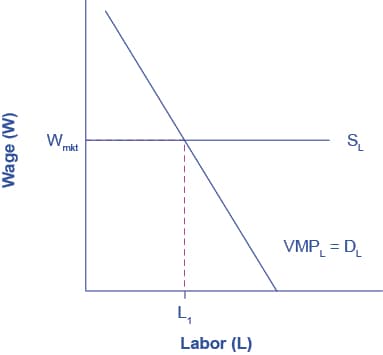
The key concept here is the marginal revenue product of labor (MRPL), which measures the additional revenue a firm earns by hiring one more worker. You calculate it as:
- MPL (marginal product of labor) = the extra output one additional worker produces
- P = the market price of that output
A firm keeps hiring as long as each new worker brings in more revenue than they cost. The profit-maximizing rule: hire until (the wage rate). If the next worker's MRPL is $18 and the wage is $15, hiring that worker adds $3 in profit. If MRPL drops to $12, that worker costs more than they're worth.
The firm's labor demand curve is the downward-sloping portion of the MRPL curve. It slopes downward because of diminishing marginal returns: as you add more workers with fixed capital, each additional worker produces a bit less than the one before.

Imperfect Competition
In imperfectly competitive markets (monopoly, oligopoly, monopolistic competition), firms have some control over their product's price. They face a downward-sloping demand curve, which means selling more units requires lowering the price.
This changes the MRPL calculation. Since marginal revenue is now less than price (the firm must cut its price on all units to sell one more), MRPL becomes:
Here MR (marginal revenue) replaces P, and because of that price reduction effect.
The hiring rule stays the same: hire until . But because MR is lower than the product price, the MRPL curve drops off faster. This produces a steeper labor demand curve compared to a perfectly competitive firm. In practical terms, an imperfectly competitive firm hires fewer workers at any given wage than an otherwise identical competitive firm would.

Equilibrium Wage Rate
Determining Factors
The market wage rate settles where labor supply and labor demand intersect. At this equilibrium, the number of workers willing to work at that wage equals the number firms want to hire.
What shifts labor supply:
- Size of the working-age population (immigration, demographic changes)
- Labor force participation rates (e.g., more women entering the workforce shifts supply right)
- Education and skill levels of the workforce
- Availability of alternative jobs in other industries
- Non-labor income sources like government benefits or family support (higher non-labor income can reduce the incentive to work, shifting supply left)
What shifts labor demand:
- Demand for the final product or service (if consumers want more of the good, firms need more workers to produce it)
- Labor productivity (better-trained workers or improved technology raises MPL, shifting demand right)
- Prices of other inputs, especially capital (if machines become cheaper, firms may substitute capital for labor, shifting labor demand left)
- Government regulations like minimum wage laws or payroll taxes (these raise the effective cost of hiring)
When any of these factors change, the relevant curve shifts and a new equilibrium wage emerges. For example, if demand for electric vehicles surges, firms producing EVs need more workers. Their labor demand curve shifts right, pushing wages up in that industry. Conversely, if automation makes warehouse robots cheaper, labor demand in warehousing could shift left, putting downward pressure on wages.
See Fiveable more often in Google
Mark Fiveable as a preferred source and Google is more likely to show you our guides in Top Stories, with a "preferred" badge in AI Mode and AI Overviews.