3.3 Changes in Equilibrium Price and Quantity: The Four-Step Process

🛒Principles of Microeconomics Unit 3 Review
3.3 Changes in Equilibrium Price and Quantity: The Four-Step Process
🛒 Principles of Microeconomics
The Four-Step Process and Changes in Equilibrium
Four-step process for market equilibrium
The "four-step process" in most microeconomics courses isn't about finding the initial equilibrium from scratch. It's a method for analyzing how equilibrium changes when something in the market shifts. Here's how it works:
- Draw the initial supply and demand curves and identify the starting equilibrium price () and quantity ().
- Decide which curve is affected. Ask: does the event affect buyers (demand) or sellers (supply)?
- Determine the direction of the shift. Does the curve shift right (increase) or left (decrease)?
- Find the new equilibrium where the shifted curve intersects the unchanged curve. Compare the new price and quantity to the original.
At equilibrium, quantity demanded equals quantity supplied, so the market "clears" with no surplus or shortage. The whole point of this process is to predict what happens to price and quantity after a specific change hits the market.
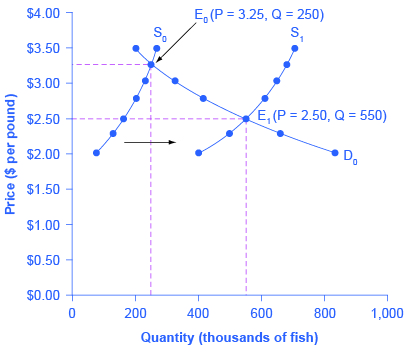
Effects of demand and supply shifts
Shifts in demand:
When the demand curve shifts, equilibrium price and quantity move in the same direction.
- An increase in demand (curve shifts right) raises both equilibrium price and quantity. For example, if a new study finds that blueberries prevent colds, demand for blueberries rises, pushing up both price and quantity sold.
- A decrease in demand (curve shifts left) lowers both equilibrium price and quantity. If health concerns cause people to stop buying sugary sodas, both the price and quantity of soda fall.
Factors that shift demand: changes in income (higher income increases demand for normal goods, decreases it for inferior goods), consumer preferences, prices of related goods (a rise in the price of a substitute boosts demand; a rise in the price of a complement reduces it), expectations about future prices, and the number of buyers in the market.
Shifts in supply:
When the supply curve shifts, equilibrium price and quantity move in opposite directions.
- An increase in supply (curve shifts right) lowers equilibrium price but raises equilibrium quantity. A technological breakthrough that cuts production costs is a classic example.
- A decrease in supply (curve shifts left) raises equilibrium price but lowers equilibrium quantity. A drought that destroys crops reduces supply, driving prices up while less is sold.
Factors that shift supply: input prices (higher wages or material costs reduce supply), technology improvements, expectations about future conditions, government policies (taxes, subsidies, regulations), and the number of sellers in the market.

Construction of real-world demand-supply graphs
Applying the four-step process to a real scenario like gasoline prices ties everything together:
- Identify the relevant event. Say a major oil-producing region faces a supply disruption, and it's also the start of summer driving season.
- Determine which curves shift and in which direction. The oil disruption decreases supply (supply curve shifts left). Summer travel increases demand (demand curve shifts right).
- Plot both shifts on the same graph. Start with the original equilibrium, then draw the new supply curve to the left and the new demand curve to the right.
- Locate the new equilibrium. The new intersection shows a higher price. In this case, the quantity effect is ambiguous: decreased supply pushes quantity down, while increased demand pushes it up. The net change in quantity depends on which shift is larger.
For instance, if gas was originally per gallon and the new equilibrium is , that's a 50% price increase. Whether quantity rises or falls depends on the relative size of the two shifts.
When both curves shift at the same time, you can always predict the direction of one variable (price or quantity) but not the other without knowing the relative magnitudes of the shifts.
Curve movements vs. curve shifts
This distinction is one of the most common sources of mistakes on exams. Keep it straight:
Movement along a curve happens when the good's own price changes and everything else stays the same.
- On a demand curve: a price increase causes quantity demanded to fall (you move up and to the left along the curve). A price decrease causes quantity demanded to rise (down and to the right).
- On a supply curve: a price increase causes quantity supplied to rise (up and to the right). A price decrease causes quantity supplied to fall (down and to the left).
A shift of the entire curve happens when a non-price factor changes.
- Demand shifts are caused by changes in income, preferences, prices of related goods, expectations, or number of buyers.
- Supply shifts are caused by changes in input prices, technology, expectations, government policies, or number of sellers.
The key test: Did the good's own price change, or did something else change? If it's the good's own price, you move along the curve. If it's anything else, the curve shifts. Mixing these up is the single most common error in supply-and-demand analysis.
Market Forces and Equilibrium Dynamics
Supply and demand interact to push markets toward equilibrium through two self-correcting mechanisms:
- A surplus occurs when the price is above equilibrium, so quantity supplied exceeds quantity demanded. Sellers can't move all their inventory, which puts downward pressure on price until the market clears.
- A shortage occurs when the price is below equilibrium, so quantity demanded exceeds quantity supplied. Buyers compete for limited goods, which puts upward pressure on price until the market clears.
Comparative statics is the term for what the four-step process does: comparing the old equilibrium to the new one after a change in market conditions. You're not tracking the adjustment in real time; you're comparing two snapshots, before and after.
Price elasticity affects how large the price and quantity changes are when a curve shifts. If demand is very inelastic (steep curve), a supply shift will cause a large price change but only a small quantity change. If demand is very elastic (flat curve), the same supply shift produces a smaller price change but a larger quantity change. You'll explore elasticity in more depth in its own unit, but for now, recognize that the slope and shape of the curves determine the magnitude of equilibrium changes, not just the direction.
See Fiveable more often in Google
Mark Fiveable as a preferred source and Google is more likely to show you our guides in Top Stories, with a "preferred" badge in AI Mode and AI Overviews.