1.4 How To Organize Economies: An Overview of Economic Systems

🛒Principles of Microeconomics Unit 1 Review
1.4 How To Organize Economies: An Overview of Economic Systems
🛒 Principles of Microeconomics
Economic Systems and Measures
Economic systems are the frameworks societies use to answer three fundamental questions: What should be produced? How should it be produced? Who gets what's produced?* Every society answers these differently, and the type of economic system in place shapes everything from ownership rights to government power. This topic also introduces GDP as a way to measure how well an economy is performing.

Top images from around the web for Economic systems comparison
Perfect Competition – Introduction to Microeconomics View original
Is this image relevant?
2.1 What is Economics? – Foundations of Business View original
Is this image relevant?
Reading: How Economies Can Be Organized | Introduction to Business View original
Is this image relevant?
Perfect Competition – Introduction to Microeconomics View original
Is this image relevant?
2.1 What is Economics? – Foundations of Business View original
Is this image relevant?
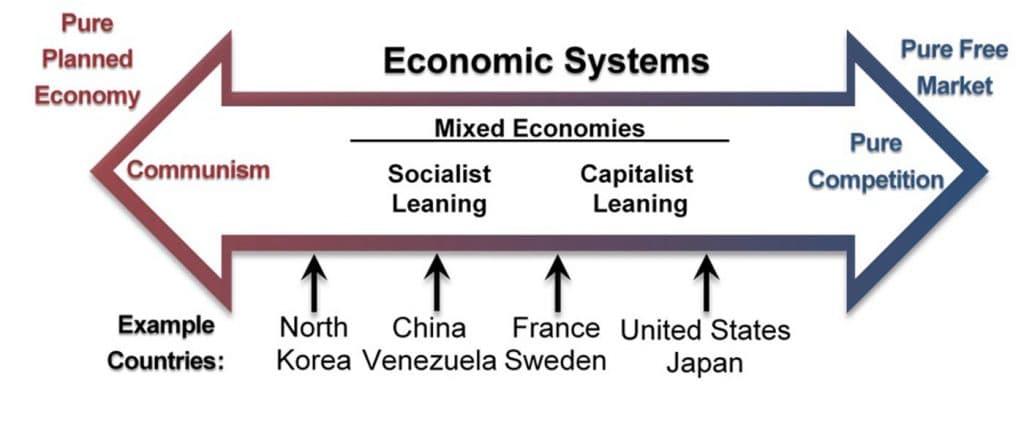
Economic Systems Comparison
There are three main types of economic systems. In practice, most real-world economies are mixed, blending elements of more than one type.
Traditional Economic Systems
Traditional economies rely on customs, traditions, and beliefs to guide economic activity. Decisions about what to produce and how to distribute it are shaped by cultural heritage and social structure rather than markets or government plans. These systems tend to use limited modern technology and focus on meeting basic needs through established practices like farming, hunting, or herding.
- Examples: Inuit communities in the Arctic, subsistence farming villages in parts of Sub-Saharan Africa
Command Economic Systems
In a command economy, a government or central authority makes nearly all economic decisions. A central plan determines what gets produced, how much, and who receives it. Private ownership is heavily restricted, and individuals have little freedom to start businesses or choose occupations independently.
- Examples: The former Soviet Union, North Korea
The upside of central planning is that the government can direct resources toward specific goals (like industrialization or military buildup). The downside is that without market signals like prices, it's very difficult to allocate resources efficiently, which often leads to shortages or surpluses of goods.
Market Economic Systems
Market economies place most economic decisions in the hands of private individuals and businesses. Resources are allocated through the forces of supply and demand, and prices act as signals that guide what gets produced and consumed. The government's role is relatively limited, focused mainly on enforcing property rights, ensuring fair competition, and providing public goods.
- Competition and the pursuit of self-interest drive innovation and efficiency
- Examples: The United States, Canada, Australia (all of which are technically mixed market economies, since their governments still play significant roles in areas like healthcare, education, and regulation)
Key Differences at a Glance
| Feature | Traditional | Command | Market |
|---|---|---|---|
| Resource ownership | Community/family | Government (public) | Private individuals/firms |
| Decision-making | Decentralized (custom) | Centralized (government) | Decentralized (markets) |
| Role of government | Minimal/informal | Extensive | Limited |
| Main incentive | Cultural obligation | Collective goals set by state | Self-interest and profit |
| Property rights | Based on tradition | Weak for individuals | Strong legal protections |
Strong property rights matter because they encourage people to invest, innovate, and take risks, knowing they'll benefit from the results.

GDP: Definition and Significance
Gross Domestic Product (GDP) is the total market value of all final goods and services produced within a country's borders during a specific period, usually one year. The word "final" is important: GDP counts the finished product (a car), not all the intermediate parts (steel, glass, tires) that went into it, to avoid double-counting.
GDP is calculated using the expenditure approach:
- C = Consumption (household spending on goods and services)
- I = Investment (business spending on equipment, structures, and inventories)
- G = Government spending (on goods and services, not transfer payments like Social Security)
- X - M = Net exports (exports minus imports)
Why GDP matters:
- It's the most widely used measure of an economy's size and growth rate
- It allows comparisons between countries and across time periods
- Policymakers use GDP data to shape fiscal and monetary policy decisions
- Investors look at GDP trends to assess a country's economic health
Limitations of GDP:
GDP is useful, but it doesn't tell the whole story. Here's what it misses:
- Non-market activities: Household work, childcare by parents, and volunteer work all contribute to well-being but aren't counted
- Income distribution: A country can have high GDP while wealth is concentrated among a small percentage of the population
- Quality of life: GDP doesn't directly measure health outcomes, education quality, or leisure time
- Environmental costs: GDP can rise even when growth comes at the expense of natural resources or increased pollution. A factory that pollutes a river adds to GDP through its output but the environmental damage isn't subtracted

Economic Efficiency and Growth
Economic efficiency means allocating resources in a way that maximizes output and minimizes waste. In market economies, the price mechanism is the main tool for achieving this. When a resource becomes scarce, its price rises, signaling producers to use less of it and consumers to seek alternatives.
Two concepts that drive efficiency and growth:
- Comparative advantage: When individuals, firms, or countries specialize in producing what they can make at the lowest opportunity cost, then trade with each other, total output increases for everyone involved.
- Division of labor: Breaking production into specialized tasks allows workers to become more skilled at their specific job, boosting productivity. Adam Smith's famous pin factory example showed that ten workers specializing in different steps could produce far more pins than ten workers each making pins from start to finish.
Economic growth is the increase in a country's productive capacity over time, typically measured by the growth rate of real GDP. The main drivers include technological progress, accumulation of physical capital (factories, equipment), and development of human capital (education, skills, health).
Globalization and International Trade
Globalization's Economic Impact
Globalization refers to the increasing interconnectedness of economies worldwide through trade, investment, and the flow of technology and ideas across borders. Over the past several decades, falling transportation costs, advances in communication technology, and deliberate policy choices to reduce trade barriers have accelerated this process.
Impact on national economies:
- Domestic firms face increased competition from foreign producers, which pushes them to improve efficiency and product quality
- Producers gain access to much larger markets, allowing them to achieve economies of scale (lower per-unit costs at higher production volumes)
- Countries can attract foreign direct investment and technology transfers that boost productivity
- The flip side: greater integration means greater exposure to global economic shocks. A financial crisis in one region can ripple outward quickly
Effects on international trade:
- Trade barriers like tariffs and quotas have been reduced through agreements such as those negotiated by the World Trade Organization (WTO) and regional deals like the USMCA (which replaced NAFTA)
- Global supply chains have emerged, where different stages of production happen in different countries. Your smartphone, for example, might be designed in the U.S., use components manufactured in Japan and South Korea, and be assembled in China
- Consumers benefit from a greater variety of goods at lower prices
Challenges and controversies:
Globalization's benefits are not evenly distributed, and that's where much of the debate lies.
- Some industries and workers in developed countries face job displacement and wage pressure as production moves to lower-cost countries
- Environmental and labor standards vary widely across nations, raising concerns about a "race to the bottom" where countries compete by weakening protections
- Developing countries may benefit from new jobs and investment, but they can also become dependent on volatile global markets
- Ongoing debates surround the fairness of trade agreements and whether international organizations like the WTO and IMF adequately represent the interests of all member countries
See Fiveable more often in Google
Mark Fiveable as a preferred source and Google is more likely to show you our guides in Top Stories, with a "preferred" badge in AI Mode and AI Overviews.