14.4 Bilateral Monopoly

🛒Principles of Microeconomics Unit 14 Review
14.4 Bilateral Monopoly
🛒 Principles of Microeconomics
Bilateral Monopoly in Labor Markets
A bilateral monopoly occurs when a single buyer (monopsony employer) faces a single seller (a labor union) in a labor market. Understanding this structure matters because the resulting wage and employment levels can't be predicted by supply and demand alone. Instead, the outcome depends on bargaining power, making this one of the more interesting cases in labor economics.

Top images from around the web for Monopsony and Union Power
Labor Market Power by Employees | Public Economics View original
Is this image relevant?
Labor Market Power by Employers | Microeconomics View original
Is this image relevant?
The Labor Relations Process | OpenStax Intro to Business View original
Is this image relevant?
Labor Market Power by Employees | Public Economics View original
Is this image relevant?
Labor Market Power by Employers | Microeconomics View original
Is this image relevant?
Monopsony and Union Power
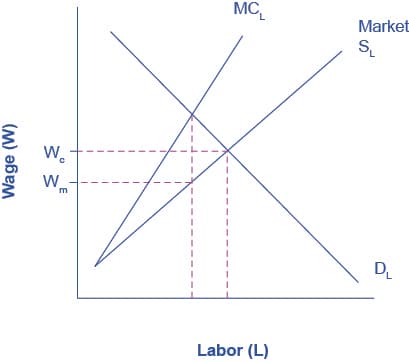
A monopsony exists when one employer (or a small group of employers) dominates a labor market. Because the firm faces an upward-sloping labor supply curve, it can push wages below the competitive level. Workers have few outside options, so the employer doesn't need to match the market wage to attract labor.
A labor union counteracts this by bargaining collectively on behalf of workers. Instead of each worker negotiating alone against a dominant employer, the union negotiates as a bloc. Its leverage comes from the ability to organize collective action, most notably strikes, which impose real costs on the firm.
When these two forces meet, neither side is a price-taker. That tension is what defines a bilateral monopoly.

Wage and Employment Determination
The wage outcome in a bilateral monopoly falls within a bargaining range:
- The floor of the range is the monopsony wage, which is what the employer would pay if workers had no collective bargaining power.
- The ceiling is the wage the union would demand if it faced no resistance, often at or above the competitive wage.
The actual bargained wage lands somewhere in this range, depending on each side's leverage.
Employment is then determined by where the bargained wage intersects the firm's marginal revenue product of labor (MRPL) curve. The firm hires workers up to the point where the cost of an additional worker (the bargained wage) equals the revenue that worker generates (MRPL).
A key result: if the bargained wage is set close to the competitive level, employment can actually increase compared to the pure monopsony outcome. The monopsonist on its own restricts hiring to keep wages low. A union-negotiated wage removes that incentive, potentially pushing employment closer to the efficient level.

Impact on Labor Market Outcomes
- Wages end up higher than the monopsony wage but may be higher or lower than the competitive wage, depending on union strength.
- Employment is generally higher than under pure monopsony but can still fall short of the competitive level, especially if the bargained wage overshoots the competitive wage.
- Efficiency is not guaranteed. The bargaining process can produce outcomes that differ from competitive equilibrium, creating deadweight loss if employment is reduced below the efficient quantity. However, bilateral monopoly can also reduce the deadweight loss that a pure monopsony would create, since the monopsonist's wage suppression is partially corrected.
The exact outcome is indeterminate from theory alone. Unlike a standard supply-and-demand model, there's no single equilibrium prediction. The final wage depends on bargaining dynamics, not just market curves.
Bargaining Power Dynamics
Several factors determine where the wage lands within the bargaining range.
Union bargaining power increases with:
- High membership rates and worker solidarity
- Strong ability to organize strikes or other collective action
- Public sympathy and political support
- Availability of alternative jobs for workers (better outside options raise the union's threat point)
Employer bargaining power increases with:
- Greater labor market concentration (fewer competing employers)
- Access to substitute inputs like automation or outsourcing
- An elastic labor supply (easy to replace striking workers)
- Deep financial reserves to withstand a prolonged work stoppage
External conditions also matter:
- High unemployment weakens union leverage because replacement workers are easier to find.
- Strong product demand strengthens the union's hand because the firm has more to lose from a strike.
- Legal frameworks shape the playing field. Right-to-work laws, for example, weaken unions by allowing workers to opt out of paying dues. Government mediation and labor regulations can shift power in either direction.
See Fiveable more often in Google
Mark Fiveable as a preferred source and Google is more likely to show you our guides in Top Stories, with a "preferred" badge in AI Mode and AI Overviews.