1.3 How Economists Use Theories and Models to Understand Economic Issues

🛒Principles of Microeconomics Unit 1 Review
1.3 How Economists Use Theories and Models to Understand Economic Issues
🛒 Principles of Microeconomics
The Role of Theories and Models in Economics
Economics deals with incredibly complex systems where millions of people make decisions simultaneously. To make sense of all that complexity, economists build theories and models that strip away the noise and focus on the relationships that matter most. The circular flow model is one of the first and most useful examples you'll encounter.

Top images from around the web for Circular flow of economic activity
File:CircularFlowEN-SVG.svg - Wikimedia Commons View original
Is this image relevant?
Trade – Introduction to Microeconomics View original
Is this image relevant?
Trade – Introduction to Microeconomics View original
Is this image relevant?
File:CircularFlowEN-SVG.svg - Wikimedia Commons View original
Is this image relevant?
Trade – Introduction to Microeconomics View original
Is this image relevant?
Circular Flow of Economic Activity
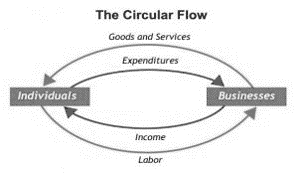
The circular flow model maps out how two main groups, households and firms, interact across two types of markets. Think of it as a simplified diagram of an entire economy's basic plumbing.
Here's how the two players connect:
Households:
- Own the factors of production (land, labor, capital, entrepreneurship)
- Sell those resources to firms in factor markets (for example, you selling your labor by getting a job)
- Receive income in return: wages, rent, interest, or profit
- Use that income to buy goods and services from firms in product markets (groceries, clothing, streaming subscriptions)
Firms:
- Hire factors of production from households (employers posting job listings, renting office space)
- Use those inputs to produce goods and services
- Sell their products to households in product markets
- Pay households for the resources they used (paychecks, dividend payments, rent checks)
The money and the physical stuff flow in opposite directions. Resources, goods, and services move one way around the loop, while money payments move the other way. This is what makes it "circular."
The basic circular flow model assumes a closed economy with no government and no international trade. That's a simplifying assumption. More advanced versions add government spending, taxes, and imports/exports.
The key takeaway: households and firms are interdependent. Households need firms for income and products. Firms need households for labor and revenue from consumer spending. Neither side functions without the other.

Role of Economic Theories and Models
A theory is a conceptual framework for organizing facts and reasoning about a topic. Supply and demand is a theory: it gives you a structured way to think about how prices are determined.
A model is a simplified representation of a real-world situation, often visual or mathematical. The circular flow diagram is a model: it leaves out tons of detail so you can see the core relationships clearly.
Theories and models help economists:
- Explain economic phenomena (what causes inflation?)
- Make predictions about future outcomes (what happens if the minimum wage increases?)
- Develop and test hypotheses (is there a measurable relationship between education level and earnings?)
- Analyze complex issues by zeroing in on the most relevant variables
Every model relies on simplifying assumptions that don't perfectly match reality. The most common one you'll see is ceteris paribus, a Latin phrase meaning "all other things held constant." It lets economists isolate the effect of one variable at a time. For instance, you might ask "how does a price increase affect quantity demanded, ceteris paribus?" That means you're assuming income, preferences, and everything else stay the same so you can focus on just the price change.

Goods Markets vs. Labor Markets
A market is any arrangement that allows buyers and sellers to exchange goods, services, or resources. It can be a physical place (a farmers' market) or virtual (an online retailer).
Product markets (goods and services markets):
- Households are the buyers; firms are the sellers
- Covers everything from cars and smartphones to haircuts and restaurant meals
- Prices are determined by the interaction of supply and demand, settling at an equilibrium price
Factor markets (including labor markets):
- The roles flip: households are the sellers (offering their labor, land, or capital) and firms are the buyers
- In the labor market specifically, households supply labor and firms demand it. The price of labor is the wage, determined by labor supply and labor demand.
- Other factor markets work similarly: landlords earn rent, lenders earn interest, and entrepreneurs earn profit. Each price is set by supply and demand in its respective market.
Prices in both types of markets act as signals. A rising wage in a particular field signals that firms want more workers there. A falling price for a product signals that supply may be outpacing demand. These price signals coordinate the decisions of millions of households and firms without anyone directing traffic.
Economic Analysis and Decision-Making
A few foundational concepts come up repeatedly alongside models and theories:
- Positive economics deals with objective, testable statements about what is. Example: "Raising the minimum wage to $15 will reduce employment by X%." You can gather data to check this.
- Normative economics involves value judgments about what ought to be. Example: "The minimum wage should be $15." This reflects opinions and priorities, not just facts.
- Scarcity is the core economic problem: resources are limited, but human wants are virtually unlimited. Because of scarcity, every choice has an opportunity cost, which is the value of the next best alternative you gave up.
- Marginal analysis is how economists evaluate decisions at the edge: comparing the additional benefit of one more unit against its additional cost. Most economic decision-making happens "at the margin."
See Fiveable more often in Google
Mark Fiveable as a preferred source and Google is more likely to show you our guides in Top Stories, with a "preferred" badge in AI Mode and AI Overviews.