5.11 Campaign Finance

👩🏾⚖️AP US Government Unit 5 Review
5.11 Campaign Finance
👩🏾⚖️ AP US Government
5.1
Voting Rights and Models of Voting Behaviour
5.2
Voter Turnout
5.3
Political Parties
5.4
How and Why Political Parties Change
5.5
Third-Party Politics
5.6
Interest Groups Influencing Policy Making
5.7
Groups Influencing Policy Outcomes
5.8
Electing a President
5.9
Congressional Elections
5.10
Modern Campaigns
5.11
Campaign Finance
5.12
The Media
5.13
Changing Media
TLDR
Campaign finance is about the rules and debates over money in elections, and how the Supreme Court has treated political spending as a form of protected speech under the First Amendment. The key conflict you need to know is between protecting free speech and keeping elections fair and competitive, shown through laws like the Bipartisan Campaign Reform Act (BCRA) and the required case Citizens United v. FEC.
Campaign Finance in AP Gov
Campaign finance in AP Gov is the study of how money flows into elections and how laws and court cases try to regulate that money. The core AP question is whether campaign spending should be protected as political speech or limited to make elections more competitive and fair.
For Topic 5.11, connect three pieces: BCRA tried to limit soft money and make ads more transparent, Citizens United v. FEC protected independent political spending under the First Amendment, and PACs/Super PACs influence elections through fundraising and spending. Keep direct contributions and independent expenditures separate in your answers.
Why This Matters for the AP Gov Exam
This topic connects money, free speech, and elections, which makes it a strong source of MCQs and a likely FRQ topic. Citizens United v. FEC is one of your required Supreme Court cases, so it can show up on the SCOTUS Comparison FRQ (FRQ 3), where you compare a required case to a non-required one and tie it to a political principle like First Amendment free speech.
You can also use campaign finance debates in the Argument Essay (FRQ 4) when a prompt asks about the balance between individual rights and government regulation, or in Concept Application (FRQ 1) when a scenario involves PACs, donors, or campaign spending.
Key Takeaways
- The core debate is free speech versus fair and competitive elections, with the Court generally treating political spending as protected speech.
- The Bipartisan Campaign Reform Act (BCRA) of 2002 tried to ban soft money to national parties and added the "I'm [candidate] and I approve this message" provision to cut down on anonymous attack ads.
- Citizens United v. FEC (2010) ruled that political spending by corporations, associations, and labor unions is protected speech, so the government cannot limit their independent political spending.
- Citizens United protects independent expenditures only, not direct donations to candidates from corporations or unions.
- Different types of PACs, including Super PACs, influence elections through fundraising and spending.
- Debates continue over individual, PAC, and party contributions and whether money gives wealthy donors too much influence.
Core Idea: Money, Speech, and Elections
Modern campaigns run on money. Candidates use it for ads, social media, field organizing, and fundraising events. That reliance has produced decades of legal and political debate over a few central questions: How much money is too much? Should spending money count as speech? And how far can Congress or the courts go in regulating campaign finance without violating the First Amendment?
For AP Gov, the most important pattern is that the Supreme Court has often sided with treating political spending as protected speech, which limits how much the government can restrict it.
Key Campaign Finance Law: BCRA
The Bipartisan Campaign Reform Act (BCRA) of 2002, sometimes called McCain-Feingold, is the main piece of campaign finance legislation you need for this topic.
What BCRA tried to do:
- Ban "soft money," which is unregulated money given to national political parties for activities like voter registration and party building. Before BCRA, soft money was used to indirectly influence elections.
- Reduce attack ads by adding the "Stand by Your Ad" provision, which created the now familiar line: "I'm [candidate's name] and I approve this message." This forces candidates to publicly own their ads.
The goal was to shift influence away from large, hidden donations and make campaign advertising more transparent. Later court rulings, especially Citizens United, undid parts of it.
A useful distinction here is hard money versus soft money:
- Hard money is regulated and given directly to candidates or parties. It has legal limits and must be disclosed to the Federal Election Commission (FEC).
- Soft money was unregulated and given to parties for "party-building." BCRA banned soft money donations to national parties to close that loophole.
Required Case: Citizens United v. FEC (2010)
This is the required Supreme Court case for this topic, so you should know the facts, the ruling, and the reasoning.
The Facts
Citizens United, a conservative nonprofit, wanted to air a film critical of Hillary Clinton close to the 2008 Democratic primary. The FEC blocked it under BCRA's limits on corporate-funded electioneering communications close to an election. Citizens United sued, arguing this violated their First Amendment free speech rights.
The Ruling and Reasoning
The Court ruled in favor of Citizens United. It held that political spending by corporations, associations, and labor unions is a form of protected speech under the First Amendment. As a result, the government cannot limit the independent political spending of these groups.
The key reasoning: if spending money to spread political messages is speech, then banning that spending limits speech. The Court treated independent spending as something that does not directly corrupt a candidate, since it is not coordinated with the campaign.
Why It Matters
Citizens United opened the door to unlimited independent expenditures, which led to the rise of Super PACs. These groups can raise and spend unlimited money to support or oppose candidates, as long as they do not coordinate directly with a campaign.
One distinction that trips students up: Citizens United did not allow corporations or unions to give money directly to candidates. It only protected independent expenditures.
PACs and Super PACs
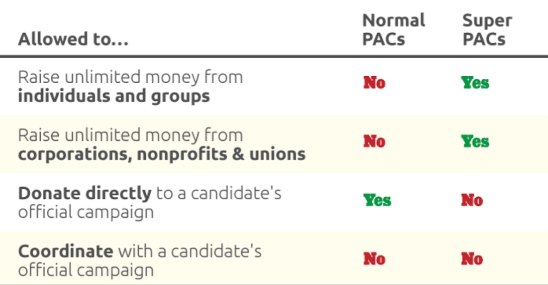
Different types of PACs influence elections through fundraising and spending, and this is part of the required content.
Political Action Committees (PACs) collect and spend money to support candidates or causes. After Citizens United, the Super PAC became a major force.
| Feature | PACs | Super PACs |
|---|---|---|
| Donation limits | Accept limited contributions | Accept unlimited contributions |
| Giving to candidates | Can contribute directly to candidates (within limits) | Cannot give directly to candidates |
| Spending | Limited | Can spend unlimited amounts independently |
| Coordination | Some coordination with campaigns allowed | Must stay independent from candidates and parties |
Regular PACs still matter, but Super PACs have become a dominant force in spending on presidential and Senate races.
The Central Debate
This topic is built around an ongoing debate, and you should be able to argue both sides.
Arguments that spending is protected speech:
- Contributions and spending let individuals and groups express support for candidates and ideas.
- Limiting spending can mean limiting political expression.
- Independent expenditures do not directly corrupt a candidate if there is no coordination.
Arguments for stricter campaign finance laws:
- Unlimited spending lets wealthy individuals and corporations have outsized influence on elections.
- The "independent" line between Super PACs and campaigns can blur in practice.
- Limited transparency can reduce public trust in elections.
Application: Spending After Citizens United
As an application of this topic, independent political spending grew sharply after Citizens United. Total independent spending rose from hundreds of millions in 2008 to billions in later election cycles, with large contributions flowing through Super PACs. These figures are real-world examples of the ruling's effects, not required AP content, but they show why the debate over money and influence stays heated.
How to Use This on the AP Gov Exam
These are the most relevant ways this topic shows up, not every possible question type.
MCQ
Expect questions that test whether you know what BCRA did (banned soft money, added the "approve this message" provision) and what Citizens United ruled (political spending by corporations, unions, and associations is protected speech). Watch for questions asking you to identify the First Amendment as the relevant principle.
FRQ 3: SCOTUS Comparison
Citizens United v. FEC is a required case, so it can appear here. You might compare it to a non-required case and connect both to a political principle. Be ready to state the holding (independent political spending by corporations and unions is protected speech) and the constitutional basis (First Amendment).
FRQ 4: Argument Essay
Use campaign finance when a prompt asks about balancing individual rights against government regulation, or about fair elections. You can cite the free speech reasoning from Citizens United on one side and concerns about unequal influence on the other. Remember to respond to the opposing view with a rebuttal or refutation, using phrases like "while some may argue."
FRQ 1: Concept Application
A scenario might describe a donor, PAC, or Super PAC. Be ready to explain how that actor influences elections and how campaign finance rules apply.
Common Trap
Do not claim Citizens United let corporations donate directly to candidates. It protected independent spending, not direct contributions.
Common Misconceptions
- Misconception: Citizens United allowed direct corporate or union donations to candidates.Actually: Citizens United did not allow direct corporate or union donations to candidates. It protected independent expenditures that are not coordinated with a campaign.
- Misconception: Super PACs are the same as regular PACs.Actually: Super PACs are not the same as regular PACs. Super PACs can raise and spend unlimited money but cannot give directly to candidates, while regular PACs can give directly but face contribution limits.
- Misconception: Money is speech.Actually: "Money is speech" is a simplification. The Court has treated political spending as protected by the First Amendment, but it has still upheld some contribution limits and disclosure rules.
- Misconception: BCRA's ban on soft money ended big money in politics.Actually: BCRA banning soft money did not end big money in politics. Later rulings, especially Citizens United, opened new channels like Super PACs.
- Misconception: Soft money and hard money are the same.Actually: Soft money and hard money are different. Hard money is regulated and goes directly to candidates or parties; soft money was unregulated party money that BCRA banned at the national party level.
Related AP Gov Guides
Practice Questions for 5.11
1 of 10
Which change most directly explains the sharp rise in independent expenditures between 2008 and 2012?
A.
Individual federal contribution limits did not increase and cannot explain surge.
B.
Citizens United allowed unlimited corporate and union independent spending.
C.
Bipartisan Campaign Reform Act restricted some electioneering communications.
D.
Changes in disclosure rules increased transparency but did not create new funding.
Vocabulary
The following words are mentioned explicitly in the AP® course framework for this topic.Term | Definition |
|---|---|
attack ads | Political advertisements that criticize or attack an opponent rather than promote a candidate's own positions. |
Bipartisan Campaign Reform Act of 2002 | Federal legislation designed to regulate campaign finance by banning soft money contributions and requiring candidates to approve their own advertisements. |
campaign contributions | Money donated by individuals, organizations, and political parties to support candidates and political campaigns. |
campaign finance | The money raised and spent by candidates, political parties, and interest groups to support political campaigns and elections. |
First Amendment | The constitutional amendment that protects fundamental freedoms including religion, speech, press, assembly, and petition. |
political action committees (PACs) | Organizations that raise and spend money to support or oppose political candidates and causes, subject to federal contribution limits. |
political parties | Organizations that seek to influence government policy and elect candidates to office by mobilizing voters around shared ideological positions. |
protected speech | Expression and communication that is safeguarded by the First Amendment and cannot be restricted by the government. |
soft money | Unregulated campaign contributions to political parties that are not subject to federal contribution limits, often used for party-building activities. |
Frequently Asked Questions
What is campaign finance in AP Gov?
Campaign finance is the set of rules and debates about money in elections. In AP Gov, it connects political participation, interest groups, PACs, parties, free speech, and the question of whether money should be regulated to protect fair elections.
What did the Bipartisan Campaign Reform Act do?
The Bipartisan Campaign Reform Act of 2002 tried to ban soft money donations to national parties and reduce anonymous attack ads through the Stand by Your Ad provision. It is also called McCain-Feingold.
What did Citizens United v. FEC decide?
Citizens United v. FEC held that independent political spending by corporations, labor unions, and associations is protected speech under the First Amendment. It did not allow direct corporate or union donations to candidates.
What is the difference between PACs and Super PACs?
Regular PACs can contribute directly to candidates but face contribution limits. Super PACs can raise and spend unlimited money independently, but they cannot donate directly to candidates or coordinate with campaigns.
Why is campaign finance connected to free speech?
The Supreme Court has treated political spending as a way to express political views. That means limits on certain spending can raise First Amendment questions.
How can campaign finance show up on the AP Gov exam?
It can appear in MCQs, Concept Application, Argument Essay prompts, and the SCOTUS Comparison FRQ because Citizens United v. FEC is a required case.
See Fiveable more often in Google
Mark Fiveable as a preferred source and Google is more likely to show you our guides in Top Stories, with a "preferred" badge in AI Mode and AI Overviews.