2.2 Structures, Powers, and Functions of Congress

👩🏾⚖️AP US Government Unit 2 Review
2.2 Structures, Powers, and Functions of Congress
👩🏾⚖️ AP US Government
2.1
Congress: The Senate and the House of Representatives
2.2
Structures, Powers, and Functions of Congress
2.3
Congressional Behavior
2.4
Roles and Power of the President
2.5
Checks on the Presidency
2.6
Expansion of Presidential Power
2.7
Presidential Communication
2.8
The Judicial Branch
2.9
Legitimacy of the Judicial Branch
2.10
The Court in Action
2.11
Checks on the Judicial Branch
2.12
The Bureaucracy
2.13
Discretionary and Rule-Making Authority
2.14
Holding the Bureaucracy Accountable
2.15
Policy and the Branches of Government
TLDR
The House and Senate are built differently on purpose, and those differences shape how bills become law. The House uses tighter rules like the Rules Committee and a closed rule to control debate, while the Senate allows looser debate with tools like the filibuster and cloture.
Powers of Congress in AP Gov 2.2
AP Gov 2.2 focuses on how congressional structure shapes lawmaking. Congress has constitutional powers like taxing, spending, regulating interstate commerce, declaring war, and overseeing the executive branch, but the way those powers operate depends on House and Senate rules.
The exam usually asks you to connect a procedure to its effect. House rules, especially the Rules Committee, control debate and amendments. Senate rules allow more individual influence through holds, filibusters, and cloture. Committees, party leadership, and conference committees explain why bills move, stall, or change before becoming law.
Why This Matters for the AP Gov Exam
This topic is about cause and effect: how the design of each chamber changes the way policy gets made. That kind of reasoning shows up across Unit 2, which is the heaviest unit on the multiple-choice section.
You will likely use this material to explain why a bill stalls in one chamber but moves in another, or how a specific procedure either speeds up or blocks legislation. On the free-response side, this fits FRQ 1: Concept Application, where you apply concepts like the filibuster, conference committees, or the power of the purse to a described scenario. The budget content also supports FRQ 2: Quantitative Analysis if you have to connect spending data to congressional priorities.
Key Takeaways
- The House and Senate differ by design, and those structural differences directly shape the legislative process.
- House debate is more tightly controlled, mainly through the Rules Committee, which sets the terms for debate on a bill.
- Senate debate is looser, with the filibuster to delay or block a vote and cloture (60 votes) to end debate.
- Committees do most of the detailed work, and the majority party controls committee leadership.
- A conference committee reconciles differences when the House and Senate pass different versions of the same bill.
- The federal budget splits into mandatory spending (entitlements like Social Security, Medicare, Medicaid) and discretionary spending approved each year.
How the Two Chambers Differ

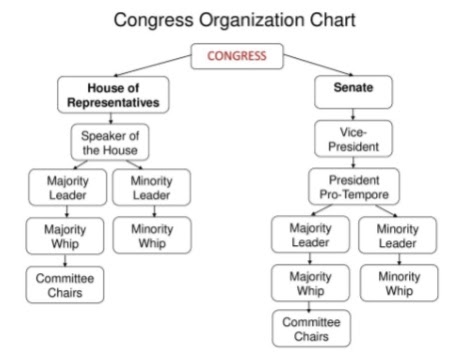
The House and Senate were set up with different structures, and that affects how each one handles legislation.
The House has 435 members, so it needs more formal procedures to manage debate. Bills move through tighter rules, and floor time is closely controlled.
The Senate has 100 members, which allows for looser rules, more individual influence, and longer debates. A single senator can slow things down in ways a single House member usually cannot.
These differences are not just trivia. They explain why the same bill can move smoothly in one chamber and get stuck in the other.
Constitutional Powers of Congress
Congress uses both enumerated powers (listed in the Constitution) and implied powers (justified through the necessary and proper clause) to make policy. These powers include:
- Passing a federal budget, taxing, borrowing money, and coining money
- Declaring war and funding the armed forces
- Setting the rules for naturalization (how people become citizens)
- Regulating interstate commerce
- Creating federal courts and setting their jurisdiction
- Conducting oversight of the executive branch and the bureaucracy
A major tool here is the power of the purse. Because Congress controls federal spending, it can fund, limit, or pressure executive agencies by adjusting their budgets.
Committees: Where the Work Happens
Most of the detailed legislative work happens in committees, not on the floor. Both chambers refer bills to committees, which hold hearings, debate, and mark up bills by adding revisions. The majority party controls committee leadership, which gives it real power over what gets considered.
| Committee Type | What It Does |
|---|---|
| Standing | Permanent committees focused on specific policy areas |
| Select | Temporary committees, often for investigation |
| Joint | Includes members from both chambers |
| Conference | Reconciles House and Senate versions of the same bill |
Committee leadership matters because chairs influence which bills get hearings and which ones quietly die.
Rules and Procedures: House vs. Senate
House Procedures
Because the House is large, it relies on structured rules.
- The Speaker of the House is elected by a majority of members and presides over the chamber's legislative work.
- The Rules Committee sets the terms for debate on a bill, including whether amendments are allowed. A closed rule blocks floor amendments.
- The House can form a Committee of the Whole to expedite debate.
- A discharge petition lets a member try to force a bill out of committee to the floor, but it is rarely used.
- All revenue (tax) bills must originate in the House.
Senate Procedures
The Senate runs on more flexible rules.
- Bills are usually brought to the floor by unanimous consent.
- A senator can place a hold to delay a bill from reaching the floor.
- A filibuster prolongs debate to delay or block a vote.
- A cloture motion ends debate and requires 60 votes.
| Term | What It Means |
|---|---|
| Filibuster | Prolonging debate to delay or prevent a vote |
| Cloture | A vote to end debate, requiring 60 votes |
| Hold | A senator's request to delay a bill or nomination |
Reconciling the Two Versions
When both chambers pass bills on the same topic but with different wording, a conference committee meets to work out the differences. This step is necessary because a bill must pass both chambers in identical form before it can go to the president.
The Federal Budget
Congress must build a budget that covers two kinds of spending.
| Type | Description |
|---|---|
| Mandatory spending | Required by law for entitlement programs like Social Security, Medicare, and Medicaid |
| Discretionary spending | Approved each year for areas like defense, education, and infrastructure |
Here is the tension to remember: as entitlement costs grow, the room for discretionary spending shrinks unless tax revenue rises or the deficit grows. That trade-off is a common way the budget shows up on the exam.
Pork-Barrel Spending and Logrolling
Not every legislative move is about ideology. Members also use tactics to build support.
- Pork-barrel legislation directs funding to local projects inside a larger appropriation bill, often to please constituents.
- Logrolling is trading political favors, like agreeing to vote for each other's bills.
These tactics help build the coalitions needed to pass legislation, even when individual members disagree on other issues.
How to Use This on the AP Gov Exam
These are the most common ways this topic shows up, not every possible question.
MCQ
Expect questions that ask you to connect a procedure to its effect. For example, why a closed rule limits amendments, how a filibuster can block a vote, or why revenue bills start in the House. Knowing the difference between House and Senate rules is the key move.
FRQ 1: Concept Application
A scenario might describe a stalled bill, a budget fight, or a procedural standoff. You apply concepts like the filibuster, cloture, conference committee, committee chairs, or the power of the purse to explain what is happening and why.
FRQ 2: Quantitative Analysis
If a prompt gives you budget data, you may need to connect trends in mandatory versus discretionary spending to congressional priorities or constraints.
Common Trap
Do not mix up House and Senate procedures. The filibuster and cloture belong to the Senate. The Rules Committee and closed rule belong to the House. Swapping them is an easy way to lose points.
Common Misconceptions
- Misconception: The filibuster is a House tool.Actually: The filibuster is a Senate tool, not a House tool. The House controls debate through the Rules Committee instead.
- Misconception: Cloture passes a bill.Actually: Cloture does not pass a bill. It only ends debate, and it takes 60 votes.
- Misconception: A discharge petition is a routine way bills reach the floor.Actually: A discharge petition exists, but it is rarely used, so do not assume it is a routine way bills reach the floor.
- Misconception: Mandatory spending is optional from year to year.Actually: Mandatory spending is not optional from year to year. It is required by law for entitlement programs, which is why it squeezes discretionary spending over time.
- Misconception: Committees are neutral.Actually: The majority party controls committee leadership, so committees are not neutral. Chairs can shape or block what gets considered.
- Misconception: A bill can pass both chambers in different forms.Actually: A bill must pass both chambers in identical form, which is why the conference committee step exists when versions differ.
Related AP Gov Guides
Practice Questions for 2.2
1 of 10
A senator from a swing state places a hold on a judicial nomination, delaying its consideration on the Senate floor. She states that she wants more time to review the nominee's record before the full Senate votes. Which structural feature of the Senate is most clearly demonstrated by this action?
A.
The filibuster allows senators to block nominations through extended debate
B.
Committee chairs determine which nominations reach the Senate floor for a vote
C.
The Senate Majority Leader controls all floor scheduling and can override individual senators
D.
The Senate's smaller size and looser rules allow individual senators significant procedural power
Vocabulary
The following words are mentioned explicitly in the AP® course framework for this topic.Term | Definition |
|---|---|
bills | Proposed legislation that is introduced in Congress for consideration and potential passage into law. |
budget | Congress's annual financial plan that allocates funds for mandatory and discretionary spending programs. |
budget deficit | The shortfall that occurs when government spending exceeds tax revenues. |
calendar assignment | The process of scheduling bills for consideration and debate in a legislative chamber. |
cloture | A Senate procedure that ends debate and forces a vote on a bill, typically requiring a supermajority of senators. |
Committee of the Whole | A procedural mechanism in the House that allows all members to participate in debate on a bill to expedite the legislative process. |
committees | Specialized groups of legislators within Congress that conduct hearings, debate, and review bills before they are considered by the full chamber. |
conference committee | A joint committee formed to reconcile differences between versions of a bill passed by both chambers of Congress. |
discharge petition | A procedure that allows individual House members to bring a bill to the floor for debate without committee approval. |
discretionary spending | Government spending approved annually by Congress for programs such as defense, education, and infrastructure. |
entitlement programs | Government benefit programs that provide payments to individuals who meet specified eligibility requirements, such as Social Security and Medicare. |
filibuster | A Senate tactic in which a senator prolongs debate to delay or prevent a vote on a bill. |
hold | A Senate procedure that allows a senator to request a delay or prevention of a bill from reaching the floor for a vote. |
logrolling | The practice of legislators exchanging political favors, such as trading votes, to gain support for legislation. |
majority political party | The political party with the most members in a legislative chamber, which determines committee leadership. |
mandatory spending | Government spending required by law for entitlement programs such as Social Security, Medicare, and Medicaid. |
markup | The process by which a committee revises and adds amendments to a bill before recommending it to the full chamber. |
policymaking process | The series of steps and procedures through which Congress develops, debates, and enacts legislation into law. |
pork-barrel legislation | Funding for local projects included in larger appropriation bills, often used to benefit a legislator's district. |
revenue bills | Legislation that raises taxes or generates government income, which must originate in the House of Representatives. |
rider amendments | Amendments added to bills that are often unrelated to the original bill's purpose. |
Rules Committee | The House committee that establishes the rules and procedures for debate on bills in the House chamber. |
Speaker | The elected leader of the House of Representatives who presides over legislative work and is chosen by a majority of House members. |
unanimous consent | A Senate procedure for bringing bills to the floor for consideration when all senators agree to proceed without objection. |
whips | Party leaders in Congress responsible for ensuring party members are present for votes and supporting party positions. |
Frequently Asked Questions
What are the powers of Congress in AP Gov?
Congress has powers such as taxing, spending, borrowing, regulating interstate commerce, declaring war, funding the military, creating federal courts, and overseeing the executive branch. Topic 2.2 focuses on how House and Senate structures shape the use of those powers.
What is the difference between House and Senate procedures?
The House uses stricter rules because it has 435 members. The Senate has looser debate rules, which gives individual senators tools like holds and filibusters.
What does the Rules Committee do in the House?
The House Rules Committee sets the terms for debate on a bill, including how long debate lasts and whether amendments are allowed. A closed rule blocks floor amendments.
What is a discharge petition in AP Gov?
A discharge petition is a House procedure that can force a bill out of committee and onto the floor for debate. It exists as a tool for bypassing committee control, but it is rarely used.
What are filibuster and cloture?
A filibuster is a Senate tactic that prolongs debate to delay or block a vote. Cloture is the procedure used to end debate, and it requires 60 votes.
How does AP Gov 2.2 show up on FRQs?
FRQs often ask you to apply a congressional procedure to a scenario. Connect the procedure to its effect, such as how the filibuster delays votes, how conference committees reconcile bills, or how budget authority gives Congress leverage.
See Fiveable more often in Google
Mark Fiveable as a preferred source and Google is more likely to show you our guides in Top Stories, with a "preferred" badge in AI Mode and AI Overviews.