6.1 Soil Classification and Properties

👷🏻♀️Intro to Civil Engineering Unit 6 Review
6.1 Soil Classification and Properties
👷🏻♀️ Intro to Civil Engineering
Soil classification and properties form the foundation of geotechnical engineering. Understanding how soils behave under different conditions is crucial for designing safe and efficient structures. This knowledge helps engineers predict soil behavior and make informed decisions about foundation design and construction methods.
Soil mechanics involves categorizing soils based on particle size and plasticity, then measuring key properties like density, strength, and permeability. These characteristics influence how soils respond to loads, water, and environmental factors, impacting everything from building foundations to road construction and environmental projects.
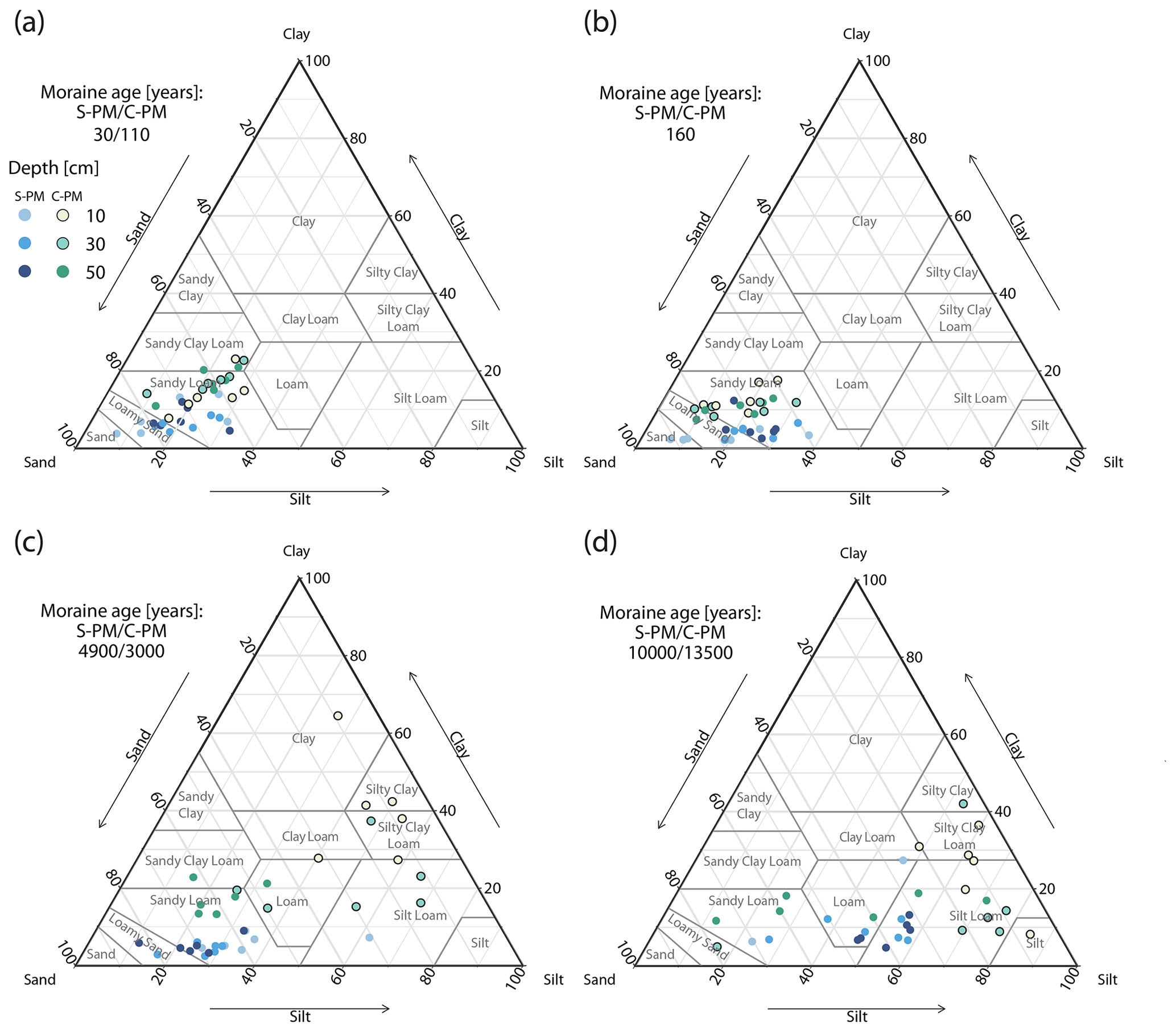
Soil Classification by Particle Size and Plasticity

Top images from around the web for Unified Soil Classification System (USCS)
ESSD - The impact of landscape evolution on soil physics: evolution of soil physical and ... View original
Is this image relevant?
Earthbag Village and Earthbag Home Open Source Engineering Hub View original
Is this image relevant?
ESS Topic 5.1: Introduction to Soil Systems - AMAZING WORLD OF SCIENCE WITH MR. GREEN View original
Is this image relevant?
ESSD - The impact of landscape evolution on soil physics: evolution of soil physical and ... View original
Is this image relevant?
Earthbag Village and Earthbag Home Open Source Engineering Hub View original
Is this image relevant?
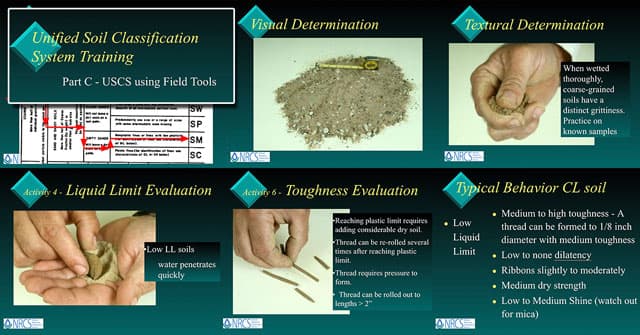
Unified Soil Classification System (USCS)
The USCS is the most widely used system in geotechnical practice. It splits soils into two main groups based on whether most particles pass through a No. 200 sieve (0.075 mm opening).
Coarse-grained soils (more than 50% retained on the No. 200 sieve) are classified by grain size distribution:
- Gravel: particles larger than 4.75 mm
- Sand: particles between 4.75 mm and 0.075 mm
These are tested using sieve analysis, where soil is shaken through a stack of progressively finer sieves.
Fine-grained soils (50% or more passing the No. 200 sieve) are classified based on plasticity rather than grain size, since individual particles are too small to sieve effectively:
- Silt: low plasticity, gritty feel, weak when dry
- Clay: high plasticity, sticky when wet, hard when dry
Fine-grained particle sizes are measured using hydrometer analysis, which tracks how fast particles settle in a water column.
Atterberg Limits define the plasticity characteristics of fine-grained soils:
- Liquid limit (LL): the water content at which soil transitions from plastic to liquid behavior
- Plastic limit (PL): the water content at which soil becomes moldable (plastic) rather than crumbly
- Plasticity index (PI): calculated as . A higher PI means the soil is more plastic and more sensitive to moisture changes.
Engineers plot the liquid limit and plasticity index on a plasticity chart (also called the Casagrande chart) to classify fine-grained soils. Soils plotting above the A-line are typically clays; those below are typically silts.
Soil Gradation and Behavior
Gradation describes the range of particle sizes in a soil. Two coefficients quantify it:
- Coefficient of uniformity (): measures the spread of particle sizes. Calculated as , where and are the particle diameters at 60% and 10% passing on the grain size distribution curve.
- Coefficient of curvature (): indicates the shape of the distribution curve. Calculated as .
Well-graded soils have a wide range of particle sizes ( for gravels, for sands, with between 1 and 3). The smaller particles fill gaps between larger ones, producing higher strength and lower compressibility.
Poorly-graded soils have a narrow range of particle sizes (failing the criteria above). Think of a bucket of marbles: all the same size, so lots of void space between them. These soils may be more susceptible to liquefaction during earthquakes.
Why gradation matters in practice:
- Road base materials typically require well-graded soils because they compact more tightly and provide better stability.
- Drainage layers often use poorly-graded (uniform) gravels or sands because the consistent void spaces allow water to flow through easily.
Key Physical Properties of Soils

Density and Void Characteristics
Soil is a three-phase material: solid particles, water, and air. The relationships between these phases define most physical properties.
Density can be expressed several ways:
- Bulk density: total mass (solids + water) divided by total volume
- Dry density: mass of solids only divided by total volume
- Relative density (): compares how dense a granular soil is in the field relative to its loosest and densest possible states. A of 0% means the soil is as loose as possible; 100% means as dense as possible.
Void ratio () is the volume of voids divided by the volume of solids. A higher void ratio means a more porous, typically looser soil. Porosity () expresses the same idea as a percentage of total volume occupied by voids. Both affect how much water a soil can hold and how compressible it is.
Moisture content () is the ratio of water mass to dry soil mass, expressed as a percentage. It directly affects strength, compressibility, and workability. For compaction, there's an optimum moisture content (typically 8-20% depending on soil type) where you achieve maximum dry density.
Specific gravity () of soil solids typically ranges from 2.60 to 2.80 for most inorganic soils. Quartz sand, for example, has a of about 2.65. This value is used in many geotechnical calculations, including determining void ratio and degree of saturation.
Hydraulic and Strength Properties
Permeability is measured by the coefficient of permeability (), which quantifies how easily water flows through soil. The range is enormous:
- Clean gravel: cm/s
- Clay: cm/s
That's a ten-million-fold difference, which is why soil type matters so much for drainage design and seepage analysis.
Shear strength determines how much load a soil can carry before it fails. It has two components:
- Cohesion (): the inherent bonding between particles (significant in clays, essentially zero in clean sands)
- Internal friction angle (): resistance to sliding between particles. Loose sand has , while dense sand reaches .
Shear strength is measured through direct shear tests or triaxial tests in the lab.
Consolidation describes how soil compresses and settles under sustained loading over time, primarily relevant for clays. Two key parameters:
- Compression index (): indicates how much the soil will compress. Normally consolidated clay has ; overconsolidated clay has .
- Coefficient of consolidation (): indicates how fast settlement occurs. Higher means faster consolidation.
Soil Classification in Civil Engineering
Foundation and Earthwork Applications
Soil classification directly guides foundation design decisions:
- It determines whether shallow foundations (spread footings, mats) or deep foundations (piles, drilled shafts) are appropriate. Soft clays often require deep foundations, while dense sands can typically support shallow ones.
- It influences bearing capacity calculations and settlement estimates, which together control how large and deep a foundation must be.
For earthwork projects, classification helps with:
- Selecting excavation methods (mechanical excavation for softer soils, blasting for rock)
- Establishing compaction requirements, including target optimum moisture content and maximum dry density
- Conducting slope stability analyses for cut slopes and embankments
In road construction, the California Bearing Ratio (CBR) is a key metric for pavement design. CBR values typically range from 2-5% for clay soils up to 20-40% for well-graded granular soils. Subgrade soil type and strength directly determine pavement thickness requirements.
Hydraulic and Environmental Applications
For hydraulic structures like dams and levees, soil classification informs:
- Seepage analysis: predicting how water moves through and under the structure
- Filter design: selecting properly graded materials that prevent fine particles from migrating while still allowing water to drain
- Piping assessment: evaluating the risk of internal erosion, where seeping water carries soil particles and creates channels through the structure
Environmental applications rely heavily on soil classification as well. Clay liners in landfills, for instance, must have permeability below cm/s to prevent contaminants from reaching groundwater. Soil type also governs how contaminants travel through the subsurface, which affects remediation strategies.
From an economic standpoint, proper soil classification can lead to 10-20% cost savings on large infrastructure projects by optimizing material selection, preventing over-engineering, and identifying problematic soils (like expansive clays or liquefiable sands) before they cause failures.
Methods for Soil Exploration and Sampling
Surface and Shallow Subsurface Techniques
Test pits and trenches allow engineers to visually inspect soil profiles down to about 3-4 meters. They're useful for small structures and road subgrade assessments because you can see the soil layers directly, collect bulk samples, and perform in-situ density measurements using a sand cone or nuclear density gauge.
The Standard Penetration Test (SPT) is one of the most widely used in-situ tests worldwide. Here's how it works:
- A borehole is drilled to the desired test depth.
- A split-spoon sampler is driven into the soil at the bottom of the borehole.
- A 63.5 kg hammer is dropped 760 mm repeatedly to drive the sampler 450 mm.
- The number of blows for the last 300 mm of penetration is recorded as the N-value.
N-values correlate with soil density and consistency: values below 4 indicate very loose sand, while values above 50 indicate very dense sand. The test also provides a disturbed soil sample for identification.
The Cone Penetration Test (CPT) pushes an instrumented cone into the ground at a constant rate, measuring tip resistance and sleeve friction continuously. Unlike the SPT, it doesn't retrieve a sample, but it produces a continuous soil profile that's excellent for identifying layer boundaries, especially in soft soil deposits.
Deep Exploration and Specialized Methods
For deeper investigations, several boring methods are available:
- Auger boring: works well in cohesive soils above the water table
- Wash boring: suited for granular soils and conditions below the water table
- Rotary drilling: versatile enough for all soil types and rock, capable of reaching depths over 100 meters for deep foundation investigations
Geophysical methods provide non-invasive ways to investigate subsurface conditions over large areas:
- Seismic refraction: maps bedrock profiles and estimates soil stiffness
- Electrical resistivity: useful for groundwater and contamination studies
- Ground Penetrating Radar (GPR): detects near-surface features like buried utilities or voids
These methods are often used for preliminary site assessment before committing to more expensive drilling programs.
Undisturbed sampling is critical when you need accurate lab results for consolidation or strength testing. Disturbed samples (like those from the SPT) are fine for classification, but measuring in-situ properties requires samples that preserve the original soil structure:
- Thin-walled tube samplers (Shelby tubes): standard choice for cohesive soils
- Piston samplers: designed for very soft soils that would fall out of a regular tube
- Block sampling: used for stiff clays and cemented soils
Choosing the right exploration method depends on the project. A high-rise building may require deep borings with extensive in-situ testing, while a small residential project might only need test pits and hand auger samples. The goal is always to get enough information to design safely without spending more on investigation than necessary.
See Fiveable more often in Google
Mark Fiveable as a preferred source and Google is more likely to show you our guides in Top Stories, with a "preferred" badge in AI Mode and AI Overviews.