6.4 Earthworks and Excavation

👷🏻♀️Intro to Civil Engineering Unit 6 Review
6.4 Earthworks and Excavation
👷🏻♀️ Intro to Civil Engineering
Earthwork Operations
Earthworks and excavation involve moving, placing, and reshaping soil and rock to prepare a site for construction. Nearly every civil engineering project starts with some form of earthwork, whether it's digging a foundation, grading a road, or building an embankment. Understanding how soil behaves during these operations is what separates a stable, long-lasting structure from one that settles, slides, or fails.

Top images from around the web for Excavation Techniques and Equipment
Working on electrical parts and equipment in the tunnels i… | Flickr View original
Is this image relevant?
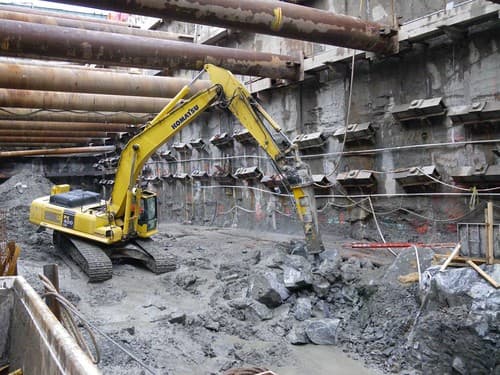
CQ031 - Mechanical Excavation In The Open Cut (3-08-2011) | Flickr View original
Is this image relevant?
Trenching for fiber | The fiber optic cable trench has some … | Flickr View original
Is this image relevant?
Working on electrical parts and equipment in the tunnels i… | Flickr View original
Is this image relevant?
CQ031 - Mechanical Excavation In The Open Cut (3-08-2011) | Flickr View original
Is this image relevant?
Excavation Techniques and Equipment
Different project needs call for different excavation approaches:
- Open-cut excavation removes soil from the surface down to the required depth. It's the simplest and most common method, used when there's enough space and the excavation isn't too deep.
- Trenching creates narrow, deep cuts for utilities like pipes and cables. Because trenches are deeper relative to their width, they carry higher collapse risk and often need shoring or trench boxes.
- Tunneling is used when surface excavation isn't feasible, such as under existing buildings or waterways. It requires specialized boring equipment and ground support.
Each technique relies on specific equipment. Excavators dig and load material, bulldozers push and grade soil over short distances, and scrapers cut, haul, and spread material over longer distances.
Cut and fill balance is a key planning concept. The goal is to use soil excavated from high areas (cuts) to fill low areas (fills) on the same site, minimizing the need to import or export material. A well-balanced cut-and-fill plan directly reduces hauling costs and project duration.
Filling and Compaction Methods
Filling isn't just dumping soil into a hole. The material needs to be selected, placed in controlled layers (called lifts), and compacted to achieve the required density and strength.
Three main compaction methods are used, each suited to different soil types:
- Static compaction relies on the dead weight of equipment (like a smooth-wheel roller) pressing down on the soil. Works well for cohesive soils like clay.
- Vibratory compaction applies rapid, repetitive oscillations through the roller or plate. This is most effective for granular soils like sand and gravel, where vibration rearranges particles into a denser arrangement.
- Impact compaction delivers high-energy blows to the soil surface. It's used for deeper compaction or when standard methods aren't achieving the target density.
Quality control during compaction involves two main checks:
- Field density tests verify that the compacted soil meets the specified density. Common methods include the nuclear density gauge (fast, non-destructive) and the sand cone method (slower but doesn't require calibration with radioactive sources).
- Moisture content monitoring ensures the soil is near its optimum moisture content, the water content at which maximum density is achieved for a given compaction effort. Tools include oven-drying (the lab standard) and the speedy moisture tester (a quick field method).
Soil Stabilization Techniques
Sometimes the soil at a site is too weak, too compressible, or too permeable to support a structure as-is. Stabilization modifies the soil's properties so it can perform adequately, often saving the cost of removing and replacing it entirely.

Chemical Stabilization
Chemical stabilization mixes additives into the soil to trigger reactions that improve its engineering properties. The right additive depends on the soil type and the problem you're trying to solve:
- Lime stabilization is most effective for clay soils. The lime reacts with clay minerals, reducing plasticity (the soil becomes less "sticky" and workable) and increasing strength over time through pozzolanic reactions.
- Cement stabilization works across a wider range of soil types. Adding Portland cement improves bearing capacity and reduces shrink-swell potential, which is critical for expansive clays that change volume with moisture.
- Fly ash stabilization uses a byproduct of coal combustion. Fly ash enhances strength and reduces permeability, and it's often combined with lime or cement for better results.
Choosing the right stabilizer also involves environmental considerations, such as the potential for chemical leaching into groundwater.
Mechanical Stabilization and Ground Improvement
Where chemical additives aren't appropriate or sufficient, mechanical methods physically alter the soil structure or reinforce it.
Mechanical stabilization includes:
- Soil mixing, which blends weak soil with stronger granular materials to improve overall strength.
- Reinforcement with geosynthetics like geogrids and geotextiles, which add tensile strength to soil that has very little on its own. Think of it like rebar in concrete, but for soil.
Ground improvement targets weak or loose soils at depth:
- Dynamic compaction drops heavy weights (often 10–20 tons) from heights of 10–20 meters onto the ground surface. The impact energy densifies loose granular soils several meters deep.
- Vibro-compaction inserts a vibrating probe into the ground to densify loose sands and gravels in place.
- Stone columns are created by drilling into weak soil and filling the hole with compacted gravel or crushed stone. They act as stiff vertical elements that carry load and also speed up drainage.
Grouting injects fluid materials into the ground to fill voids, reduce permeability, or increase strength:
- Permeation grouting pushes low-viscosity grout into soil pores without disturbing the soil structure. It's suited for sandy and gravelly soils.
- Jet grouting uses high-pressure fluid jets to break up and mix soil with cement grout, creating columns of soil-cement. It works in a wider range of soil types.
Preloading and vertical drains address soft, compressible soils (like soft clays) that settle slowly under load:
- Vertical drains (prefabricated strips of drainage material) are installed into the soft soil to shorten the drainage path.
- A surcharge load (extra fill) is placed on top, squeezing water out of the soil through the drains.
- Over weeks or months, the soil consolidates and gains strength. The surcharge is then removed before construction begins.
Excavation Stability and Support
Any time you dig into the ground, you're removing material that was holding the surrounding soil in place. Without proper analysis and support, excavation walls can collapse, the bottom can heave upward, or adjacent structures can be damaged by ground movement.

Stability Analysis and Factors
Stability analysis evaluates whether an excavation will remain safe during construction. Four main factors control excavation stability:
- Soil properties: shear strength, cohesion, and internal friction angle determine how well the soil can hold itself up.
- Groundwater conditions: pore water pressure reduces effective stress in the soil, and seepage forces can push soil particles toward the excavation face.
- Excavation geometry: deeper and steeper excavations are less stable. Width matters too, since narrow excavations can benefit from arching effects.
- Surcharge loads: weight from nearby buildings, stockpiled materials, or construction equipment adds stress to the soil around the excavation.
Two common analysis approaches:
- Limit equilibrium methods calculate a factor of safety (the ratio of resisting forces to driving forces along a potential failure surface). A factor of safety greater than 1.0 means the resisting forces exceed the driving forces; most codes require values of 1.3 to 1.5 or higher.
- Finite element analysis (FEA) models the stress-strain behavior of the entire soil mass numerically. It's more complex but can predict deformations and handle complicated geometries that limit equilibrium methods struggle with.
Support Systems and Monitoring
Temporary support systems keep excavation walls stable during construction:
- Soldier pile and lagging: vertical steel H-piles are driven or drilled at regular spacing, and horizontal timber or concrete planks (lagging) are placed between them to retain the soil. Common for medium-depth excavations.
- Sheet piling: interlocking steel sheets are driven into the ground to form a continuous wall. Good for waterfront work or sites with high groundwater.
- Trench boxes: prefabricated steel or aluminum boxes placed inside a trench to protect workers. They don't actually retain the soil but provide a safe working space if the walls collapse inward.
Permanent earth retention structures provide long-term lateral support:
- Cantilever retaining walls resist soil pressure through their own weight and the weight of soil on their base slab. They work well for moderate wall heights (typically up to about 6 meters).
- Anchored retaining walls use tie-backs or ground anchors drilled into stable soil or rock behind the wall. This allows thinner wall sections and greater heights than cantilever walls.
Dewatering systems lower the water table around an excavation to keep it dry and stable:
- Wellpoints are small-diameter wells connected to a vacuum pump, effective for shallow dewatering in sandy soils.
- Deep wells use submersible pumps in larger-diameter wells, suited for deeper excavations or less permeable soils where wellpoints can't pull water fast enough.
Monitoring instruments track ground behavior in real time so engineers can respond before problems develop:
- Inclinometers measure lateral (sideways) ground movement at various depths, detecting whether an excavation wall is tilting or bulging.
- Piezometers monitor pore water pressure in the soil, which is critical for verifying that dewatering is working and that excess pressures aren't building up.
Soil Mechanics in Earth Structures
Earth structures like embankments, dams, and retaining walls are built primarily from soil and rock. Their design relies directly on soil mechanics principles, because the construction material is the ground.
Design Principles for Embankments and Dams
Three soil mechanics concepts drive the design of earth structures:
- Shear strength governs whether the structure can resist sliding along internal failure surfaces.
- Consolidation predicts how much the structure (and the ground beneath it) will settle over time as water is squeezed from the soil.
- Seepage describes how water flows through the structure, which affects both stability and long-term erosion.
Embankment design must address:
- Slope stability analysis to determine the steepest safe slope angles. Flatter slopes are more stable but require more material.
- Settlement analysis to predict how much the embankment and its foundation will compress over months or years.
- Internal drainage systems (like drainage blankets or chimney drains) to control seepage and prevent pore pressures from building up inside the embankment.
Earth and rockfill dam design adds further complexity:
- Zoning of materials places different soil and rock types where their properties are most useful. For example, a low-permeability clay core at the center prevents seepage, while coarser rockfill on the outer shells provides strength and drainage.
- Seepage control measures like clay cores, grout curtains, and cutoff walls limit water flow through and under the dam.
- Slope protection using riprap (large stones) on the upstream face prevents wave erosion, while vegetation on the downstream face controls surface erosion.
Retaining Walls and Geosynthetics
Retaining wall design involves three main steps:
- Calculate lateral earth pressures. Three conditions matter: active pressure (wall moves away from soil), passive pressure (wall pushes into soil), and at-rest pressure (no wall movement). Active pressure is the minimum and is used for flexible walls; at-rest pressure is higher and applies to rigid walls.
- Evaluate global stability against three failure modes: sliding along the base, overturning about the toe, and bearing capacity failure of the foundation soil.
- Design structural elements including the stem (the vertical wall face), the footing (base slab), and counterforts or buttresses if needed for taller walls.
Geosynthetics are manufactured polymer materials that enhance earth structure performance:
- Geotextiles serve as separators (keeping different soil layers from mixing), filters (allowing water through while retaining soil particles), and drainage layers.
- Geogrids reinforce soil by providing tensile strength, commonly used in mechanically stabilized earth (MSE) walls and reinforced slopes.
- Geomembranes are impermeable sheets used as barriers in landfills, ponds, and dam linings.
Seismic design adds two considerations for earth structures in earthquake-prone areas:
- Liquefaction potential assessment evaluates whether loose, saturated sandy soils could lose their strength during shaking and behave like a liquid.
- Dynamic stability analysis checks whether the structure can withstand the additional forces generated by earthquake loading.
Construction quality control ties everything together. Even a well-designed earth structure will fail if it's poorly built. This includes material testing (gradation, compaction, strength), field inspections during placement and compaction, and ongoing performance monitoring of settlement, deformation, and pore water pressures throughout construction and beyond.
See Fiveable more often in Google
Mark Fiveable as a preferred source and Google is more likely to show you our guides in Top Stories, with a "preferred" badge in AI Mode and AI Overviews.