12.5 Disaster Resilience and Mitigation

👷🏻♀️Intro to Civil Engineering Unit 12 Review
12.5 Disaster Resilience and Mitigation
👷🏻♀️ Intro to Civil Engineering
Disaster Types Affecting Infrastructure
Disaster resilience and mitigation focus on designing infrastructure that can withstand and recover from both natural and human-caused disasters. For civil engineers, this means assessing where systems are vulnerable, building in protective measures, and planning for what happens when things go wrong. This topic covers the main disaster types, how engineers evaluate risk, structural and non-structural strategies for resilience, and how response and recovery planning works.

Top images from around the web for Natural Disasters and Their Impacts
2004 Indian Ocean earthquake and tsunami - Wikipedia View original
Is this image relevant?
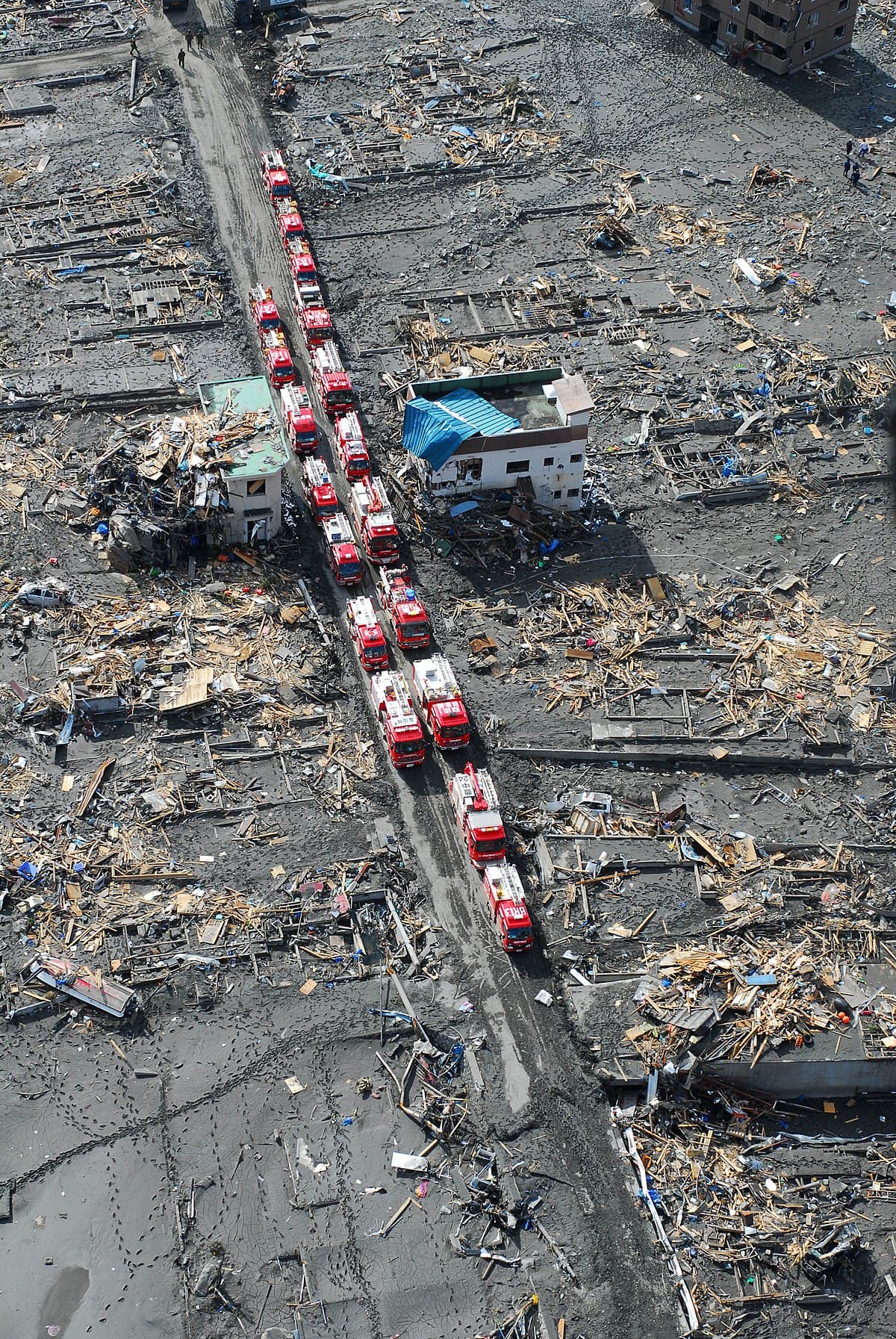
Aftermath of the 2011 Tōhoku earthquake and tsunami - Wikipedia View original
Is this image relevant?
2004 Indian Ocean earthquake and tsunami - Wikipedia View original
Is this image relevant?
Aftermath of the 2011 Tōhoku earthquake and tsunami - Wikipedia View original
Is this image relevant?
Natural Disasters and Their Impacts
Different natural disasters stress infrastructure in very different ways, and engineers need to design for the specific threats a region faces.
- Earthquakes cause ground shaking and liquefaction, damaging buildings, roads, and buried utilities. Liquefaction occurs when saturated soil loses strength during shaking and behaves like a liquid.
- Hurricanes combine high winds with storm surge, which can destroy coastal structures and flood areas well inland.
- Floods inundate low-lying areas, overwhelm drainage systems, and erode foundations over time.
- Tsunamis generate powerful, fast-moving waves that devastate coastal communities and port facilities.
- Landslides destabilize hillsides, threatening roads, pipelines, and buildings downslope.
- Wildfires burn through vegetation and structures, damaging power lines and communication towers while also increasing future landslide and erosion risk.
Each of these hazards has unique load characteristics. An earthquake imposes rapid lateral forces, while a flood applies sustained hydrostatic pressure. Engineers must understand these differences to design appropriate protections.
Man-Made and Climate-Induced Disasters
Not all disasters are natural. Engineers also design against human-caused threats and the growing effects of climate change.
- Industrial accidents can release hazardous materials that contaminate soil and water resources near infrastructure.
- Terrorist attacks may target critical infrastructure like bridges or power plants, disrupting essential services.
- Cyberattacks on infrastructure control systems (like those running water treatment or the power grid) can cause widespread service outages without any physical damage.
- Structural failures, such as bridge collapses, can result from design flaws, material degradation, or inadequate maintenance.
Climate change is intensifying many of these risks. Sea-level rise threatens coastal infrastructure, while more frequent extreme weather events (heat waves, intense storms) stress energy and water systems beyond their original design capacity.
One critical concept here is cascading failure: when one system goes down, it can trigger failures in others. A power outage, for example, can shut down water treatment plants and traffic signals simultaneously, compounding the disaster's impact.
Disaster Classification and Analysis
Engineers and planners rely on standardized systems to categorize and compare disasters:
- The Emergency Events Database (EM-DAT) classifies disasters by type (natural vs. technological) and sub-type (geophysical, hydrological, etc.), providing a consistent global dataset.
- Severity scales quantify impacts for specific hazard types. The Enhanced Fujita (EF) Scale rates tornado intensity from EF0 to EF5 based on damage indicators, while the Modified Mercalli Intensity scale measures earthquake shaking effects.
- Disaster impact analysis considers both direct effects (a collapsed bridge) and indirect effects (the economic cost of rerouting traffic for months).
Historical disaster data from these sources directly informs risk assessment and helps engineers decide where to invest in mitigation.
Disaster Resilience and Mitigation
Resilience Concepts and Frameworks
Disaster resilience is the ability of infrastructure to absorb, adapt to, and recover from disruptive events. It's not just about surviving the event; it's about how quickly and fully a system bounces back.
The Four R's form the foundation of resilient infrastructure design:
- Robustness — Inherent strength to withstand stress without significant degradation of function.
- Redundancy — Spare capacity and backup systems so that if one component fails, others can compensate. Think of a hospital with two independent power feeds.
- Resourcefulness — The ability to mobilize resources and improvise when conditions change unexpectedly.
- Rapidity — How quickly services can be restored and the system can return to normal operation.
The disaster management cycle has four phases, and civil engineers play a role in each:
- Mitigation — Actions taken before a disaster to reduce its impact (updating building codes, constructing flood barriers).
- Preparedness — Planning and training for potential disasters (emergency drills, stockpiling materials).
- Response — Immediate actions during and after a disaster (search and rescue, damage assessment).
- Recovery — Long-term efforts to rebuild and improve resilience for next time (infrastructure upgrades, revised land-use plans).
Resilience Assessment and Investment
Resilience measures cost money, so engineers need to justify those investments with data.
- Cost-benefit analysis compares the upfront cost of resilience features against the expected losses they prevent. If a seismic retrofit costs $2 million but prevents an estimated $15 million in earthquake damage over the building's life, the investment makes sense.
- The resilience dividend captures the additional everyday benefits of resilience measures beyond disaster protection. A flood-control park, for instance, also provides recreation space and increases nearby property values.
- NIST resilience metrics provide a standardized way to measure resilience through three key indicators:
- How much functionality is retained during a disaster
- How long it takes to recover essential services
- How much economic loss is avoided
Other tools include multi-criteria decision analysis (which factors in stakeholder preferences, not just dollars) and life-cycle cost analysis (which evaluates long-term benefits rather than just initial construction costs).
Infrastructure Vulnerability Assessment

Risk Analysis Methodologies
Before you can make infrastructure more resilient, you need to figure out where it's most vulnerable. That's what vulnerability assessment does: it identifies weak points and prioritizes protection efforts.
The basic process follows these steps:
- Hazard identification — Catalog all potential threats to the infrastructure system (earthquakes, floods, cyberattacks, etc.).
- Risk analysis — Quantify the likelihood of each hazard occurring and the consequences if it does.
- Prioritization — Focus resources on the highest-risk scenarios.
Probabilistic risk assessment (PRA) techniques help model complex system failures:
- Fault tree analysis works backward from a failure to map all the possible pathways that could cause it.
- Event tree analysis works forward from an initiating event to evaluate the range of possible outcomes.
Geographic Information Systems (GIS) are especially powerful for spatial vulnerability analysis. Engineers overlay hazard maps (flood zones, seismic zones) with infrastructure locations to identify which critical facilities sit in high-risk areas. Remote sensing tools like satellite imagery can detect land subsidence, while LiDAR surveys produce detailed elevation maps for flood modeling.
Performance-Based Assessment
Traditional design codes set minimum standards, but performance-based engineering goes further by evaluating how infrastructure actually behaves under various hazard intensities.
In seismic design, for example, performance objectives are defined at three levels:
- Immediate occupancy — The building remains safe to use right after the earthquake.
- Life safety — The structure may be damaged but won't collapse; occupants can evacuate.
- Collapse prevention — The building barely stands but prevents total failure.
Fragility curves are graphs that relate hazard intensity (like peak ground acceleration) to the probability of exceeding a specific damage state. They help engineers estimate how likely a structure is to suffer minor, moderate, or severe damage at different shaking levels.
Interdependency modeling captures how failures in one infrastructure sector affect others. Input-output models quantify the economic ripple effects, while agent-based simulations model the dynamic behavior of interconnected systems over time.
Climate change adds another layer. Climate change vulnerability assessments use downscaled climate models and scenario analysis to evaluate how infrastructure will perform under future conditions, not just today's hazards.
Enhancing Infrastructure Resilience
Structural Mitigation Measures
These are physical modifications to infrastructure that directly increase its ability to resist disaster forces.
Seismic retrofitting strengthens existing buildings against earthquake damage:
- Base isolation systems place flexible bearings between the building and its foundation to absorb ground motion.
- Shear walls and steel bracing increase a structure's lateral strength so it can resist horizontal forces.
Flood barriers protect critical infrastructure in flood-prone areas:
- Levees and floodwalls contain rising water levels.
- Pump stations remove excess water from protected areas when barriers are overtopped or seepage occurs.
Wind-resistant design improves building performance during hurricanes and tornadoes:
- Impact-resistant windows and doors prevent damage from wind-borne debris.
- Enhanced roof-to-wall connections resist uplift forces that can peel roofs off structures.
Hardening of critical facilities ensures essential services survive disasters:
- Reinforced concrete shelters for emergency operations centers.
- Redundant power systems (backup generators, dual utility feeds) for hospitals and data centers.
Non-Structural and Nature-Based Solutions
Not every resilience strategy involves pouring more concrete. Non-structural measures and nature-based solutions are often more cost-effective and sustainable.
Land-use planning reduces exposure by keeping people and buildings out of harm's way:
- Zoning regulations limit development in high-risk areas like floodplains.
- Setback requirements create buffer zones along coastlines and riverbanks.
Building codes and standards set minimum levels of disaster resistance that all new construction must meet. Key references include seismic design provisions in the International Building Code (IBC) and ASCE 7, which specifies minimum design loads for buildings and other structures.
Early warning systems give people and operators time to prepare:
- Tsunami warning buoys (like the DART system) detect undersea seismic activity and transmit alerts.
- Weather radar networks track severe storms and provide advance notice of tornadoes and hurricanes.
Nature-based solutions use ecosystems to provide protective functions:
- Restored wetlands absorb floodwaters and buffer storm surge.
- Urban green infrastructure (rain gardens, permeable pavement, green roofs) manages stormwater runoff and reduces urban flooding.
Smart infrastructure technologies enable real-time monitoring:
- IoT sensors embedded in structures can detect damage during earthquakes and report conditions instantly.
- AI-driven systems can optimize power grid operations during extreme weather to prevent cascading failures.
Emergency Response and Recovery Plans
Immediate Response Strategies
When a disaster strikes, a clear plan determines how quickly infrastructure can be assessed and restored.
Damage assessment happens first:
- The ATC-20 methodology provides a standardized procedure for post-earthquake building safety evaluations, tagging buildings as safe (green), limited entry (yellow), or unsafe (red).
- Remote sensing techniques allow rapid large-scale damage mapping when ground access is limited.
Resource allocation must be strategic:
- Triage systems prioritize utility repairs based on public safety impact (hospitals and water systems before commercial buildings).
- Mutual aid agreements between jurisdictions allow sharing of equipment and personnel when local resources are overwhelmed.
Communication and coordination tie everything together:
- Interoperable radio systems ensure first responders from different agencies can talk to each other.
- Public information systems keep affected populations informed with updates and instructions.
The Incident Command System (ICS) standardizes how disaster response is organized. It establishes a clear chain of command, defines roles for multi-agency coordination, and uses a scalable structure that works for both small incidents and major catastrophes.
Long-Term Recovery Planning
Recovery goes well beyond clearing debris. It's about rebuilding smarter than before.
- Business continuity planning ensures critical services keep running during and after disasters through measures like alternate operating locations for government functions and backup data centers.
- Post-disaster needs assessment (PDNA) evaluates damage across sectors (transportation, energy, water) and engages stakeholders to identify community priorities for reconstruction.
- Adaptive management builds flexibility into recovery by using phased implementation and periodic reassessment of goals as new information becomes available.
The Build Back Better principle is central to resilient recovery. Rather than simply restoring infrastructure to its pre-disaster condition, engineers upgrade it to higher performance standards and incorporate future hazard projections into the new designs. A bridge destroyed by flooding, for example, would be rebuilt with higher clearance and stronger scour protection based on updated flood models.
Long-term monitoring programs track recovery progress using key performance indicators for infrastructure resilience and longitudinal studies of socio-economic impacts, ensuring that lessons learned feed into future planning.
See Fiveable more often in Google
Mark Fiveable as a preferred source and Google is more likely to show you our guides in Top Stories, with a "preferred" badge in AI Mode and AI Overviews.