3.2 Newton’s Great Synthesis

🪐Intro to Astronomy Unit 3 Review
3.2 Newton’s Great Synthesis
Newton's laws revolutionized our understanding of motion, both on Earth and in space. These fundamental principles explain how planets orbit the Sun, why objects fall, and how rockets launch. They form the backbone of classical mechanics and shape our view of the cosmos.
Mass, volume, and density are key properties that help us understand celestial bodies. Comparing these values across planets, stars, and other objects reveals a lot about their composition and structure. Angular momentum, meanwhile, plays a crucial role in maintaining stable orbits and rotations.
Newton's Laws and Celestial Mechanics
Newton's laws in celestial mechanics
Newton's first law (law of inertia) says an object at rest stays at rest, and an object in motion keeps moving at the same speed and direction, unless an unbalanced force acts on it. A planet in orbit doesn't slow down on its own because there's no friction in space. However, gravity is constantly acting on orbiting planets, which is what curves their path into an orbit rather than letting them fly off in a straight line.
Newton's second law () tells you that acceleration is directly proportional to the net force on an object and inversely proportional to its mass. The Sun's gravitational pull continuously accelerates each planet toward it, bending the planet's otherwise straight-line motion into a curved orbit. A more massive planet like Jupiter requires a much larger gravitational force to maintain its orbit than a lighter planet at the same distance would.
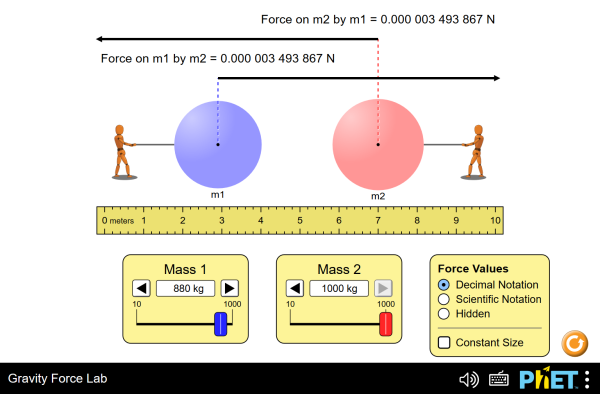
Newton's third law states that for every action there is an equal and opposite reaction. The Sun pulls on Earth gravitationally, and Earth pulls back on the Sun with exactly the same force. The Sun barely moves in response because its mass is so much greater, but it does wobble slightly. Astronomers actually use this principle to detect exoplanets around distant stars.
Together, these three laws form the foundation of classical mechanics, which describes the motion of everyday and astronomical-scale objects.
Momentum in planetary motion
Momentum () is the product of an object's mass and velocity: . In the absence of external forces, the total momentum of a system stays constant. This is the conservation of momentum.
Planets in the solar system exchange momentum with each other through gravitational interactions. Jupiter and Saturn, for example, are in a near orbital resonance where their gravitational tugs on each other repeat in a regular pattern. Over long timescales, these interactions can nudge orbital speeds and directions, contributing to effects like the slow precession of Mercury's orbit.

Mass, Volume, and Density
Mass vs. volume vs. density
These three properties are distinct but related:
- Mass is the amount of matter in an object, measured in kilograms (kg) or solar masses (). Earth's mass is about kg.
- Volume is the space an object occupies, measured in cubic meters () or cubic kilometers (). Earth's volume is roughly .
- Density () is mass per unit volume: , measured in or .
Density is especially useful for figuring out what a planet is made of. Earth's density is , which tells us it has a heavy iron-nickel core. Jupiter's density is only despite being far more massive, because it's composed mostly of hydrogen and helium gas. So a big planet isn't necessarily a dense planet.
Angular momentum of planetary systems
Angular momentum () is the rotational equivalent of linear momentum: , where is the moment of inertia (which depends on how mass is distributed relative to the rotation axis) and is angular velocity.
The conservation of angular momentum states that a system's total angular momentum stays constant as long as no external torques act on it. This is why a figure skater spins faster when pulling their arms in, and it's the same reason a cloud of gas spins faster as it collapses to form a solar system.
Each planet carries angular momentum from its orbital motion around the Sun. Earth's angular momentum vector points perpendicular to its orbital plane. Conservation of angular momentum is a big part of why planetary orbits remain stable over billions of years. That said, gravitational perturbations from other planets do cause small, gradual changes in orbital parameters like eccentricity and inclination.
Newton's Great Synthesis
What made Newton's work so groundbreaking was that he showed the same laws governing a falling apple also govern the Moon's orbit. Before Newton, people treated "earthly" physics and "heavenly" physics as completely separate subjects. Newton unified them.
His law of universal gravitation describes the gravitational force between any two masses in the universe. To develop and prove this law, Newton invented calculus, giving him the mathematical tools to analyze complex motions and forces that simpler math couldn't handle.
By combining terrestrial and celestial mechanics into one framework, Newton provided powerful support for the heliocentric model of the solar system. His approach also exemplified the scientific method: he started with observations, built mathematical models, and then used those models to make testable predictions. That cycle of observe, model, predict, and test is still how physics works today.
See Fiveable more often in Google
Mark Fiveable as a preferred source and Google is more likely to show you our guides in Top Stories, with a "preferred" badge in AI Mode and AI Overviews.