2.2 Ancient Astronomy

🪐Intro to Astronomy Unit 2 Review
2.2 Ancient Astronomy
🪐 Intro to Astronomy
Ancient Astronomical Practices and Earth's Properties
Ancient Astronomical Practices
Cultures across the world independently developed sophisticated methods for tracking the sky. Their motivations were practical: predicting floods, planning harvests, and marking religious ceremonies. These weren't casual stargazers. They built entire systems of timekeeping and prediction that lasted centuries.
Babylonians developed a lunisolar calendar based on both Moon and Sun cycles. They recorded detailed observations of planetary motion on clay tablets and used a base-60 number system for their calculations. That base-60 system is why we still divide hours into 60 minutes and circles into 360 degrees.
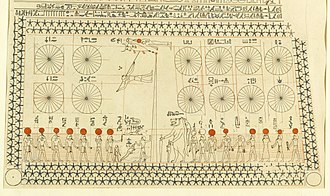
Egyptians aligned pyramids and temples with astronomical events, particularly the rising of the star Sirius, which signaled the annual flooding of the Nile. They created a 365-day solar calendar and used a tool called a merkhet (a plumb line and sighting instrument) to determine cardinal directions.
Chinese astronomers kept some of the most thorough records in the ancient world, documenting comets, novae, and supernovae. They developed their own lunisolar calendar and tied astronomical events to political legitimacy through the concept of the Mandate of Heaven.
Maya constructed remarkably precise calendars tracking the Sun, Moon, and Venus. They built observatories and temples aligned with specific astronomical events, and their calendar cycles were deeply connected to both agriculture and religious ceremonies.
These cultures also developed tools for measurement and prediction. The astrolabe, for instance, allowed astronomers to determine the positions of celestial bodies and became one of the most important instruments in early astronomy.
Greek Reasoning for a Spherical Earth
Greek thinkers used logical reasoning and direct observation to argue that Earth is a sphere. Three key pieces of evidence supported this:
- Lunar eclipses show Earth's shadow on the Moon is always circular. Only a sphere casts a circular shadow from every angle.
- Ships disappearing over the horizon vanish bottom-first: the hull drops out of sight before the mast and sails. On a flat surface, the entire ship would just shrink into the distance.
- Star positions change as you travel north or south. Constellations visible near the horizon in one location appear higher in the sky (or disappear entirely) in another. This only makes sense on a curved surface.
Greek Method for Measuring Earth's Size
Around 240 BCE, Eratosthenes calculated Earth's circumference with surprising accuracy. Here's how he did it:
- He knew that on the summer solstice, the Sun was directly overhead in Syene (modern Aswan), casting no shadow at noon.
- On the same day, he measured the Sun's angle in Alexandria using a gnomon (a vertical stick). The shadow showed the Sun was about 7.2° from directly overhead.
- He measured (or obtained) the distance between Syene and Alexandria: roughly 5,000 stadia.
- Since 7.2° is 1/50 of a full 360° circle, he multiplied the distance by 50 to get the full circumference.
His key assumptions: Earth is a sphere, Syene and Alexandria lie on roughly the same north-south meridian, and the Sun is far enough away that its rays arrive essentially parallel. His result came remarkably close to the modern value of about 40,075 km.
Precession and Ptolemy's Geocentric Model
Precession
Precession is the slow, conical wobble of Earth's rotational axis over a cycle of approximately 26,000 years. It's caused by the gravitational pull of the Sun and Moon on Earth's equatorial bulge (Earth isn't a perfect sphere; it's slightly wider at the equator).
The effects of precession play out over long timescales:
- The celestial poles gradually shift position against the background stars. Right now, Polaris is our North Star, but thousands of years from now, a different star will take that role.
- Star positions slowly drift relative to the coordinate grid astronomers use.
- The timing of equinoxes and solstices shifts slightly earlier each year relative to Earth's orbital position, a phenomenon called the precession of the equinoxes.
Hipparchus, a Greek astronomer around 130 BCE, was among the first to detect precession by comparing his star catalogs to earlier records.
Ptolemy's Geocentric Model
Ptolemy (2nd century CE) built the most influential model of the cosmos in the ancient world. His geocentric model placed Earth at the center of the universe, with the Sun, Moon, planets, and stars all orbiting around it.
The model had a clever mechanism to explain retrograde motion (the apparent backward movement of planets against the stars). Planets moved on small circles called epicycles, which themselves traveled along larger circles called deferents. This combination of circular motions could reproduce the observed looping paths of planets in the sky.
Ptolemy's model was widely accepted for over 1,400 years. It worked well enough for predicting planetary positions and dominated astronomical thinking until the Copernican heliocentric model gained acceptance in the 16th century. Whatever its flaws, the Ptolemaic system demonstrated something lasting: the power of building mathematical models to explain and predict observations.

Celestial Coordinate Systems and Measurements
The Celestial Sphere and Coordinate Systems
The celestial sphere is an imaginary sphere surrounding Earth onto which all celestial objects appear to be projected. It's not physically real, but it's an extremely useful model for describing where things are in the sky.
Key features of the celestial sphere:
- The celestial equator is the projection of Earth's equator onto the celestial sphere. It divides the sky into northern and southern halves.
- The ecliptic is the apparent path the Sun traces across the celestial sphere over the course of a year. It's tilted about 23.5° relative to the celestial equator because of Earth's axial tilt.
- The zodiac is a band of constellations that lies along the ecliptic. These are the constellations the Sun, Moon, and planets appear to move through. The zodiac has traditional significance in astrology, but in astronomy it simply describes a region of the sky.
Astronomical Measurements
The astronomical unit (AU) is a standard unit of distance equal to roughly the average distance between Earth and the Sun (about 150 million km or 93 million miles). It's the go-to unit for measuring distances within the solar system. For example, Mars orbits at about 1.5 AU from the Sun, while Jupiter is about 5.2 AU out.
See Fiveable more often in Google
Mark Fiveable as a preferred source and Google is more likely to show you our guides in Top Stories, with a "preferred" badge in AI Mode and AI Overviews.