22.5 The Evolution of More Massive Stars

🪐Intro to Astronomy Unit 22 Review
22.5 The Evolution of More Massive Stars
🪐 Intro to Astronomy
Evolution of Massive Stars
Massive stars (those above about 8 solar masses) live fast and die young. They burn through their fuel in just a few million years, compared to the billions of years a star like our Sun takes. Along the way, they forge nearly every heavy element in the periodic table through nuclear fusion, and when they finally die, they explode as supernovae, seeding the cosmos with those elements and leaving behind exotic remnants like neutron stars or black holes.

Top images from around the web for Evolution rates of stars
Evolution from the Main Sequence to Red Giants | Astronomy View original
Is this image relevant?
Stellar Life Cycle | Earth Science View original
Is this image relevant?
Evolution of Massive Stars: An Explosive Finish | Astronomy View original
Is this image relevant?
Evolution from the Main Sequence to Red Giants | Astronomy View original
Is this image relevant?
Stellar Life Cycle | Earth Science View original
Is this image relevant?
Evolution Rates of Stars
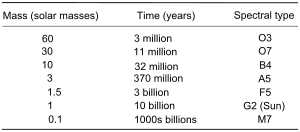
Why do massive stars evolve so much faster? It comes down to gravity. A more massive star has a much hotter, denser core, which drives nuclear fusion at a dramatically higher rate. The star is burning brighter, but it's also burning through its fuel supply far more quickly.
- Massive stars (>8 solar masses): Core temperatures and pressures are extreme, so fusion runs at a furious pace. Total lifetimes are on the order of a few million years.
- Lower-mass stars (<8 solar masses): Cooler cores mean slower fusion. The Sun, for example, has a main-sequence lifetime of roughly 10 billion years.
Massive stars also lose significant mass through powerful stellar winds throughout their lives. This mass loss affects how they evolve and what kind of remnant they leave behind.

Nucleosynthesis in Massive Stars
Nucleosynthesis is the process of building new atomic nuclei from existing protons and neutrons. In massive stars, this happens in a series of stages, each requiring higher temperatures than the last. Think of the star's core like an onion: each layer fuses a different element, with the heaviest elements at the center.
The stages proceed as follows:
- Hydrogen fusion ( K): Hydrogen fuses into helium.
- Helium fusion ( K): Helium fuses into carbon and oxygen.
- Carbon fusion ( K): Carbon fuses into neon and magnesium.
- Neon fusion ( K): Neon fuses into oxygen and magnesium.
- Oxygen fusion ( K): Oxygen fuses into silicon and sulfur.
- Silicon fusion ( K): Silicon fuses into iron and nickel.
Notice how each stage demands a higher temperature. Each stage also goes faster than the one before it. Hydrogen burning lasts millions of years, but silicon burning can be over in just a single day.
The process stops at iron. Fusing iron doesn't release energy; it absorbs energy. So once the core fills with iron, there's no longer an energy source to support the star against its own gravity. The core collapses, triggering a supernova explosion. The formation of an iron core is the point of no return for a massive star.

Stellar Remnants
What's left after the supernova depends on how massive the original star was:
- Stars between roughly 8–20 solar masses typically leave behind a neutron star, an incredibly dense object where protons and electrons have been crushed together into neutrons. A neutron star can pack more than the Sun's mass into a sphere only about 20 km across.
- Stars above roughly 20 solar masses may collapse into a black hole, where gravity is so strong that not even light can escape.
Both types of remnants influence the surrounding interstellar medium. The supernova blast wave compresses nearby gas clouds, which can trigger new rounds of star formation.
Stellar Populations and Chemical Composition
Cluster Composition and Stellar Age
The chemical makeup of a star tells you something about when it formed. The very first stars in the universe had almost nothing to work with besides hydrogen and helium, because heavier elements hadn't been created yet. Each generation of stars that lived and died through supernovae and stellar winds enriched the surrounding gas with heavier elements (astronomers call anything heavier than helium a metal). Later generations of stars then formed from this enriched material.
You can see this pattern clearly by comparing two types of star clusters:
- Globular clusters are old (typically >10 billion years). Their stars are metal-poor because they formed early in the universe's history, before many generations of supernovae had enriched the gas. The first stars in these clusters were made almost entirely of hydrogen and helium.
- Open clusters are young (generally <1 billion years). Their stars are metal-rich because they formed from gas that had already been enriched by billions of years' worth of stellar deaths. The Pleiades is a well-known example.
This difference in chemical composition between old and young clusters is direct evidence for how stellar evolution gradually enriches the universe with heavier elements over time. The iron in your blood and the calcium in your bones were forged inside massive stars that exploded long before our Solar System formed.
See Fiveable more often in Google
Mark Fiveable as a preferred source and Google is more likely to show you our guides in Top Stories, with a "preferred" badge in AI Mode and AI Overviews.