22.3 Checking Out the Theory

🪐Intro to Astronomy Unit 22 Review
22.3 Checking Out the Theory
🪐 Intro to Astronomy
Stellar Evolution and Star Clusters
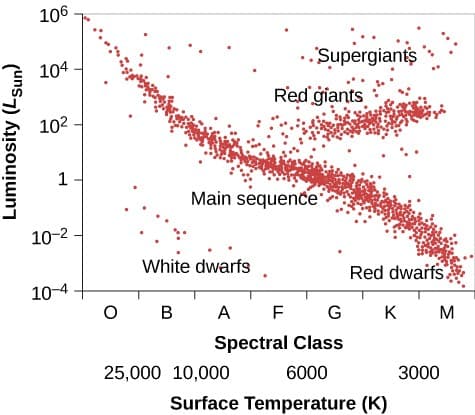
Star clusters are one of the best tools astronomers have for testing theories of stellar evolution. Because all the stars in a cluster formed from the same molecular cloud at roughly the same time, they share the same age and initial composition. The only major difference between them is mass. That makes clusters natural experiments: you can watch how stars of different masses age side by side, all on one H-R diagram.

Top images from around the web for Star clusters in H-R diagrams
The H–R Diagram | Astronomy View original
Is this image relevant?
The H–R Diagram | Astronomy View original
Is this image relevant?
Star Clusters in H-R Diagrams
When you plot the stars of a cluster on an H-R diagram (luminosity vs. temperature), a pattern emerges. Stars that are still fusing hydrogen in their cores sit along the main sequence, a diagonal band running from hot, luminous stars in the upper left to cool, dim stars in the lower right. The positions stars occupy when they first begin hydrogen fusion is called the zero-age main sequence.
Over time, stars evolve off the main sequence as they exhaust the hydrogen in their cores:
- High-mass stars evolve faster and move toward the upper right of the diagram, becoming red supergiants.
- Low-mass stars evolve more slowly and eventually become red giants, also shifting to the right but at lower luminosities.
The overall distribution of stars on the diagram tells you the cluster's age. A young cluster still has most of its stars sitting on the main sequence, with only a few massive stars beginning to peel away. An older cluster shows a more dramatic departure, with many stars having moved off the main sequence entirely.
Main-Sequence Turnoff for Age Determination
The main-sequence turnoff point is the location on the H-R diagram where stars are just beginning to leave the main sequence. It's the single most important feature for estimating a cluster's age.
Here's why it works:
- A star's mass determines how long it stays on the main sequence. More massive stars burn through their hydrogen fuel much faster than less massive ones.
- In a young cluster, only the most massive (hottest, most luminous) stars have had time to evolve off the main sequence, so the turnoff point sits high up on the diagram.
- As the cluster ages, progressively lower-mass stars finish their main-sequence lifetimes and begin to evolve away.
- The turnoff point therefore migrates downward and to the right (toward lower masses and cooler temperatures) over time.
The rule is straightforward: the lower the mass and temperature of the turnoff point, the older the cluster. By comparing the turnoff point to theoretical models of how long stars of each mass spend on the main sequence, astronomers can estimate the cluster's age with good precision.
H-R Diagrams of Different Cluster Types
Different types of clusters illustrate different stages of this aging process:
Young open clusters (e.g., the Pleiades, ~100 million years old)
- Most stars still sit on the main sequence.
- The turnoff point is at high mass and high temperature.
- Very few evolved stars like red giants or supergiants are present.
Older open clusters (e.g., the Hyades, ~625 million years old)
- The upper main sequence is noticeably depleted because the more massive stars have already evolved away.
- The turnoff point has shifted to lower mass and cooler temperature compared to the Pleiades.
- A visible population of red giants appears on the diagram.
Globular clusters (e.g., M3, ~11 billion years old)
- The main sequence is sparsely populated at higher masses since nearly all massive stars evolved long ago.
- The turnoff point sits at even lower mass and cooler temperature.
- The diagram shows a prominent red giant branch and a horizontal branch (stars that are fusing helium in their cores).
- Blue stragglers appear above the turnoff point. These are stars that seem too hot and luminous for the cluster's age. They likely formed through stellar mergers or mass transfer between close binary stars, which effectively reset their clocks.
Stellar Properties and Evolution
A star's mass is the single most important factor controlling its evolution. This relationship drives everything discussed above:
- Higher-mass stars consume their nuclear fuel at a much faster rate, giving them shorter lifetimes. A star 10 times the Sun's mass might last only about 20 million years on the main sequence.
- Lower-mass stars burn fuel slowly and can remain on the main sequence for billions of years. A star with half the Sun's mass could last over 50 billion years.
Stellar lifetime is roughly inversely related to mass (more precisely, to a power of mass), which is why the turnoff point is such a reliable age indicator.
A few additional terms worth knowing:
- Stellar nucleosynthesis is the process by which stars fuse lighter elements into heavier ones in their cores. This drives stellar evolution and gradually enriches the universe with heavier elements.
- A color-magnitude diagram is functionally the same as an H-R diagram, but it uses a star's observed color (or color index) and apparent or absolute magnitude rather than spectral type and luminosity. For clusters, these are often more practical to construct from observations.
- Stellar populations categorize stars by age and chemical composition. Population I stars are younger and metal-rich, found mainly in the galactic disk. Population II stars are older and metal-poor, typically found in globular clusters and the galactic halo. Globular clusters being dominated by Population II stars is consistent with their great ages.
See Fiveable more often in Google
Mark Fiveable as a preferred source and Google is more likely to show you our guides in Top Stories, with a "preferred" badge in AI Mode and AI Overviews.