13.3 The “Long-Haired” Comets

🪐Intro to Astronomy Unit 13 Review
13.3 The “Long-Haired” Comets
🪐 Intro to Astronomy
Cometary Structure and Composition
Comets are icy objects that develop glowing atmospheres and dramatic tails as they swing close to the Sun. Understanding their structure and behavior tells us a lot about the early solar system, since comets are leftover building material from its formation roughly 4.6 billion years ago.
Physical Features of Comets
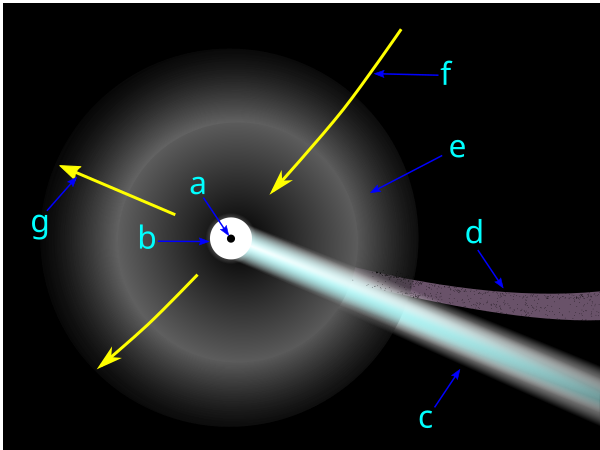
A comet has two main parts: the nucleus (the solid, central body) and the coma (a fuzzy, gaseous atmosphere that forms around the nucleus when it heats up). As a comet approaches the Sun, it also develops two distinct tails:
- Dust tail: Made of dust particles pushed away from the nucleus by the pressure of sunlight. It appears curved because the dust particles lag behind as the comet moves along its orbit.
- Ion tail: Made of ionized gas swept away from the nucleus by the solar wind. It appears straight and always points directly away from the Sun, regardless of which direction the comet is traveling.
Both tails grow longer and brighter as the comet gets closer to the Sun.
Components of Comet Nuclei
The nucleus is the solid, icy core of a comet. It's a mixture of water ice, other frozen gases (like carbon dioxide and carbon monoxide), and rocky, dustite material. This composition led astronomer Fred Whipple to describe comets as "dirty snowballs," though some scientists now prefer "icy dirtballs" since many nuclei turn out to be more dust than ice.
Nuclei are surprisingly small, typically ranging from a few hundred meters to a few tens of kilometers across. Comet 67P/Churyumov-Gerasimenko, visited by the Rosetta spacecraft, has a nucleus only about 4 km in diameter. Despite their small size, comets can produce comas and tails that stretch across millions of kilometers of space.
Behavior of Cometary Atmospheres
Here's the sequence of events as a comet approaches the Sun:
- The nucleus begins to warm as it moves closer to the Sun.
- Ices in the nucleus sublimate, meaning they change directly from solid to gas without passing through a liquid phase. This happens because the vacuum of space has essentially no atmospheric pressure.
- The escaping gas forms the coma, which can extend up to 100,000 km from the nucleus.
- As gas escapes, it carries dust particles with it, releasing them from the surface.
- Radiation pressure pushes the dust into the curved dust tail, while the solar wind sweeps ionized gas into the straight ion tail.
- The coma grows larger and more active as the comet continues to approach the Sun, with more volatile materials outgassing from the surface.
Findings of the Rosetta Mission
The Rosetta mission, launched by the European Space Agency, orbited and studied Comet 67P/Churyumov-Gerasimenko from 2014 to 2016. It even deployed a small lander called Philae onto the comet's surface. Key findings include:
- The nucleus has a complex, two-lobed shape often compared to a rubber duck. The two lobes may have been separate objects that gently collided and stuck together early in solar system history.
- The surface has a surprising variety of terrain: smooth plains, steep cliffs, pits, and boulder-strewn regions.
- The nucleus has a very low density (about 0.5 g/cm³), meaning it's highly porous, more like a loosely packed snowdrift than a solid rock.
- The comet's water has a higher deuterium-to-hydrogen ratio than Earth's ocean water. This suggests that comets like 67P were probably not the primary source of water on Earth.
- Organic compounds, including the amino acid glycine, were detected in the coma. This supports the idea that comets may have delivered some chemical building blocks of life to early Earth.

Cometary Orbits and Visibility
Variety of Cometary Orbits
Comets follow a wide range of orbital paths around the Sun. Most have highly elliptical (elongated) orbits, meaning they spend the vast majority of their time far from the Sun in the outer solar system and only briefly swing through the inner solar system near perihelion (their closest approach to the Sun).
Comets are grouped by orbital period:
- Short-period comets have orbital periods of less than 200 years. These are typically associated with the Kuiper Belt, a region of small, icy bodies orbiting beyond Neptune. Examples: Halley's Comet (about 76 years) and Comet Encke (about 3.3 years).
- Long-period comets have orbital periods greater than 200 years and often originate from the Oort Cloud, a vast spherical shell of icy bodies at the outermost edge of the solar system, extending roughly 2,000 to 100,000 AU from the Sun. Example: Comet Hale-Bopp (about 2,500 years).
- Some comets follow hyperbolic orbits, meaning they aren't gravitationally bound to the Sun at all. These comets pass through the solar system once and then escape into interstellar space, never to return.
Comet Visibility
Whether you can see a comet from Earth depends on several factors:
- Proximity to both the Earth and the Sun
- Size and activity level of the nucleus (a larger, more active nucleus produces a brighter coma and tails)
- Viewing geometry, meaning the comet's position relative to the Sun and Earth in the sky
- Albedo (surface reflectivity) of the nucleus, though the coma's brightness matters more for visibility
A comet is most visible when it's close to both the Sun and Earth, has a large and active nucleus, and appears in a dark part of the sky away from the Sun's glare. That's why truly spectacular "great comets" are rare: all of these factors have to line up at once.
See Fiveable more often in Google
Mark Fiveable as a preferred source and Google is more likely to show you our guides in Top Stories, with a "preferred" badge in AI Mode and AI Overviews.