16.4 The Solar Interior: Observations

🪐Intro to Astronomy Unit 16 Review
16.4 The Solar Interior: Observations
🪐 Intro to Astronomy
Solar Pulsations and Helioseismology
Solar Pulsations and Their Significance
The Sun's surface vibrates constantly, rising and falling in rhythmic patterns driven by sound waves trapped inside the star. These vibrations, called solar pulsations, work a lot like seismic waves on Earth: by studying how they behave, scientists can figure out what's going on deep below the surface.
Sound waves bounce around inside the Sun because they get reflected and refracted as they pass through regions of changing density and temperature. The waves that reach the surface cause it to pulse with a characteristic period of about 5 minutes (roughly 300 seconds). Millions of these overlapping oscillation modes occur simultaneously, each one sampling a slightly different path through the interior.
Why do solar pulsations matter?
- They give us a way to probe the Sun's internal structure without ever "seeing" inside it directly.
- Different oscillation modes penetrate to different depths, so by analyzing many modes at once, scientists can build a detailed picture of conditions at every layer.
- They reveal how the Sun rotates internally, including how rotation speed changes with depth and latitude.
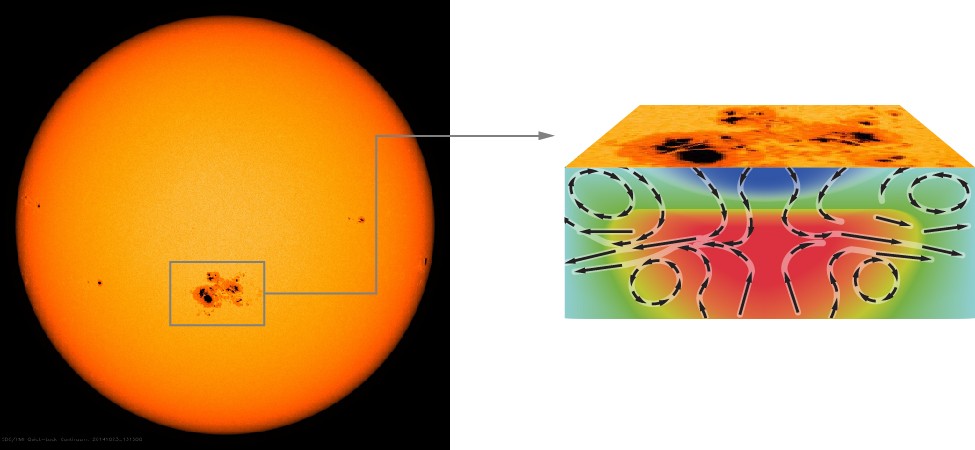
Helioseismology and Internal Structure
Helioseismology is the field dedicated to analyzing solar oscillations and using them to map the Sun's interior. The name mirrors "seismology" on Earth for good reason: both disciplines use wave behavior to infer hidden structure.
Here's how helioseismology works in practice:
- Telescopes measure tiny Doppler shifts in sunlight caused by the surface moving toward or away from us as it oscillates.
- These velocity measurements are recorded continuously over long periods (days to years) to capture as many oscillation modes as possible.
- Scientists apply Fourier analysis to break the complex surface motion into individual oscillation frequencies.
- Inversion methods then work backward from those frequencies to calculate the density, temperature, and composition at each depth inside the Sun.
What helioseismology has revealed:
- Detailed maps of how density and temperature change from the core outward
- The location of the tachocline, a thin transition layer between the radiative zone (where energy moves as radiation) and the convective zone (where energy moves via rising and sinking plasma)
- The Sun's internal rotation profile: the core and radiative zone rotate roughly as a solid body, while the convective zone shows differential rotation (faster at the equator, slower at the poles)

Solar Neutrinos in Physics and Astronomy
Solar neutrinos are subatomic particles produced by nuclear fusion reactions in the Sun's core. They barely interact with matter (they only feel the weak nuclear force), so nearly all of them fly straight out of the Sun and through anything in their path. Over 100 trillion neutrinos pass through every square centimeter of your body each second.
That extreme reluctance to interact makes neutrinos both valuable and frustrating. They carry direct information about conditions in the core right now, but detecting them requires massive, specialized underground detectors.
The Solar Neutrino Problem
For decades, detectors consistently measured only about one-third of the electron neutrinos that the Standard Solar Model predicted should be arriving from the Sun. This discrepancy was called the solar neutrino problem, and it raised a serious question: was the solar model wrong, or was something happening to the neutrinos?
The Resolution: Neutrino Oscillations
The answer turned out to be particle physics. Neutrinos come in three "flavors": electron, muon, and tau. Early detectors could only detect electron neutrinos. It turns out that as neutrinos travel from the Sun's core, they spontaneously switch between flavors in a process called neutrino oscillation. The "missing" neutrinos had simply changed into muon and tau types before reaching Earth.
This discovery had two major consequences:
- It confirmed that neutrinos have a small but nonzero mass (less than about 1 eV), which required expanding the Standard Model of particle physics.
- It validated the Standard Solar Model's predictions for core fusion rates, since the total neutrino flux (all three flavors combined) matched predictions.
What neutrinos tell us about the Sun's core:
- They provide direct evidence that nuclear fusion powers the Sun, since the neutrinos come from specific fusion reactions.
- Neutrino flux measurements help pin down the core temperature (approximately 15.7 million K) and core density (about 150 g/cm³).
- They constrain the Sun's chemical composition and how efficiently energy is transported in the core.
The Standard Solar Model and the Solar Interior
The Standard Solar Model is the theoretical framework that describes the Sun's structure and evolution. It combines principles from stellar structure, nuclear physics, and thermodynamics to predict conditions at every depth inside the Sun.
The model divides the Sun's interior into three main regions:
- Core: The central region (roughly the inner 25% of the Sun's radius) where temperatures and pressures are high enough for hydrogen nuclei to fuse into helium, releasing energy and producing neutrinos.
- Radiative zone: Extends from the core boundary out to about 70% of the Sun's radius. Energy here moves outward as photons that are repeatedly absorbed and re-emitted, a process so slow that a photon can take over 100,000 years to cross this zone.
- Convective zone: The outer ~30% of the radius. Here, the gas becomes opaque enough that radiation can't carry energy efficiently, so hot plasma physically rises while cooler plasma sinks, transporting energy by convection.
The Standard Solar Model isn't static. Scientists continually refine it using new data from helioseismology and neutrino detectors. When predictions and observations disagree, it pushes researchers to improve the physics in the model, whether that means better nuclear reaction rates, updated opacity calculations, or revised chemical abundances.
See Fiveable more often in Google
Mark Fiveable as a preferred source and Google is more likely to show you our guides in Top Stories, with a "preferred" badge in AI Mode and AI Overviews.