22.4 Further Evolution of Stars

🪐Intro to Astronomy Unit 22 Review
22.4 Further Evolution of Stars
🪐 Intro to Astronomy
Late Stellar Evolution and Nucleosynthesis
Stars don't just burn hydrogen forever. As they age, they fuse progressively heavier elements in their cores, each stage demanding higher temperatures to overcome the stronger electromagnetic repulsion between larger nuclei. This process, stellar nucleosynthesis, is how nearly every element heavier than hydrogen and helium came to exist. Low-mass stars end quietly as planetary nebulae, while massive stars explode as supernovae, scattering those freshly forged elements into space.

Top images from around the web for Core processes after hydrogen depletion
Stars - High Mass Stellar Evolution View original
Is this image relevant?
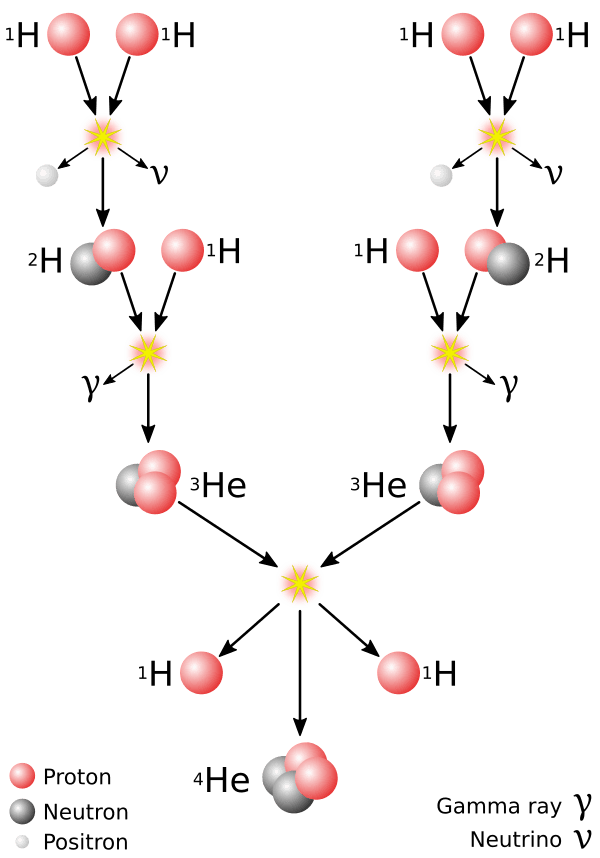
Stellar nucleosynthesis - Wikipedia View original
Is this image relevant?
Stellar evolution - Wikipedia View original
Is this image relevant?
Stars - High Mass Stellar Evolution View original
Is this image relevant?
Stellar nucleosynthesis - Wikipedia View original
Is this image relevant?
Core Processes After Hydrogen Depletion
Once a star exhausts the hydrogen in its core, gravity compresses the core further, raising temperatures enough to ignite the next fuel source.
Helium fusion begins when the core reaches roughly million K. The temperature requirement is much higher than for hydrogen fusion because helium nuclei carry a +2 charge each, creating a stronger Coulomb barrier (electrostatic repulsion) to overcome.
- The triple-alpha process fuses three helium-4 nuclei (alpha particles) into carbon-12. Some of that carbon then captures another helium nucleus to form oxygen-16.
- As helium is depleted in the core, a helium-burning shell forms around an inert carbon-oxygen core.
Carbon fusion kicks in at million K, but only in stars massive enough to reach that temperature. It produces oxygen, neon, magnesium, and sodium.
For the most massive stars (roughly above 8 solar masses), additional burning stages follow in rapid succession:
- Neon burning at billion K
- Oxygen burning at billion K
- Silicon burning at billion K
Each stage is shorter than the last. Silicon burning, the final stage, lasts only about a day and produces iron-56 and nickel-56. Iron is the endpoint because fusing iron absorbs energy rather than releasing it. That's why iron-56 sits at the peak of the binding energy curve: it's the most tightly bound nucleus, so no energy can be gained by fusing it further.

Formation of Planetary Nebulae
Low- to intermediate-mass stars (roughly 0.8 to 8 solar masses) never get hot enough for the advanced burning stages. Instead, they end their lives by gently shedding their outer layers.
During the red giant and asymptotic giant branch (AGB) phases, strong stellar winds and thermal pulsations strip away the star's envelope. What remains is the exposed hot core, which will become a white dwarf with surface temperatures exceeding 25,000 K.
That intense ultraviolet radiation from the white dwarf ionizes the surrounding ejected gas, causing it to glow. The result is a planetary nebula (the name is historical and has nothing to do with planets).
- Planetary nebulae come in a variety of shapes: spherical, elliptical, bipolar, and irregular. The shape depends on factors like rotation, magnetic fields, and binary companions.
- They are emission nebulae, glowing because ionized hydrogen, helium, and heavier elements emit light as electrons recombine with ions.
- They are short-lived on cosmic timescales, lasting only about 10,000 to 30,000 years before dispersing into the interstellar medium.
- The ejected gas is enriched in elements the star produced during its lifetime, especially carbon, nitrogen, and oxygen. This is one way stars return processed material to the galaxy.

Synthesis of New Elements
Stellar nucleosynthesis creates elements up to iron through fusion, but elements heavier than iron require a different mechanism: neutron capture. Since neutrons carry no electric charge, they can be absorbed by nuclei without needing to overcome any Coulomb barrier.
The s-process (slow neutron capture) occurs in AGB stars, where neutron densities are moderate.
- A nucleus captures a neutron.
- Before another neutron arrives, the unstable nucleus undergoes beta decay (a neutron converts to a proton, emitting an electron).
- This gradually builds up heavier elements along the valley of nuclear stability.
- The s-process produces elements like strontium, barium, and lead.
The r-process (rapid neutron capture) occurs in extreme environments where neutron flux is enormous: core-collapse supernovae and neutron star mergers.
- Nuclei capture many neutrons in rapid succession, faster than beta decay can occur.
- This creates very neutron-rich, unstable isotopes that later decay toward stability.
- The r-process is responsible for roughly half of all elements heavier than iron, including gold, platinum, and uranium.
Supernova nucleosynthesis adds another layer. During a core-collapse supernova (Types II, Ib, Ic), the extreme temperatures and densities in the explosion itself drive explosive nucleosynthesis, producing elements like zinc, selenium, and krypton. The explosion then disperses all of these elements into the interstellar medium, enriching the gas clouds from which future stars and planets will form.
Late-Stage Stellar Processes
- Stellar winds cause significant mass loss throughout a star's life, but especially during the red giant and AGB phases. This mass loss shapes the star's surroundings and determines how much material remains in the core.
- Core collapse happens in massive stars once an iron core forms. Since iron fusion absorbs energy, radiation pressure drops, and the core collapses in milliseconds under its own gravity, triggering a supernova.
- Electron degeneracy pressure is what supports a white dwarf against further collapse. This quantum mechanical effect arises because electrons resist being squeezed into the same energy state (the Pauli exclusion principle). It holds as long as the white dwarf stays below the Chandrasekhar limit of about solar masses.
See Fiveable more often in Google
Mark Fiveable as a preferred source and Google is more likely to show you our guides in Top Stories, with a "preferred" badge in AI Mode and AI Overviews.