28.3 The Distribution of Galaxies in Space

🪐Intro to Astronomy Unit 28 Review
28.3 The Distribution of Galaxies in Space
🪐 Intro to Astronomy
Galaxies aren't scattered randomly across space. They form groups, clusters, and superclusters, creating a vast cosmic web. This structure follows the cosmological principle, which says the universe looks roughly the same everywhere on large scales.
Our Milky Way is part of the Local Group, a small cluster of about 50 galaxies. Beyond that, larger clusters and superclusters stretch across billions of light-years, separated by enormous voids. This layout shapes how galaxies evolve over cosmic time.
The Distribution of Galaxies in Space
Cosmological Principle in Large-Scale Structures
The cosmological principle is the idea that, on very large scales, the universe is homogeneous (looks the same at every location) and isotropic (looks the same in every direction). No spot in the universe is "special."
- The cosmic microwave background (CMB) radiation strongly supports this principle. The CMB is nearly uniform across the entire sky, with only tiny temperature fluctuations (on the order of 1 part in 100,000).
- On smaller scales, the universe is clearly lumpy: galaxies clump into clusters, and clusters clump into superclusters. But once you zoom out past about 300 million light-years, the distribution of matter smooths out.
- This principle is what allows cosmologists to build workable models of the universe. Without assuming large-scale uniformity, the math behind models like the Big Bang framework would become unmanageable.

Components of the Local Group
The Local Group is the small galaxy cluster that contains our Milky Way. It spans roughly 10 million light-years in diameter and includes about 50 known galaxies.
- The two dominant members are the Milky Way and the Andromeda Galaxy (M31). These are both large spiral galaxies, and they're actually on a collision course, expected to merge in about 4.5 billion years.
- Other notable members include the Triangulum Galaxy (M33), the third-largest in the group, and the Large and Small Magellanic Clouds (LMC and SMC), which are irregular dwarf galaxies visible from the Southern Hemisphere.
- Most of the remaining galaxies in the Local Group are small dwarf galaxies, many of which orbit the Milky Way or Andromeda as satellites.
Groups vs. Clusters vs. Superclusters
These three categories describe increasingly large collections of galaxies, all held together by gravity.
- Groups of galaxies:
- Contain up to about 50 galaxies
- Span diameters under roughly 10 million light-years
- The Local Group is a typical example
- Clusters of galaxies:
- Contain 50 to thousands of galaxies
- Span roughly 10 to 30 million light-years in diameter
- The Virgo Cluster, about 54 million light-years away, contains over 1,000 galaxies
- Galaxy clusters were some of the first places where astronomers found evidence for dark matter, because the visible mass alone couldn't account for how fast galaxies were moving within the cluster
- Superclusters of galaxies:
- Contain multiple clusters and groups, encompassing thousands of galaxies
- Span hundreds of millions of light-years
- The Laniakea Supercluster, which includes the Milky Way, stretches about 500 million light-years across
Gravity binds groups and clusters together as stable structures. Superclusters, however, are so large that the expansion of the universe is gradually pulling them apart; they aren't truly gravitationally bound.
Voids and Cosmic Structures
Zoom out far enough, and the universe looks like a sponge or a web. Galaxies aren't spread evenly; they concentrate along specific structures with huge empty spaces between them.
- Voids are enormous regions of space containing very few or no galaxies. They can span hundreds of millions of light-years. The Boötes Void, for example, is roughly 330 million light-years across and contains almost nothing.
- Filaments are long, thread-like chains of galaxies that connect clusters and superclusters. They're the "threads" of the cosmic web.
- Walls are even larger, flatter structures made up of galaxies and galaxy clusters. The Sloan Great Wall stretches over 1.3 billion light-years in length.
Together, filaments, walls, and voids form the cosmic web. Galaxy clusters and superclusters sit at the intersections (or nodes) of this web, while voids fill the spaces in between. This web-like pattern matches predictions from computer simulations of how gravity shaped matter after the Big Bang.
Cosmic Expansion and Dark Energy
The large-scale distribution of galaxies is directly tied to the expansion of the universe.
- Hubble's law describes the relationship: the farther a galaxy is from us, the faster it's moving away. This is expressed as , where is the galaxy's recession velocity, is the Hubble constant, and is the distance.
- The redshift of distant galaxies provides the key evidence. Light from receding galaxies gets stretched to longer (redder) wavelengths, and the amount of redshift tells us how fast a galaxy is moving away.
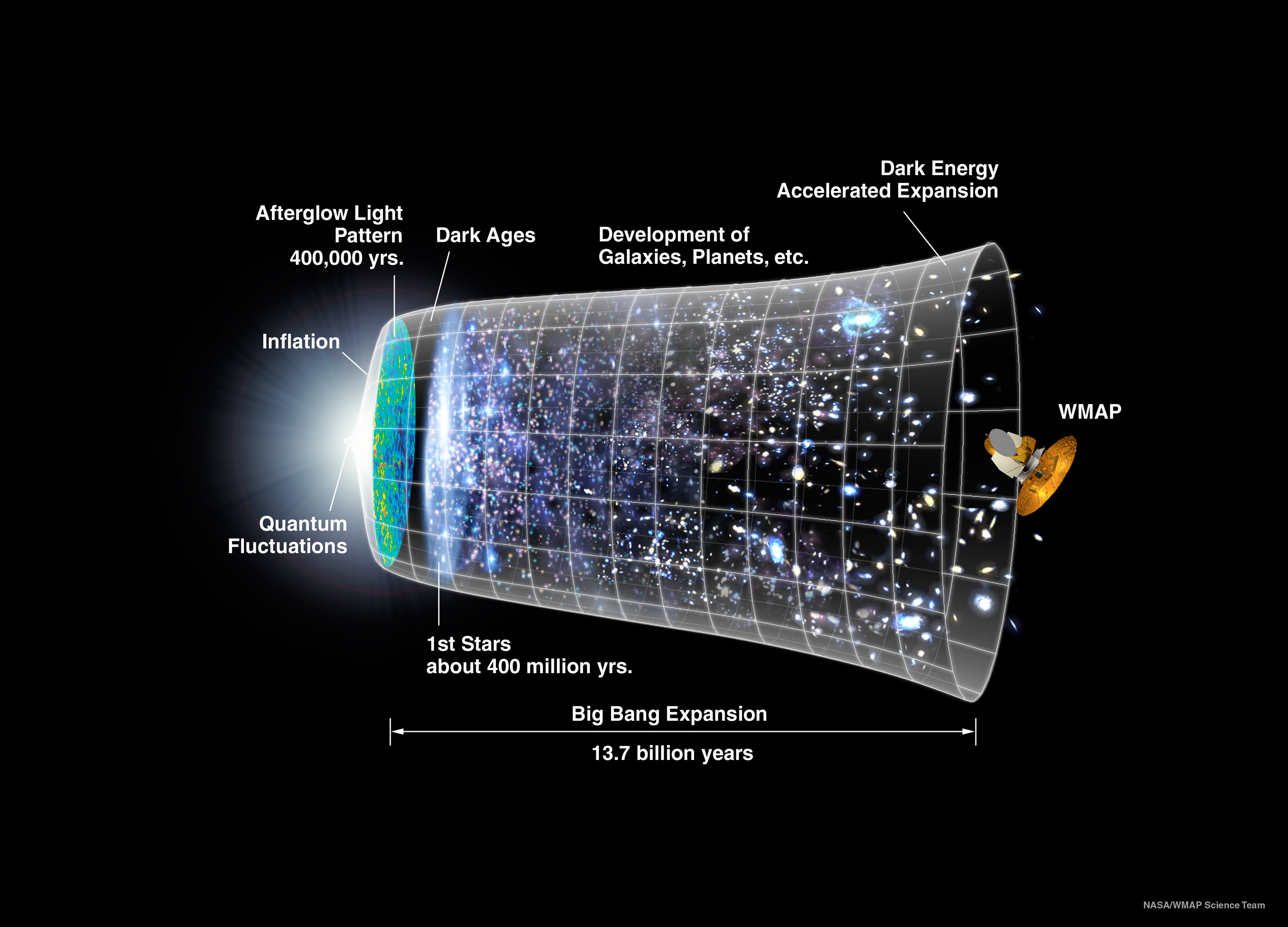
- In 1998, observations of distant Type Ia supernovae revealed that the expansion of the universe is accelerating, not slowing down. Dark energy is the name given to whatever is driving this acceleration. It makes up roughly 68% of the total energy content of the universe, yet its nature remains one of the biggest open questions in physics.
- Gravitational lensing, where massive objects bend the path of light from more distant sources, helps astronomers map the distribution of both visible and dark matter across the cosmos.
- Galaxy evolution is shaped by all of this: the cosmic web funnels gas into galaxies, cluster environments strip gas away, and the accelerating expansion gradually isolates galaxy groups from one another over time.
See Fiveable more often in Google
Mark Fiveable as a preferred source and Google is more likely to show you our guides in Top Stories, with a "preferred" badge in AI Mode and AI Overviews.