23.1 The Death of Low-Mass Stars

🪐Intro to Astronomy Unit 23 Review
23.1 The Death of Low-Mass Stars
The Death of Low-Mass Stars
Stars with masses roughly similar to our Sun don't end in dramatic explosions. Instead, they go through a slow, multi-stage process of swelling, shedding their outer layers, and leaving behind a small, incredibly dense remnant called a white dwarf. This section traces that process from the late evolutionary stages through the long, quiet cooling of the white dwarf itself.

Top images from around the web for Degenerate matter in white dwarfs
21.2 The H–R Diagram and the Study of Stellar Evolution – Astronomy View original
Is this image relevant?
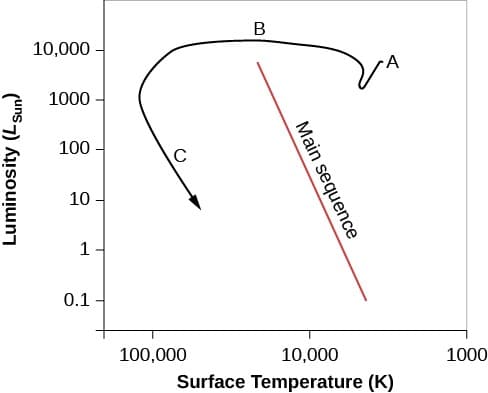
The Death of Low-Mass Stars | Astronomy View original
Is this image relevant?
Chandrasekhar limit - Wikipedia View original
Is this image relevant?
21.2 The H–R Diagram and the Study of Stellar Evolution – Astronomy View original
Is this image relevant?
The Death of Low-Mass Stars | Astronomy View original
Is this image relevant?
Late Stages of Low-Mass Stellar Evolution
After a low-mass star exhausts the hydrogen in its core, it leaves the main sequence and begins a series of structural changes that ultimately strip it down to its core.
Red Giant and the Helium Flash
When hydrogen fusion stops in the core, the core contracts and heats up while the outer layers expand enormously, turning the star into a red giant. The core becomes so compressed that it enters a degenerate state (more on that below). Once the core temperature reaches about 100 million K, helium fusion ignites all at once in a violent event called the helium flash. Because the core is degenerate, it can't expand to regulate the reaction the way a normal gas would, so the onset of fusion is sudden and explosive, though it all happens deep inside the star and isn't visible from the surface.
Horizontal Branch
After the helium flash lifts the core's degeneracy, the star settles into a stable phase of helium fusion in the core and hydrogen fusion in a surrounding shell. This is the horizontal branch phase, named for where these stars sit on the H-R diagram.
Asymptotic Giant Branch (AGB)
Once core helium is exhausted, the star expands again and enters the asymptotic giant branch (AGB). During this phase:
- The star has a carbon-oxygen core surrounded by shells burning helium and hydrogen
- It experiences thermal pulses, periodic flashes of helium shell fusion that dredge up heavier elements from deeper layers
- Strong stellar winds drive significant mass loss, sometimes shedding material at rates of solar masses per year
- These winds carry the outer envelope into space, forming a glowing shell of gas called a planetary nebula (for example, the Cat's Eye Nebula or the Ring Nebula)
What's left behind after the envelope is ejected is the exposed core: a white dwarf.

Progenitors of White Dwarfs
Stars with initial masses below about to solar masses end their lives as white dwarfs. That covers the vast majority of all stars, including our Sun.
- Main-sequence lifetime depends on mass. More massive stars burn through their fuel faster. The Sun, at 1 solar mass, has a main-sequence lifetime of roughly 10 billion years and will become a white dwarf in about 5 billion years. A 3-solar-mass star would reach that endpoint much sooner.
- Carbon-oxygen white dwarfs are the most common type, produced by stars with initial masses up to about solar masses. These stars fuse hydrogen into helium and helium into carbon and oxygen, but never get hot enough to fuse carbon.
- Oxygen-neon-magnesium white dwarfs form from stars near the upper end of the range (roughly to solar masses). These stars get hot enough to push fusion slightly further before losing their envelopes.

Degenerate Matter in White Dwarfs
A white dwarf is supported not by thermal pressure from fusion (it has none) but by a quantum mechanical effect called electron degeneracy pressure.
In normal gas, pressure comes from the motion of hot particles. In a white dwarf's core, the matter is so tightly compressed that electrons are forced into the lowest available energy states. The Pauli exclusion principle says no two electrons can occupy the same quantum state, so the electrons resist being squeezed further. This resistance is electron degeneracy pressure, and it depends only on density, not temperature. That's a key distinction: even as the white dwarf cools, the pressure holding it up doesn't change.
A few important consequences:
- More mass means a smaller white dwarf. Adding mass increases gravitational compression, squeezing the star to a smaller radius. This is the opposite of what you'd expect for normal objects.
- The Chandrasekhar limit of approximately solar masses is the maximum mass a white dwarf can have. Beyond this, electron degeneracy pressure simply cannot resist gravity, and the object will collapse further (into a neutron star, where neutron degeneracy pressure takes over, or potentially a black hole).
Long-Term Evolution of White Dwarfs
With no fusion reactions to generate energy, a white dwarf is essentially a slowly cooling ember. Its evolution from this point is gradual and spans billions of years.
- Cooling and fading: The white dwarf radiates away its stored thermal energy. Its luminosity and surface temperature steadily drop over time.
- Color shift: A young white dwarf can have a surface temperature above K, appearing blue-white. Over billions of years, it cools through white, then yellow, and eventually toward red (around K or below). Its spectral features also change as the atmosphere cools, with hydrogen and helium absorption lines shifting in prominence.
- Crystallization: At some point, the core becomes cool and dense enough that the carbon and oxygen ions arrange into a crystal lattice. This phase transition releases latent heat, which actually slows the cooling rate temporarily. Observations from the Gaia spacecraft have confirmed this crystallization pile-up in the white dwarf population.
- Cooling rate and mass: More massive white dwarfs have smaller surface areas relative to their thermal energy, but they also have higher internal temperatures initially. The relationship is complex, but in general, white dwarf cooling models are used as cosmic clocks to estimate the ages of stellar populations.
The theoretical endpoint, after trillions of years, would be a black dwarf: a completely cooled white dwarf that no longer emits significant light. The universe isn't old enough for any black dwarfs to exist yet.
See Fiveable more often in Google
Mark Fiveable as a preferred source and Google is more likely to show you our guides in Top Stories, with a "preferred" badge in AI Mode and AI Overviews.