29.4 The Cosmic Microwave Background

🪐Intro to Astronomy Unit 29 Review
29.4 The Cosmic Microwave Background
The Cosmic Microwave Background
The cosmic microwave background (CMB) is the oldest light in the universe. It's the leftover thermal radiation from the Big Bang, and it gives us a direct snapshot of the cosmos when it was only about 380,000 years old. By studying the CMB, astronomers have pinned down the universe's age, shape, and composition with remarkable precision.

Top images from around the web for Origin of cosmic microwave background
big bang theory Archives - Universe Today View original
Is this image relevant?
The Cosmic Microwave Background | Astronomy View original
Is this image relevant?
The Big Bang Archives - Universe Today View original
Is this image relevant?
big bang theory Archives - Universe Today View original
Is this image relevant?
The Cosmic Microwave Background | Astronomy View original
Is this image relevant?
Origin of the Cosmic Microwave Background
The CMB traces back to the Big Bang, roughly 13.8 billion years ago. In the first few hundred thousand years, the universe was incredibly hot and dense. Photons (light particles) couldn't travel far before slamming into free electrons, which scattered them in random directions. The universe during this period was essentially opaque, like being inside a thick fog.
About 380,000 years after the Big Bang, the universe cooled enough (to around 3,000 K) for protons and electrons to combine into neutral hydrogen atoms. This event is called recombination. Once electrons were bound into atoms, photons were finally free to travel through space without being scattered. The universe became transparent.
Those freed photons have been traveling ever since. As the universe expanded over billions of years, their wavelengths stretched (redshifted) from visible/infrared light all the way into the microwave part of the electromagnetic spectrum. That's the radiation we detect today as the CMB. Its existence is one of the strongest pieces of evidence for the Big Bang theory.

Characteristics of the CMB
The CMB has a nearly perfect blackbody spectrum with a temperature of 2.725 K (about ). A blackbody spectrum means the radiation follows the exact pattern you'd expect from an object in thermal equilibrium, which tells us the early universe was in just such a state.
The CMB is also highly isotropic, meaning it looks nearly the same no matter which direction you observe. This supports the cosmological principle: the idea that, on large scales, the universe is homogeneous (the same everywhere) and isotropic (the same in every direction).
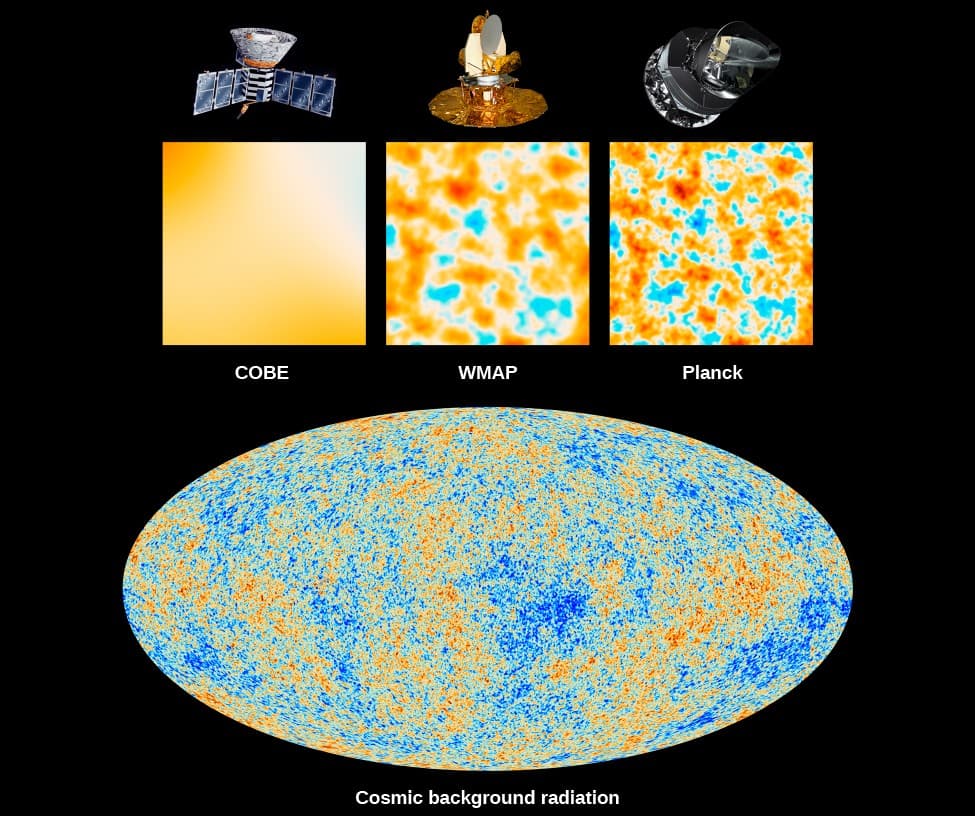
However, the CMB isn't perfectly uniform. There are tiny temperature fluctuations on the order of 1 part in 100,000. These small differences correspond to regions in the early universe that were slightly more or less dense than average. Over billions of years, the denser regions pulled in more matter through gravity, eventually growing into the galaxies, galaxy clusters, and large-scale structures (filaments, superclusters, voids) we see today. Without those tiny initial fluctuations, none of the structure in the universe would exist.

Evidence for a Flat Universe
The CMB fluctuations aren't just interesting on their own. Their angular size (how big they appear on the sky) tells us about the geometry of the universe.
- In a positively curved (closed) universe, light paths bend inward, making the fluctuations appear larger than expected.
- In a negatively curved (open) universe, light paths bend outward, making the fluctuations appear smaller than expected.
- In a flat universe, light travels in straight lines, and the fluctuations appear at their expected size.
Observations from the WMAP and Planck satellites showed that the angular size of CMB fluctuations matches what you'd predict for a flat universe. In a flat universe, the familiar rules of geometry hold: the angles of a triangle add up to , and parallel lines stay parallel forever.
This result also lines up with predictions from cosmic inflation, the theory that the universe underwent an extremely rapid expansion in its first fraction of a second. Inflation would have stretched any initial curvature to near-flatness, which is exactly what the CMB data confirms.
Insights into the Universe's Age and Composition
The CMB temperature, combined with the measured expansion rate of the universe (the Hubble constant), lets astronomers calculate the age of the universe. Current CMB-based estimates put it at approximately 13.8 billion years.
The CMB power spectrum is a plot showing the strength of temperature fluctuations at different angular scales. It has a series of peaks, and the relative heights of those peaks encode information about what the universe is made of:
- The ratio of the first and second peaks is sensitive to the amount of ordinary (baryonic) matter (protons, neutrons, electrons).
- The third peak is sensitive to the amount of dark matter.
Combining CMB data with other astronomical observations has produced our current picture of the universe's composition:
- ~5% ordinary matter
- ~27% dark matter
- ~68% dark energy
The CMB also helps constrain other parameters, including the Hubble constant and the number of light particle species (like neutrinos) present in the early universe.
Analysis of CMB Data
Because the CMB is electromagnetic radiation, astronomers can study it in detail using microwave telescopes and space-based observatories like WMAP and Planck.
The peaks in the CMB power spectrum correspond to acoustic oscillations: pressure waves that rippled through the hot plasma of the early universe before recombination. Think of them as sound waves frozen in place once the universe became transparent. The pattern of these peaks has confirmed models of cosmic inflation and provided further evidence for the cosmological principle.
See Fiveable more often in Google
Mark Fiveable as a preferred source and Google is more likely to show you our guides in Top Stories, with a "preferred" badge in AI Mode and AI Overviews.