3.4 First Amendment: Freedom of the Press

👩🏾⚖️AP US Government Unit 3 Review
3.4 First Amendment: Freedom of the Press
👩🏾⚖️ AP US Government
Required Supreme Court Cases
3.1
The Bill of Rights
3.2
First Amendment: Freedom of Religion
3.3
First Amendment: Freedom of Speech
3.4
First Amendment: Freedom of the Press
3.5
Second Amendment: Rights to Bear Arms
3.6
Amendments: Balancing Individual Freedom with Public Order and Safety
3.7
Selective Incorporation & the 14th Amendment
3.8
Amendments: Due Process and the Rights of the Accused
3.9
Amendments: Due Process and the Right to Privacy
3.10
Social Movements and Equal Protection
3.11
Government Responses to Social Movements
3.12
Balancing Minority and Majority Rights
3.13
Affirmative Action
AP Gov 3.4 Freedom of the Press Summary
Freedom of the press protects the right to publish information and opinions without government censorship before publication. The Supreme Court has built a heavy presumption against prior restraint, meaning the government almost never gets to block publication in advance, even when national security is involved.
Why This Matters for the AP Gov Exam
This topic centers on how the Supreme Court reads the First Amendment as a commitment to individual liberty, specifically through press freedom. Because New York Times Co. v. United States is a required Supreme Court case, you can expect it in multiple-choice questions and as the required case in an FRQ 3 SCOTUS Comparison, where you apply its reasoning to a non-required case.
This unit also asks you to work with sources like political cartoons and infographics. A press freedom prompt could give you a visual about censorship, government secrecy, or the public's right to know, and you would need to connect that visual to constitutional principles.
Key Takeaways
- Freedom of the press is part of the First Amendment and protects the right to publish without government interference.
- Prior restraint means stopping material from being published in the first place, and the Court treats it as the most serious form of censorship.
- The Court applies a heavy presumption against prior restraint, even when the government claims national security.
- New York Times Co. v. United States (1971) is the required case: the government failed to justify blocking publication of the Pentagon Papers.
- The First Amendment generally favors consequences after publication, not censorship before it.
What Freedom of the Press Protects
The First Amendment protects freedom of the press alongside freedom of speech. This right lets individuals, newspapers, and media outlets publish information and opinions without the government blocking or censoring them in advance. A free press supports democracy by informing citizens, encouraging public debate, and holding government officials accountable.
Press freedom serves several purposes:
- Lets journalists investigate and report on government activity
- Provides diverse viewpoints that fuel public debate
- Exposes corruption, abuse, and injustice
- Protects citizens' right to be informed about public matters
Like all rights, freedom of the press is not absolute. The government may try to restrict publication in very limited cases, especially when it claims a grave and immediate threat to national security. But the Court has made that extremely hard to do.
Prior Restraint Definition and the Court's Standard
Prior restraint refers to government actions that stop material from being published in the first place, rather than punishing it after release. The Court views prior restraint as the most serious and least tolerable form of censorship.
The Court applies a heavy presumption against prior restraint. To justify blocking publication in advance, the government carries a very high burden. In practice, that means showing:
- A compelling government interest, such as preventing direct harm to U.S. troops
- Proof that the harm is not speculative but inevitable and immediate
- No less restrictive alternative to protect that interest without censorship
The takeaway is that the First Amendment generally favors post-publication consequences. If published content is truly unlawful, the government may prosecute afterward, but it usually cannot block publication beforehand unless the danger is specific and imminent.
Required Case: New York Times Co. v. United States (1971)
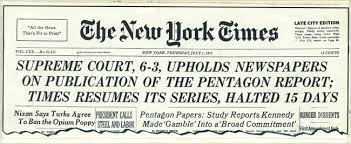
This is the required Supreme Court case for press freedom, often called the Pentagon Papers case.
- Background: During the Vietnam War, a former military analyst leaked the Pentagon Papers, a classified report on U.S. political and military involvement in Vietnam. The New York Times began publishing excerpts.
- Government's claim: The federal government sued to stop further publication, arguing it would endanger national security.
- Legal question: Could the government use prior restraint to prevent publication in the name of national security?
- Ruling: No. The Court ruled for the New York Times, finding the government had not met the heavy burden required to justify prior restraint.
- Significance: The decision reinforced that national security concerns alone do not automatically override First Amendment press freedom. The government must prove an immediate, direct, and unavoidable danger.
| Case | Issue | Holding |
|---|---|---|
| New York Times Co. v. United States (1971) | Freedom of the press and prior restraint | The government cannot block publication unless it proves an immediate, grave danger that justifies prior restraint. |
How to Use This on the AP Gov Exam
These are the most relevant ways press freedom shows up, not every possible question type.
MCQ
Expect questions that test whether you understand prior restraint and the heavy presumption against it. A common setup describes the government trying to stop a newspaper from publishing and asks you to identify the constitutional principle or the likely outcome based on New York Times Co. v. United States.
FRQ 3: SCOTUS Comparison
New York Times Co. v. United States is a required case, so it can anchor a SCOTUS Comparison. You might get a non-required case involving censorship, national security, or press restrictions and be asked to explain how the reasoning connects. Focus on the shared constitutional principle, like the presumption against prior restraint, rather than just listing facts.
Source Analysis
A prompt may give you a political cartoon or infographic about government secrecy, censorship, or the public's right to know. Read the visual clues, identify the argument, and connect it to press freedom and the First Amendment.
Common Trap
Do not claim the government can never restrict the press. The point is that prior restraint faces an extremely high bar, not that it is impossible. Saying the right is absolute will cost you accuracy.
Common Misconceptions
- Misconception: Freedom of the press is unlimited.Actually: Freedom of the press is not unlimited. The government can sometimes act, but prior restraint is the hardest restriction to justify.
- Misconception: A claim of national security automatically wins.Actually: A claim of national security does not automatically win. In the Pentagon Papers case, the government's national security argument failed because it could not prove immediate, unavoidable harm.
- Misconception: Prior restraint is about punishing content after it appears, not blocking publication in advance.Actually: Prior restraint is about blocking publication in advance, not about punishing content after it appears. Confusing the two leads to wrong answers.
- Misconception: New York Times Co. v. United States said the press can publish anything.Actually: New York Times Co. v. United States did not say the press can publish anything. It set a high standard for stopping publication beforehand, while leaving room for consequences after publication in some situations.
Related AP Gov Guides
Practice Questions for 3.4
1 of 10
Annual counts of classified national security documents published by major news outlets rose sharply between 1970 and 2020.
Which of the following is a valid limitation of using annual counts of classified national security documents published by major news outlets to evaluate the impact of the Supreme Court's ruling in New York Times Co. v. United States (1971)?
A.
It omits data on whether the news outlets profited financially from publishing these classified security documents.
B.
It omits data on whether the government attempted to use prior restraint to block the release of these documents.
C.
It omits data on whether the foreign adversaries successfully accessed the published national security documents.
D.
It omits data on whether the public supported the media's decision to publish these classified security documents.
Vocabulary
The following words are mentioned explicitly in the AP® course framework for this topic.Term | Definition |
|---|---|
First Amendment | The constitutional amendment that protects fundamental freedoms including religion, speech, press, assembly, and petition. |
freedom of the press | The First Amendment right protecting the media's ability to publish information and express opinions without government censorship or interference. |
individual liberty | The fundamental right of individuals to make personal choices and act freely within constitutional limits. |
prior restraint | Government censorship or prohibition of speech or publication before it occurs, which the Supreme Court has held to be unconstitutional in most cases. |
Supreme Court interpretation | The process by which courts analyze and apply constitutional provisions and laws to specific cases, continuously shaping the meaning and application of constitutional protections. |
Frequently Asked Questions
What does freedom of the press mean in AP Gov?
Freedom of the press is the First Amendment protection for publishing information and opinions without government censorship before publication. It supports public debate and government accountability.
What is prior restraint in AP Gov?
Prior restraint is government action that blocks material from being published before it appears. The Supreme Court applies a heavy presumption against prior restraint because it is a severe form of censorship.
What is the required case for freedom of the press?
The required AP Gov case is New York Times Co. v. United States (1971), also called the Pentagon Papers case. The Court ruled that the government had not met the heavy burden needed to stop publication.
How did New York Times Co. v. United States protect press freedom?
The decision reinforced that national security claims do not automatically override First Amendment press freedom. The government must prove a direct, immediate, and unavoidable danger to justify prior restraint.
Can the government ever restrict the press?
Yes, but prior restraint faces an extremely high bar. The key AP Gov point is not that press freedom is absolute, but that the Court strongly disfavors blocking publication in advance.
How does freedom of the press show up on the AP Gov exam?
It can appear in MCQs about prior restraint, source questions about censorship or government secrecy, and FRQ 3 SCOTUS Comparison prompts using New York Times Co. v. United States as the required case.
See Fiveable more often in Google
Mark Fiveable as a preferred source and Google is more likely to show you our guides in Top Stories, with a "preferred" badge in AI Mode and AI Overviews.