4.9 El Niño and La Niña

♻️AP Environmental Science Unit 4 Review
4.9 El Niño and La Niña
♻️ AP Environmental Science
El Niño and La Niña are the two phases of the El Niño Southern Oscillation (ENSO), a pattern of changing ocean surface temperatures in the Pacific Ocean. El Niño is a warming phase and La Niña is a cooling phase, and both shift global rainfall, wind, and ocean circulation patterns in ways that affect different regions differently.
El Niño and La Niña in AP Environmental Science
In AP Environmental Science, El Niño and La Niña are the warm and cool phases of ENSO, a Pacific Ocean-atmosphere pattern. El Niño happens when trade winds weaken and warm surface water shifts east toward South America. La Niña happens when trade winds strengthen, warm water is pushed west, and cold upwelling increases near South America.
The exam usually cares less about memorizing a map and more about cause and effect. If you can connect trade winds, ocean surface temperature, thermocline depth, upwelling, rainfall, and ecosystem impacts, you can handle most APES questions on this topic.
Why This Matters for the AP Environmental Science Exam
This topic sits in the climate part of Unit 4, where you connect the sun's energy, Earth's geography, and the movement of air and water. On the exam, you may need to describe how ENSO changes ocean temperatures, winds, and rainfall, and explain why those changes affect different locations in different ways. A common skill here is reading and interpreting diagrams or maps of ocean and wind conditions, then explaining the environmental consequences. Being able to walk through cause and effect, like how weaker trade winds lead to warmer eastern Pacific water, is exactly the kind of reasoning that shows up in multiple-choice and free-response questions.
Key Takeaways
- ENSO involves changing ocean surface temperatures in the Pacific Ocean and drives global changes in rainfall, wind, and ocean circulation.
- El Niño is the warming phase: trade winds weaken and warm water builds up off the South American coast.
- La Niña is the cooling phase: trade winds strengthen, pushing warm water west and increasing cold-water upwelling near South America.
- The thermocline moves deeper during El Niño and shallower during La Niña, which changes how much warm water sits at the surface.
- Both phases affect different locations in different ways depending on geography, so impacts on rainfall and temperature are not the same everywhere.
- Geographic and geologic factors shape where and how strongly these effects appear.
El Niño

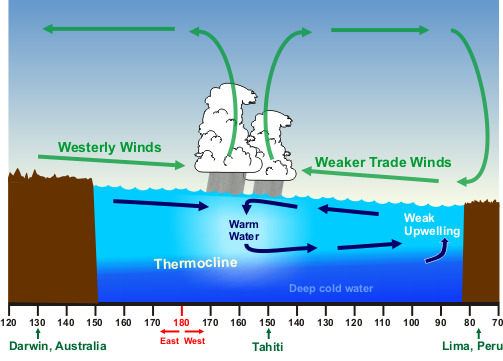
An El Niño is a warming of the Pacific Ocean surface between South America and the western Pacific near Papua New Guinea and Australia. It happens when the trade winds in that region weaken. Normally those winds push warm surface water west, but when they slow down, warm water builds up along the west coast of South America.
During El Niño, the thermocline moves deeper. The thermocline is the layer of ocean where temperature drops quickly with depth, separating warm surface water from colder deep water. When it sinks lower, there is more warm water near the surface on the eastern side of the Pacific.
These warmer surface waters change weather patterns. El Niño tends to bring higher precipitation to normally drier areas along parts of the Americas and can shift winter conditions in other regions.
La Niña
A La Niña is a cooling of the Pacific Ocean surface between Papua New Guinea and South America, basically the opposite of El Niño. It begins when the trade winds get stronger and push warm surface water even further away from the South American coast.
As that warm water moves west, deeper and colder water rises to take its place. This process is called upwelling. Because cold water rises near South America, the thermocline moves up, leaving less room for warm surface water on the eastern side of the Pacific.
La Niña generally brings cooler, wetter conditions to some regions while pushing other regions toward warmer, drier conditions. The exact effect depends on the location, which is why the same event can cause flooding in one place and drought in another.
Greater Environmental Impacts
ENSO events can have effects felt around the world. Rapid changes in ocean temperature and rainfall can stress species whose ecological tolerance does not match the new conditions, sometimes forcing relocation. Patterns like bird migration timing can also shift when seasonal cues change.
Changes in ocean surface temperature affect how much heat the ocean exchanges with the atmosphere, which influences weather. Shifts in temperature and precipitation can tip regions toward either flooding or drought, and these effects vary by geography.
As an applied example, El Niño has been connected to reduced upwelling and disruptions to fisheries along the coast of Peru, since less upwelling means fewer nutrients reaching surface waters. This is an illustration of the concept, not a required fact to memorize.
How to Use This on the AP Environmental Science Exam
MCQ
Expect questions that ask you to identify whether a described scenario is El Niño or La Niña based on trade wind strength, ocean surface temperature, and thermocline depth. Read carefully for direction words like "warming," "cooling," "weakened winds," or "upwelling."
Free Response
You may need to describe environmental changes from an ENSO event and explain effects on rainfall, wind, or ocean circulation. Strong answers connect cause and effect clearly, such as: weaker trade winds lead to warmer eastern Pacific water, which leads to changed rainfall patterns. If a prompt gives a map or diagram, use the visual to support your explanation.
Using Sources Effectively
When you get a diagram of ocean temperatures or wind direction, point to specific features. Note where warm water sits, which way the trade winds blow, and whether the thermocline is deep or shallow. Then explain what those features mean for weather and ocean life.
Common Trap
Do not assume El Niño and La Niña affect every region the same way. The impacts depend on geography, so the same event can mean more rain in one place and drought in another.
Common Misconceptions
- Misconception: El Niño and La Niña are single storms or events at one spot.Actually: El Niño and La Niña are not single storms or events at one spot. They are large-scale ocean and atmosphere patterns across the Pacific that can last months.
- Misconception: La Niña is just a weak El Niño.Actually: La Niña is not just a weak El Niño. It is the opposite phase, with stronger trade winds and cooler eastern Pacific surface water.
- Misconception: A deeper thermocline means colder surface water.Actually: A deeper thermocline does not mean colder surface water. During El Niño, a deeper thermocline goes with warmer surface water in the eastern Pacific.
- Misconception: El Niño causes the same weather everywhere.Actually: El Niño does not cause the same weather everywhere. Whether a region gets wetter, drier, warmer, or cooler depends on its location and geography.
- Misconception: Upwelling is the cause of El Niño.Actually: Upwelling is not the cause of El Niño. Strong upwelling is associated with La Niña, when cold deep water rises near South America.
Related AP Environmental Science Guides
Practice Questions for 4.9
1 of 10
Net primary productivity (NPP) in the eastern equatorial Pacific depends on nutrient-rich upwelling. Oceanographers hypothesized that El Niño deepens the thermocline and decreases NPP, whereas La Niña creates a shallower thermocline and increases NPP. They measured NPP and thermocline depth over 15 years spanning multiple ENSO cycles, as shown in the figure.
Which statement is best supported by the data and the hypothesis?
A.
The data refute the hypothesis because shallower thermoclines are associated with lower NPP.
B.
The data support the hypothesis because deeper thermoclines are associated with lower NPP.
C.
The data are inconclusive because thermocline depth shows no measurable relationship with NPP.
D.
The data contradict the hypothesis because El Niño events are associated with increased NPP.
Vocabulary
The following words are mentioned explicitly in the AP® course framework for this topic.Term | Definition |
|---|---|
El Niño | A climate phenomenon characterized by warmer than normal ocean surface temperatures in the Pacific Ocean that causes global changes to rainfall, wind, and ocean circulation patterns. |
El Niño-Southern Oscillation | The coupled ocean-atmosphere system in the tropical Pacific that includes both El Niño and La Niña events and their effects on global climate patterns. |
La Niña | A climate phenomenon characterized by cooler than normal ocean surface temperatures in the Pacific Ocean that causes global changes to rainfall, wind, and ocean circulation patterns. |
ocean circulation patterns | The movement and flow of ocean currents and water masses, which can be altered during El Niño and La Niña events. |
ocean surface temperatures | The temperature of water at the ocean's surface, which changes during El Niño and La Niña events and influences global climate patterns. |
rainfall patterns | The distribution and amount of precipitation across regions, which can be altered globally during El Niño and La Niña events. |
wind patterns | The direction and strength of winds across regions, which can be changed globally during El Niño and La Niña events. |
Frequently Asked Questions
What is El Niño in APES?
El Niño is the warm phase of ENSO. Trade winds weaken, warm surface water shifts east across the equatorial Pacific, and upwelling near South America decreases.
What is La Niña in APES?
La Niña is the cool phase of ENSO. Trade winds strengthen, warm surface water is pushed farther west, and colder deep water rises near South America through upwelling.
What is ENSO?
ENSO stands for El Niño-Southern Oscillation. It is a Pacific Ocean-atmosphere pattern that changes ocean surface temperatures and can shift global rainfall, wind, and ocean circulation.
How do trade winds change during El Niño and La Niña?
During El Niño, trade winds weaken, so warm surface water spreads east. During La Niña, trade winds strengthen, pushing warm water west and increasing cold-water upwelling in the eastern Pacific.
How does ENSO affect rainfall and ecosystems?
ENSO shifts where warm water and rising air are located, which changes rainfall patterns. Those rainfall and ocean-temperature changes can affect drought, flooding, marine food chains, fisheries, and species ranges.
What is the difference between El Niño and La Niña?
El Niño brings warmer eastern Pacific surface water, weaker trade winds, and reduced upwelling. La Niña brings cooler eastern Pacific surface water, stronger trade winds, and increased upwelling.
See Fiveable more often in Google
Mark Fiveable as a preferred source and Google is more likely to show you our guides in Top Stories, with a "preferred" badge in AI Mode and AI Overviews.