3.1 Cultural Contexts of Early European and Colonial American Art

🖼AP Art History Unit 3 Review
3.1 Cultural Contexts of Early European and Colonial American Art
🖼 AP Art History
3.1
Cultural Contexts of Early European and Colonial American Art
3.2
Interactions Within and Across Cultures in Early European and Colonial American Art
3.3
Materials, Processes, and Techniques in Early European and Colonial American Art
3.4
Purpose and Audience in Early European and Colonial American Art
3.5
Theories and Interpretations of Early European and Colonial American Art
3.6
Unit 3 Required Works
Religion, politics, learning, and physical setting shaped art across the medieval, Renaissance, and Baroque periods, plus the colonial Spanish Americas. The main skill is explaining why a work looks and functions the way it does based on the culture that made it, whether that culture valued Jewish, Christian, or Islamic worship, classical revival, or Counter-Reformation drama.
What Cultural Contexts Shaped Early European and Colonial American Art?
Early European and Colonial American art was shaped by worship, court culture, learning, classical revival, the Reformation, the Counter-Reformation, and Spanish Catholic colonial contexts. These forces affected subject matter, style, naturalism, text, ornament, patronage, and the kinds of works artists made.
For AP Art History, connect a cultural context to visible evidence. A strong answer explains how belief system, political setting, or historical change shaped the work's form, content, or function.
Why This Matters for the AP Art History Exam
This topic builds the contextual analysis skill you use everywhere on the exam. Once you can connect a work's form, function, and content to the beliefs and setting that produced it, you can explain why early Christian art looks different from Renaissance painting, or why Islamic art leans on calligraphy and geometric pattern instead of figures.
The exam tests this in both multiple-choice and free-response sections. You will be asked to identify a work, attribute it to a culture or style, and explain how it reflects its context. Unit 3 is also where you start connecting a single work to a larger tradition and explaining continuity or change, so getting comfortable with these cultural contexts now pays off on comparison and longer free-response questions later.
Key Takeaways
- Medieval art (European c. 300-1400 CE; Islamic c. 300-1600 CE) came out of the needs of worship (Jewish, Christian, or Islamic), elite or court culture, and learning.
- Medieval traditions are named for their main culture, religion, government, or style: late antique, early Christian, Byzantine, Islamic, migratory, Carolingian, Romanesque, and Gothic.
- Medieval works often avoid naturalism, focus on religious or courtly subjects, and include text.
- 15th-century European art reflected classical models, more naturalism, Christianity, pageantry, and more formal artistic training.
- The 16th-century Protestant Reformation and Catholic Counter-Reformation split northern and southern European art: religious imagery declined in the north as landscape, still life, genre, and portraiture grew, while the south increased religious imagery, propaganda, and pageantry with bold, dramatic naturalism.
- 17th-century art kept classical principles but added compositional complexity, dynamic movement, theatricality, and stronger emotional impact.
Cultural Contexts of Artistic Movements
Late Antique and Byzantine Art
Late antique art (roughly 200-500 CE) was shaped by the spread of Christianity, with churches commissioning art to communicate religious ideas and decorate sacred spaces. The Roman Empire still controlled much of the Mediterranean, which blended different traditions together. This period also saw the rise of the Byzantine Empire, whose art was likewise centered on Christian worship. Required works such as the Catacomb of Priscilla (Rome, Italy, Late Antique Europe, c. 200-400 CE, excavated tufa and fresco) show how early Christian belief shaped what art was made and where it appeared.
Islamic Art
Islamic art in this period grew out of the requirements of Islamic worship and court culture. You will notice calligraphy (decorative script) and geometric and organic ornament instead of large figural religious imagery. Across the three major medieval religions, audiences sometimes rejected figural imagery on religious structures or objects on theological grounds, which helps explain the emphasis on pattern, line, and script. Islamic court culture also prized learning, including scientific and mathematical theory, alongside theology and poetry.
Early Medieval and Migratory Art
After the fall of the Western Roman Empire, new political groups rose across Europe, and earlier traditions mixed with regional styles. This shows up in works like the Merovingian looped fibulae (Early medieval Europe, mid-sixth century CE, silver gilt with filigree and garnet inlays) and the Lindisfarne Gospels (Early medieval Hiberno-Saxon Europe, c. 700 CE, illuminated manuscript). These works favor dense ornament, calligraphic line, and the incorporation of text rather than naturalistic figures.
Romanesque Art
Religion stayed central in the Romanesque period. Pilgrimage culture grew, and many churches were built or expanded to receive visitors and house relics. The Church of Sainte-Foy (Conques, France, Romanesque Europe, church c. 1050-1130 CE) is a strong example of a pilgrimage site whose architecture and imagery served worship and devotion.
Gothic Art
Gothic art stayed rooted in Christian tradition, seen in the soaring cathedrals of the period. Chartres Cathedral (Chartres, France, Gothic Europe, original construction c. 1145-1155 CE, reconstructed c. 1194-1220 CE, limestone and stained glass) shows how ground plans, elevations, and ornament were built to support worship. The Golden Haggadah (Late medieval Spain, c. 1320 CE, illuminated manuscript) is a reminder that Jewish liturgical art was also part of this world, made for Passover observance.
Renaissance Art
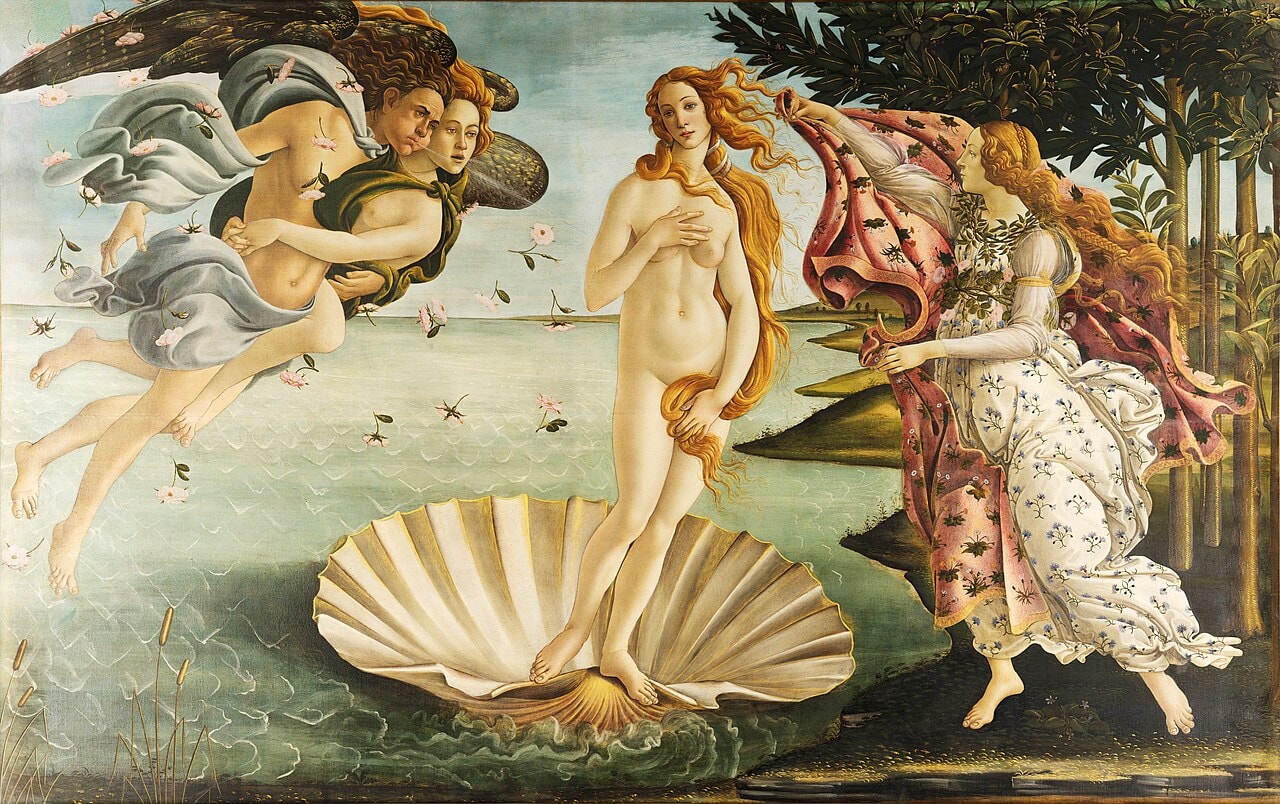
The arts of 15th-century Europe reflected renewed interest in classical models, enhanced naturalism, Christianity, pageantry, and more formal artistic training. This is why figures look more lifelike and grounded than in earlier medieval work. Required works like the Birth of Venus (Sandro Botticelli, c. 1484-1486 CE, tempera on canvas) and the Sistine Chapel ceiling and altar frescoes (Vatican City, Michelangelo, ceiling c. 1508-1512 CE, altar c. 1536-1541 CE, fresco) show both the classical revival and continued Christian subject matter.
Reformation and Counter-Reformation
In the 16th century, the Protestant Reformation and the Catholic Counter-Reformation pushed northern and southern European art apart. In the north, religious imagery declined and nonreligious genres such as landscape, still life, genre, mythology, history, and portraiture grew. Hunters in the Snow (Pieter Bruegel the Elder, 1565 CE, oil on wood) and Fruit and Insects (Rachel Ruysch, 1711 CE, oil on wood) are examples of these expanding secular genres. In the south, religious imagery, propaganda, and pageantry increased, with dynamic compositions, bold color, and emotionally powerful images and spaces. Allegory of Law and Grace (Lucas Cranach the Elder, c. 1530 CE, woodcut and letterpress) reflects Reformation theology directly.
Baroque Art
In the 17th century, painting, sculpture, and architecture kept classical principles but added compositional complexity, dynamic movement, theatricality, and heightened emotional impact. Works like Il Gesù (Rome, Italy), the Ecstasy of Saint Teresa (Gian Lorenzo Bernini, c. 1647-1652 CE, marble, stucco, and gilt bronze), and San Carlo alle Quattro Fontane (Francesco Borromini, 1638-1646 CE, stone and stucco) show this drama in service of the Counter-Reformation church. Baroque practices also spread to the Spanish Americas, where colonial art often corresponded most closely to southern European Catholic models.
How to Use This on the AP Art History Exam
Multiple Choice
Use cultural context to attribute works you may not recognize. If you see calligraphy and geometric ornament with no figures, think Islamic worship context. If you see dramatic light, movement, and theatrical religious emotion, think 17th-century Catholic south. Matching visual traits to a culture and belief system is exactly what attribution questions reward.
Free Response
When a question asks how context shaped a work, name the specific belief system, patron type, or setting, then tie it to concrete visual evidence. Do not just say "it was religious." Say which religion, what the work was for, and what features show that. For example, link Gothic cathedral elevation and stained glass to Christian worship, or link a still life to the decline of religious imagery in the Protestant north.
Continuity and Change
Unit 3 is where you practice explaining how a work both continues and changes a tradition. Identify traits of the work, traits of the larger tradition, and the context, then explain the connection. Renaissance naturalism continuing Christian subject matter while reviving classical form is a clean example.
Common Trap
Always pair a context claim with visual evidence. A statement about belief or patronage with no description of form, content, or function will not support a stronger score on free-response questions.
Common Misconceptions
- "Medieval art is just early Christian art." Medieval traditions include late antique, early Christian, Byzantine, Islamic, migratory, Carolingian, Romanesque, and Gothic, and they draw on Jewish, Christian, and Islamic worship plus court culture and learning.
- "Islamic art has no figures at all." The rejection of figural religious imagery was about theological context for sacred spaces and objects. Islamic court culture still valued imagery in some settings, and the larger emphasis was on calligraphy, ornament, and learning.
- "The Renaissance dropped religion for classical themes." Renaissance art revived classical models and naturalism but stayed deeply Christian. Both can be true in the same work.
- "Northern and southern European art were basically the same in the 1500s." The Reformation and Counter-Reformation split them. The north grew secular genres while the south expanded religious imagery, propaganda, and pageantry.
- "Baroque drama means artists abandoned classical rules." Baroque art kept classical principles and formulas but added complexity, movement, theatricality, and emotional intensity.
- "Colonial art in the Americas copied all of Europe equally." Because it developed in a Spanish Catholic context, it corresponded most closely to southern European art.
Related AP Art History Guides
- Unit 3 Overview: Early Europe and Colonial Americas, 200-1750 CE
- 3.3 Materials, Processes, and Techniques in Early European and Colonial American Art
- 3.4 Purpose and Audience in Early European and Colonial American Art
- 3.5 Theories and Interpretations of Early European and Colonial American Art
- 3.2 Interactions Within and Across Cultures in Early European and Colonial American Art
- 3.6 Unit 3 Required Works
Frequently Asked Questions
What cultural contexts shaped Early European and Colonial American art?
This art was shaped by worship, court culture, learning, classical revival, the Reformation, the Counter-Reformation, and Spanish Catholic colonial contexts. These forces affected subject matter, style, function, and naturalism.
How did religion shape medieval art?
Jewish, Christian, and Islamic worship shaped medieval art through sacred architecture, manuscripts, icons, calligraphy, ornament, and religious subject matter. Court culture and learning also mattered.
How did the Renaissance change European art?
Fifteenth-century Europe revived classical models, increased naturalism, expanded pageantry, and formalized artistic training while still keeping Christianity central to many works.
How did the Reformation affect art?
The Protestant Reformation reduced religious imagery in many northern European areas and helped secular genres grow. The Catholic Counter-Reformation in the south encouraged dramatic, emotional religious imagery and pageantry.
How is Baroque art different from Renaissance art?
Baroque art kept many classical principles but added more theatricality, dynamic movement, emotional impact, complex composition, and heightened naturalism.
How is cultural context tested on the AP Art History exam?
AP questions may ask you to identify a work or explain how belief, politics, setting, or historical change shaped form, content, or function. Always pair context with visible evidence.