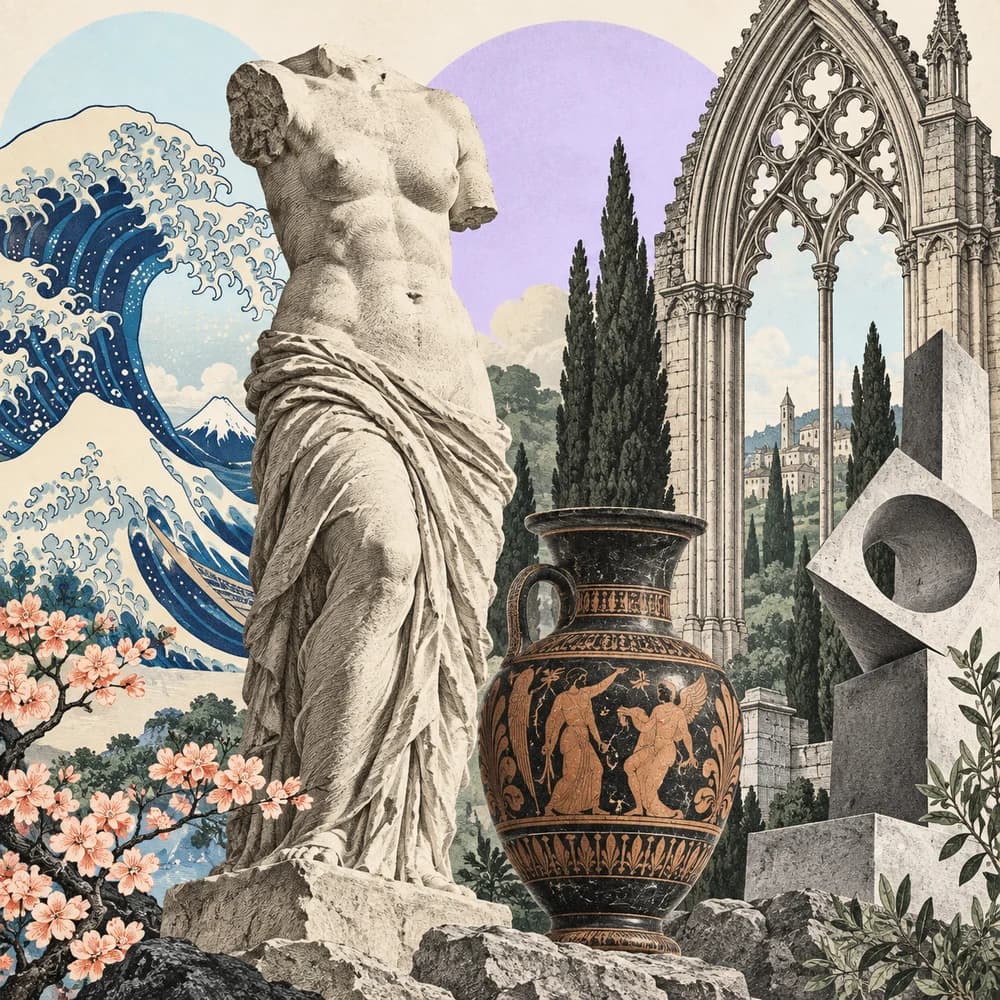
early european and colonial american art, 200–1750 ce
Early European and Colonial American Art from 200-1750 CE spans several major periods, including Early Christian, Byzantine, Romanesque, Gothic, Renaissance, and Baroque. These eras saw the development of iconic styles, techniques, and masterpieces that shaped Western art history. Key artists like Giotto, Leonardo da Vinci, and Rembrandt revolutionized painting, while innovations in sculpture, architecture, and printmaking flourished. Religious themes dominated, but secular subjects gained prominence as art patronage expanded beyond the Church to include monarchs, aristocrats, and merchants.
What topics are covered in AP Art History Unit 3 (Early Europe and Colonial Americas)?
You’ll study Early Europe and the Colonial Americas (200–1750 CE) across five core topics. The unit covers 3.1 Cultural Contexts (Medieval, Renaissance, Baroque, and colonial contexts). 3.2 Interactions Within and Across Cultures (influence, trade, hybridization). 3.3 Materials, Processes, and Techniques (perspective, fresco, mosaic, printmaking, etc.). 3.4 Purpose and Audience (patronage, liturgical functions, public vs. private display). 3.5 Theories and Interpretations (art-historical methods and changing narratives). Unit 3 weighs about 21% of the exam, is usually taught in ~21–25 class periods, and studies 54 works (numbers 48–101) — from catacombs and mosques to Renaissance, Baroque, and Spanish viceroyalty art. For focused review, Fiveable’s Unit 3 study guide, practice questions, and cram videos are available here (https://library.fiveable.me/ap-art-history/unit-3).
Where can I find an AP Art History Unit 3 PDF or unit notes?
Grab the Unit 3 study guide and notes on Fiveable’s Unit 3 page (https://library.fiveable.me/ap-art-history/unit-3). That page covers Early Europe and Colonial Americas, 200–1750 CE (topics 3.1–3.5), and includes the core works list, topic breakdowns, and the key context you’d want in a PDF-style study sheet. Unit 3 is weighted at about 21% of the exam, usually taught in ~21–25 class periods, and lists 54 works (48–101). For extra review—cheatsheets, cram videos, and more practice—see Fiveable’s AP Art History practice library (https://library.fiveable.me/practice/art-history). If you need a printable file, the Unit 3 page formats well for printing straight from your browser.
How much of the AP Art History exam is Unit 3 content?
About 21% of the AP Art History exam comes from Unit 3 (Early Europe and Colonial Americas, 200–1750 CE). The Course & Exam Description lists Unit 3 with that ~21% exam weighting, about 21–25 class periods of instruction, and 54 works to focus on (works 48–101). Some College Board materials break down subparts of the exam differently (for example, portions of multiple-choice), but the CED’s ~21% is the official unit weighting for the course. For a compact review, check Fiveable’s Unit 3 study guide and resources here (https://library.fiveable.me/ap-art-history/unit-3).
What are high-yield works and artists to study for Unit 3?
Focus your energy on these high-yield Unit 3 works and artists: Hagia Sophia (Anthemius & Isidorus), Chartres Cathedral, Arena (Scrovegni) Chapel (Giotto), Sistine Chapel ceiling (Michelangelo), School of Athens (Raphael), Annunciation Triptych (Campin), Arnolfini Portrait (Jan van Eyck), Donatello’s David, Pazzi Chapel (Brunelleschi), Last Supper (Leonardo), Calling of Saint Matthew (Caravaggio), Las Meninas (Velázquez), Ecstasy of Saint Teresa (Bernini), Palace of Versailles (Le Vau/Hardouin‑Mansart), and The Virgin of Guadalupe. Study style, materials/techniques, patronage, cultural interactions, and continuities/change — the CED skills you’ll be tested on. For targeted summaries, practice questions, cheatsheets, and cram videos tied to these works, see Fiveable’s Unit 3 guide and practice bank (https://library.fiveable.me/ap-art-history/unit-3) (https://library.fiveable.me/practice/art-history).
How should I study for AP Art History Unit 3—best strategies and resources?
Start with Fiveable’s Unit 3 guide (https://library.fiveable.me/ap-art-history/unit-3) and focus on the 54 works (200–1750 CE). Key themes include religion, power, and colonization; also drill materials/techniques and cross-cultural interactions. Build a timeline of major works. Group pieces by theme or region. Practice describing objects out loud using formal vocabulary. Do compare-and-contrast drills for likely FRQs and train for multiple choice with timed image-ID practice. Track weak spots and review materials/process diagrams for technique-based questions. For extra drills, cram videos, and 1000+ AP Art History practice items, visit Fiveable’s practice library (https://library.fiveable.me/practice/art-history).
What types of multiple-choice and free-response questions use Unit 3 material?
Unit 3 shows up in both multiple-choice and free-response parts of the exam. Multiple-choice items (single-select and stimulus-based sets) pull from Unit 3 for identification, stylistic/formal analysis, cultural context, materials/techniques, and continuity/change across works. Those questions can be standalone or embedded inside multi-item stimuli. Free-response prompts range from short-answer comparisons and contextual explanations to long essays that demand deeper analysis — think continuity versus change, patronage and purpose, cross-cultural interactions, and technical processes. Overall, Unit 3 is roughly 21% of the exam. For a focused Unit 3 review and practice questions, see Fiveable’s Unit 3 guide (https://library.fiveable.me/ap-art-history/unit-3).
Are there Unit 3 progress check MCQs or practice quizzes I can use?
You'll find official progress-check MCQs and FRQs in the College Board’s Progress Checks for Units 1–3, which are included with the AP course materials. The AP Art History Course and Exam Description also outlines unit content and practice guidance (see the College Board course description PDF at https://apcentral.collegeboard.org/media/pdf/ap-art-history-course-and-exam-description.pdf). If you want extra targeted drills and clear explanations, Fiveable’s Unit 3 guide offers practice MCQs and review resources (https://library.fiveable.me/ap-art-history/unit-3). Combining the College Board’s official checks with Fiveable’s focused practice is a solid way to track progress and shore up weak spots.
Where can I find answer keys or Quizlet sets for AP Art History Unit 3?
Yes, student-made Quizlet flashcards exist for Unit 3 (for example: https://quizlet.com/181833550/ap-art-history-unit-3-early-europe-and-colonial-americas-flash-cards/), but remember those sets are unofficial and vary in accuracy. The College Board publishes FRQ scoring guidelines and sample responses within AP materials and the course description PDF, which is useful for checking how real answers are scored (https://apcentral.collegeboard.org/media/pdf/ap-art-history-course-and-exam-description.pdf). For guided practice with explanations rather than crowdsourced flashcards, refer to Fiveable’s Unit 3 study guide (https://library.fiveable.me/ap-art-history/unit-3). Use Quizlet for quick recall and pair it with official scoring guides and guided explanations for best results.