1.3 Theories and Interpretations of Prehistoric Art

🖼AP Art History Unit 1 Review
1.3 Theories and Interpretations of Prehistoric Art
🖼 AP Art History
Because there is no writing from global prehistory, art historians lean on other fields like archaeology and anthropology to interpret what early works may have meant. Theories about prehistoric art come from visual analysis plus tools like carbon-14 dating, stratigraphic excavation, ethnographic analogy, and cross-cultural comparison, and they stay open to revision when new evidence appears.
How Do Art Historians Interpret Prehistoric Art?
Art historians interpret prehistoric art by combining visual analysis with evidence from archaeology, dating technology, anthropology, and cross-cultural comparison. Since written records usually do not exist, interpretations stay tentative and must be tied to evidence like materials, location, imagery, function, and context.
On the AP Art History exam, the strongest answers explain how a theory is built. Name the interpretation, connect it to specific evidence, and acknowledge uncertainty when the meaning or function is debated.
Why This Matters for the AP Art History Exam
This topic builds the art historical thinking skill of describing and explaining interpretations. You are expected to explain how a reading of a work comes from analyzing its form, materials, content, function, and context, and how outside disciplines and technology shape what we can claim. That kind of interpretation question shows up in both multiple-choice and free-response, so practicing it on prehistoric works like the Great Hall of the Bulls and Stonehenge prepares you to handle interpretation prompts on works across all ten units.
Prehistoric art is also the clearest place to see why uncertainty matters. With little to no written record, you have to support interpretations with evidence and use careful language like "may" or "one interpretation," which is exactly what high-scoring responses do.
Key Takeaways
- Art historians study global prehistory by working with social and physical scientists, since there is no written record to rely on.
- Carbon-14 (radiocarbon) dating and ongoing excavations help reveal connections between art across regions, but small numbers of surviving works keep many conclusions tentative.
- Ethnographic analogy uses modern traditional practices as possible models for ancient ones, and shamanism is often cited as an early, widespread spiritual approach.
- Stratigraphic archaeology, practiced since around 1900, records the exact level and location of objects and gives art historians reliable context.
- The method is to compare works to spot patterns (like transformational animal-human imagery), propose hypotheses, then test, refine, or reject them as new evidence appears.
- Great Hall of the Bulls and Stonehenge are strong examples for showing how interpretation depends on evidence and outside disciplines.
How Interpretation Works in Prehistoric Art
Because periods before writing leave no texts, scholars infer the function of art from technology, survival strategies, and the relationship between tools and how they were used. The basic move is art historical: compare works, imagery, materials, and techniques to find patterns. A common pattern is transformational animal-human iconography.
Once a pattern shows up, ethnographic approaches can turn it into a hypothesis, such as the idea that certain imagery is shamanic. Cross-cultural comparison then tests how far a generalization reaches. For example, South African, Asian, and Indigenous American peoples all created rock and cave imagery tied to a visionary aesthetic. This is how limited evidence still produces theories that can be proposed, tested, refined, and possibly rejected.
Archaeology and Art History Work Together
Modern stratigraphic archaeology, first practiced around 1900, records each level and location of every object. That precise context is what art historians build on. Major finds like the caves at Lascaux and early ceramics were first uncovered and described by archaeologists, then opened up for art historical interpretation. The two disciplines support each other.
Archaeology also shows how people, culture, and art moved across the globe long before highly organized societies formed, which helps explain similarities between distant regions.
Required Works to Know
Great Hall of the Bulls
Great Hall of the Bulls. Lascaux, France. Paleolithic Europe. 15,000-13,000 bce. Rock painting.
This site is one of the best-preserved examples of Paleolithic cave painting. Several interpretations have been proposed for the animal imagery. One reading is that it functioned as hunting or sympathetic magic meant to support successful hunts. Another is that it served ritual purposes connected to animals and the cycle of life. A third possibility is that it records a narrative or event. None of these is settled, which is exactly the point: with no written record, each reading has to be supported with visual and contextual evidence.
Notice how interpretation connects to the work's features. The images were made with pigments like charcoal and ochre, and the cave's natural conditions helped preserve them. The site was discovered in 1940, and because the paintings are fragile, a replica opened so visitors could see them without damaging the originals.
Stonehenge
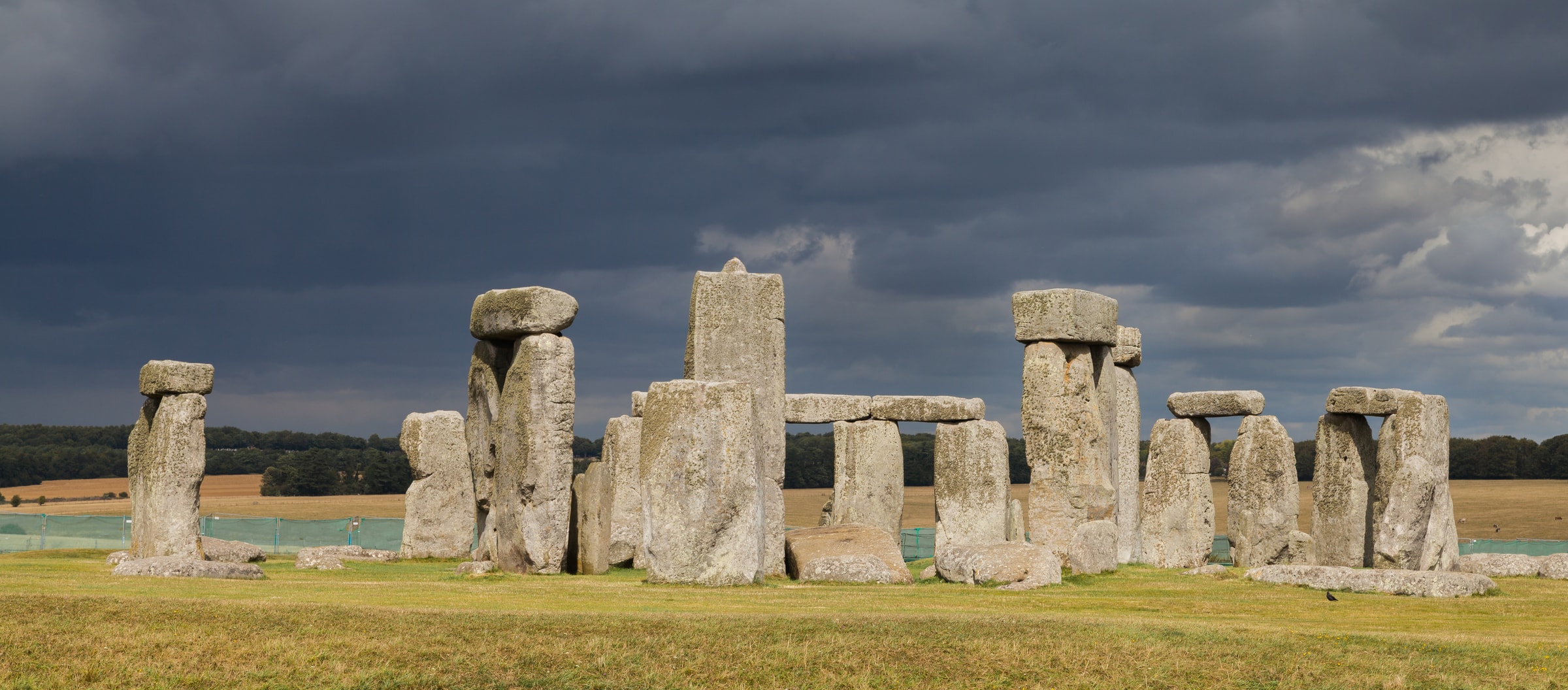
Stonehenge. Wiltshire, UK. Neolithic Europe. c. 2500-1600 bce. Sandstone.
Stonehenge is built from large sandstone (sarsen) elements, with smaller bluestones brought from Wales. It was constructed in phases over a long span, and its exact purpose is debated. Interpretations link it to ritual, ceremony, community gathering, and awareness of astronomical cycles, but these remain among several possibilities rather than proven facts. The monument is a clear case of how archaeological research, paired with visual analysis, lets scholars propose readings while keeping uncertainty visible.
How to Use This on the AP Art History Exam
Free Response
When a prompt asks you to describe and explain an interpretation, name a specific reading and then tie it to evidence in the work. For the Great Hall of the Bulls, you might explain a ritual or hunting-magic interpretation and connect it to the animal subject matter, the cave setting, and the pigments used. Always show the link between the interpretation and the work's form, content, function, or context.
Multiple Choice
Expect questions that test whether you can match an interpretation to evidence, or that ask how dating methods and excavation shape what scholars can claim. Watch for answer choices that sound confident but ignore the limited evidence of prehistory.
Common Trap
Do not state a debated function as a fact. Use language like "may," "possibly," or "one interpretation," especially for ritual, fertility, or astronomical readings. AP responses earn credit for connecting claims to evidence, not for guessing a single "correct" meaning.
Common Misconceptions
- Misconception: Prehistoric art has one proven meaning.Actually: Most functions are inferred, not proven. Many readings stay conjectural because so few works survive.
- Misconception: Carbon-14 dating tells us the meaning.Actually: Dating gives age and helps reveal connections across regions, but it does not explain purpose or symbolism.
- Misconception: Archaeology and art history are separate.Actually: They are complementary. Archaeologists find and record context; art historians interpret the works using that context.
- Misconception: Ethnographic analogy proves what ancient people believed.Actually: It offers possible models from modern traditional cultures, which leads to hypotheses, not certainty.
- Misconception: A single theory is the right answer.Actually: Theories are meant to be tested, refined, and sometimes rejected when new evidence appears.
Related AP Art History Guides
Frequently Asked Questions
How do art historians interpret prehistoric art?
They combine visual analysis with evidence from archaeology, dating technology, anthropology, and cross-cultural comparison. Because written evidence is usually missing, interpretations remain tentative and evidence-based.
What is ethnographic analogy in prehistoric art?
Ethnographic analogy uses modern traditional cultural practices as possible models for interpreting ancient works. It can support a hypothesis, but it does not prove what prehistoric people believed.
How does carbon-14 dating help interpret prehistoric art?
Carbon-14 dating helps estimate age and reveal possible connections across regions or periods. It supports historical context, but it does not directly explain a work’s meaning or function.
Why is archaeology important for prehistoric art history?
Archaeology records where objects are found, what layer they come from, and what else was nearby. That context helps art historians make more grounded interpretations.
What are the required works for AP Art History Topic 1.3?
Great Hall of the Bulls and Stonehenge are key works for this topic. Both show how interpretations depend on visual, material, archaeological, and contextual evidence.
How should you write about debated prehistoric art interpretations?
Name the interpretation, connect it to specific evidence, and keep uncertainty visible. AP responses should avoid treating debated functions as settled facts.
See Fiveable more often in Google
Mark Fiveable as a preferred source and Google is more likely to show you our guides in Top Stories, with a "preferred" badge in AI Mode and AI Overviews.