7.4 Unit 7 Required Works

🖼AP Art History Unit 7 Review
7.4 Unit 7 Required Works
🖼 AP Art History
TLDR
Unit 7 of AP Art History covers 11 required works from West and Central Asia, dated about 500 BCE to 1980 CE, including the Kaaba, the Dome of the Rock, the Great Mosque of Isfahan, two Persian Shahnama folios, and the Ardabil Carpet. These works show heavy cultural exchange across the Silk Route, strong religious purposes tied to Buddhism and Islam, and skilled use of ceramics, metalwork, textiles, painting, and calligraphy. Learn each work's title, date, location, medium, and why its form fits its function.
Why This Matters for the AP Art History Exam
This unit asks you to think about how art moves across cultures and how religion and patrons shape what gets made. The works connect the Greco-Roman world with China and India, so they are strong material for comparison questions and for explaining continuity and change within an artistic tradition.
On the exam you can use these works to:
- Identify and attribute a work using its form, medium, and visual style.
- Build contextual analysis around purpose, audience, and patron, especially religious purpose.
- Explain how interactions with other cultures shaped a work, like Hellenistic architecture appearing at Petra or Persianate styles spreading to Ottoman and Mughal art.
- Compare a West and Central Asian work with art from the ancient Mediterranean, medieval Europe, or South, East, and Southeast Asia.
The hardest skill here is explaining why continuity and change matter, not just that they exist. Practice saying what a shift in style or function tells you about the culture.
Key Takeaways
- This region forms the heart of the ancient Silk Route, so cross-cultural exchange is the main throughline.
- Buddhism and Islam are the two religious traditions that unite many of these works.
- Islamic religious art avoids figural imagery and uses calligraphy, geometric, and vegetal forms; figural imagery is common in secular Islamic art like Shahnama manuscripts.
- Key art forms include ceramics, metalwork, textiles, painting, and calligraphy, with Persian mosaic-tile architecture and luxury carpets as high points.
- Pilgrimage drives several monuments: the Kaaba, the Dome of the Rock, and Jowo Rinpoche.
- For each work, lock down title, date, location/culture, and medium before you analyze meaning.
The Required Works
Petra, Jordan: Treasury and Great Temple

The so-called Treasury (Khazneh) of Petra, Jordan, photo: Richard White (CC BY-NC-ND 2.0)
- Nabataean, Ptolemaic, and Roman; c. 400 BCE to 100 CE.
- Cut rock architecture carved directly into the cliff face.
- The Hellenistic-style facade is an example of cultural transfer, showing Greco-Roman design appearing far from Greece and Rome.
- Petra sat along trade routes that linked distant regions.
Buddha, Bamiyan
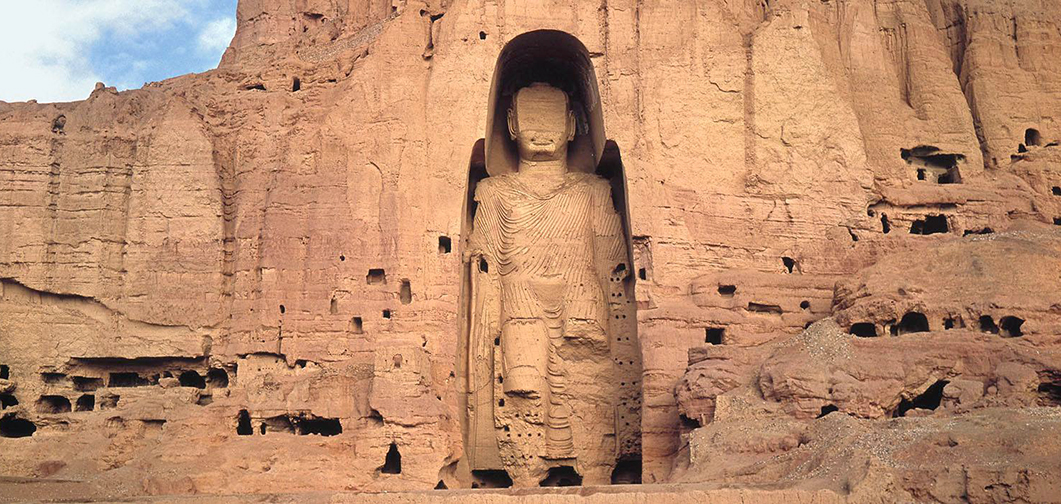
West Buddha surrounded by caves, c. 400-800 CE, cut rock with plaster and polychrome paint, Bamiyan, Afghanistan, destroyed in 2001 (photo: © Afghanistan Embassy)

- Gandharan; c. 400-800 CE; destroyed in 2001.
- Monumental Buddha figures cut from rock with plaster and polychrome paint.
- Figural imagery is central to Buddhist communities in Central Asia, used to depict the Buddha for veneration.
- Shows the spread of Buddhist sculpture along the Silk Route.
The Kaaba
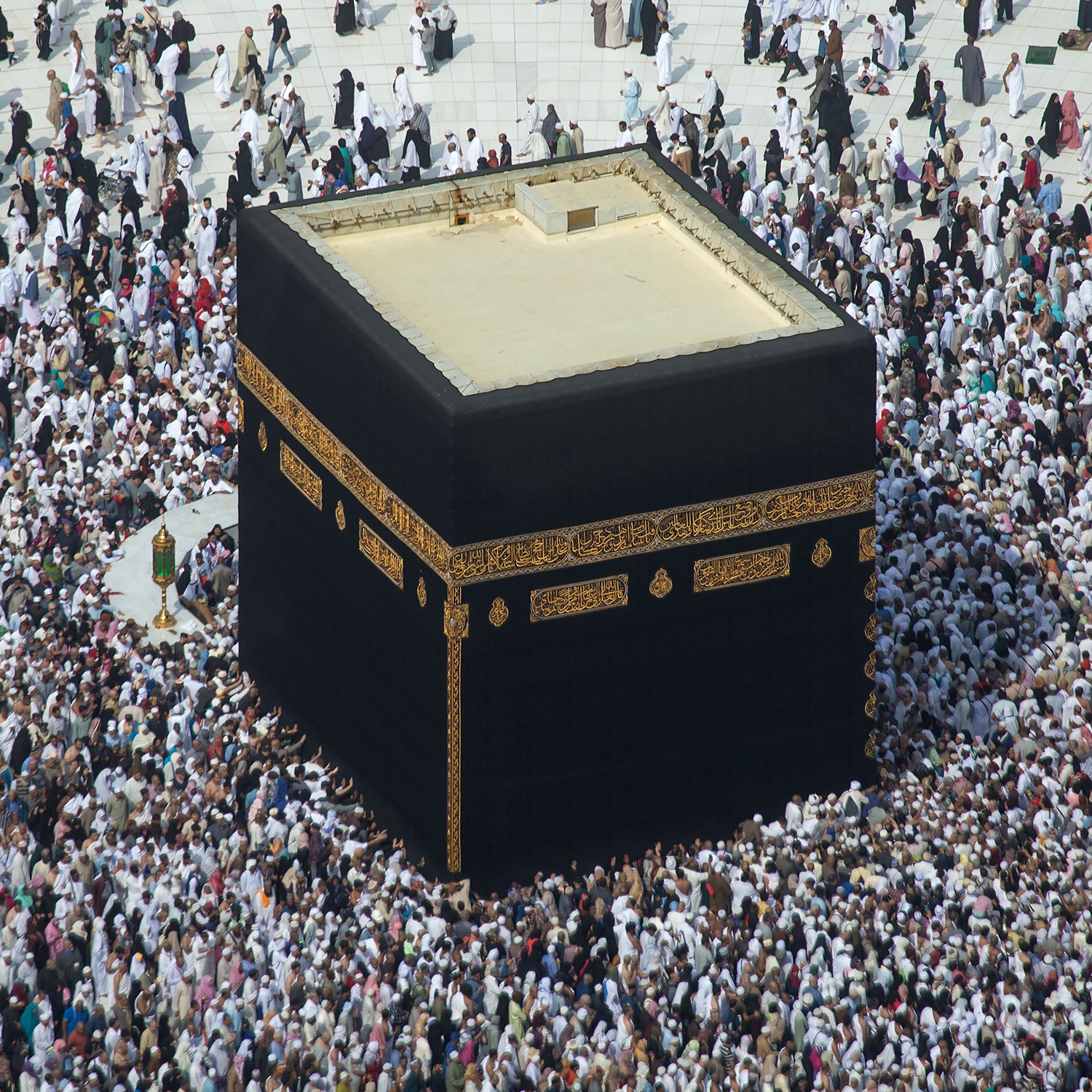
The Kaaba, granite masonry covered with silk curtain and calligraphy in gold and silver-wrapped thread, pre-Islamic monument, rededicated by Muhammad in 631-632 CE, multiple renovations, Mecca, Saudi Arabia (photo: Muhammad Mahdi Karim, GNU version 1.2 only)
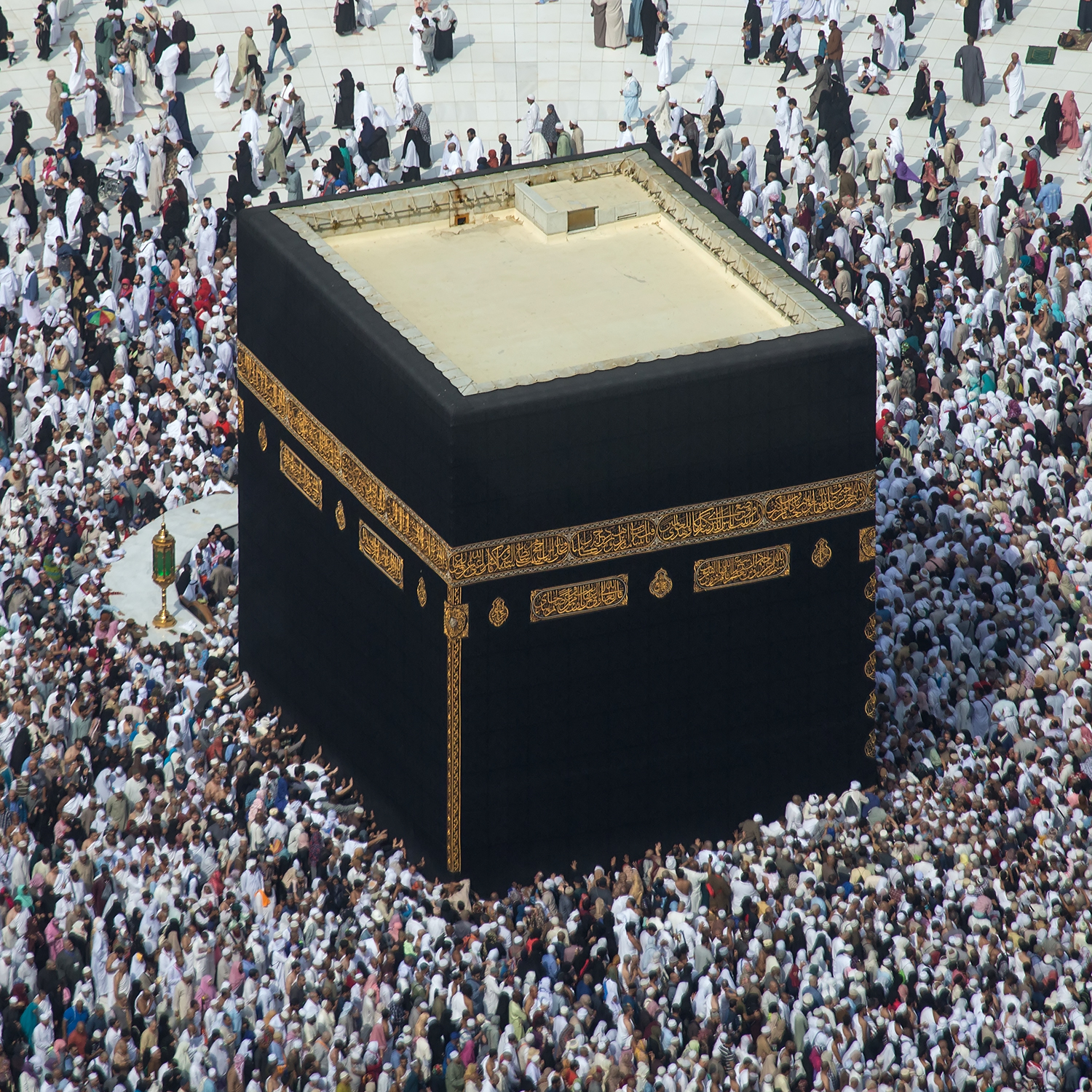
- Islamic; a pre-Islamic monument rededicated by Muhammad in 631-632 CE, with multiple renovations.
- Granite masonry covered with a silk curtain and calligraphy in gold and silver-wrapped thread.
- The most sacred site in Islam and a focus of pilgrimage.
- All mosque Qibla walls face the direction of Mecca, home of the Kaaba.
Jowo Rinpoche, Jokhang Temple
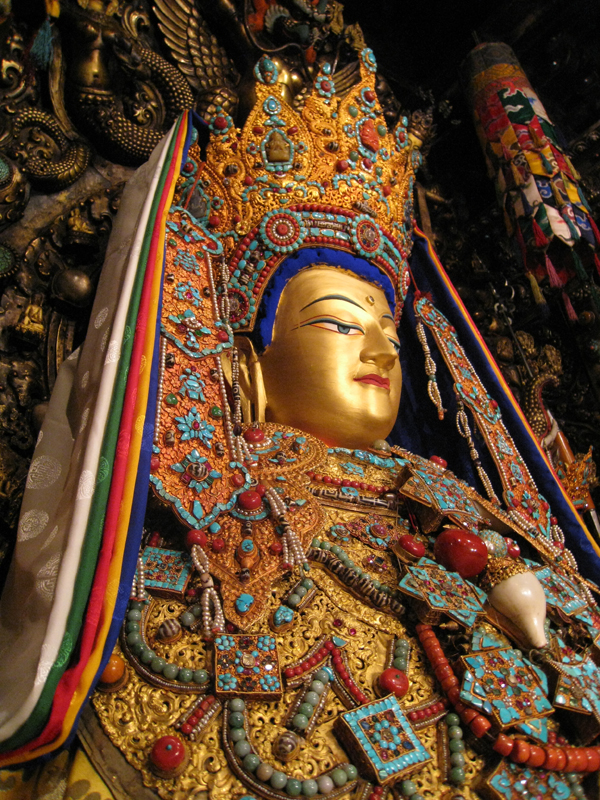
Jowo Shakyamuni, Jokhang Temple, Lhasa, Tibet, Yarlung Dynasty, gilt metals with semiprecious stones, pearls, and paint and various offerings (photo: ziyi xu, CC BY-SA 2.0)
- Yarlung Dynasty; believed to have been brought to Tibet in 641 CE.
- Gilt metals with semiprecious stones, pearls, and paint, plus various offerings.
- Considered the most sacred image in Tibet and a key pilgrimage focus.
- An example of metal sculpture in Himalayan Buddhist art, often ornamented with gilding and inlay.
Dome of the Rock
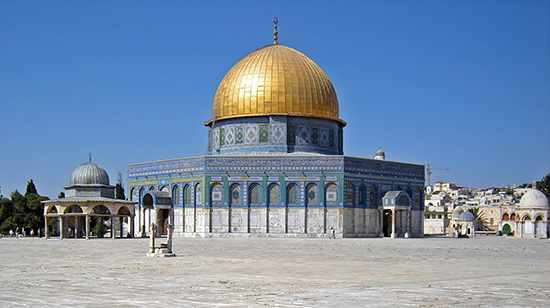
The Dome of the Rock (Qubbat al-Sakhra), Umayyad, stone masonry and wooden roof, decorated with glazed ceramic tile, mosaics, and gilt aluminum and bronze dome, 691-692 CE, with multiple renovations, Jerusalem (photo: Orientalist, CC BY 3.0)
- Islamic, Umayyad; 691-692 CE, with multiple renovations.
- Stone masonry and wooden roof decorated with glazed ceramic tile, mosaics, and a gilt aluminum and bronze dome.
- A commemorative monument and a focus of pilgrimage.
- Decorated with nonfigural imagery, including calligraphy and vegetal forms.
Great Mosque (Masjid-e Jameh), Isfahan

Courtyard, the Great Mosque or Masjid-e Jameh of Isfahan, photo: reibai (CC BY 2.0)
- Islamic, Persian: Seljuk, Il-Khanid, Timurid, and Safavid Dynasties; c. 700 CE with additions and restorations in the 14th, 18th, and 20th centuries.
- Stone, brick, wood, plaster, and glazed ceramic tile.
- A high point of Persian mosaic-tile architecture from the Seljuk through the Safavid dynasties.
- As a congregational mosque, it includes features like a central courtyard to gather practitioners for prayer.
Folio from a Qur'an
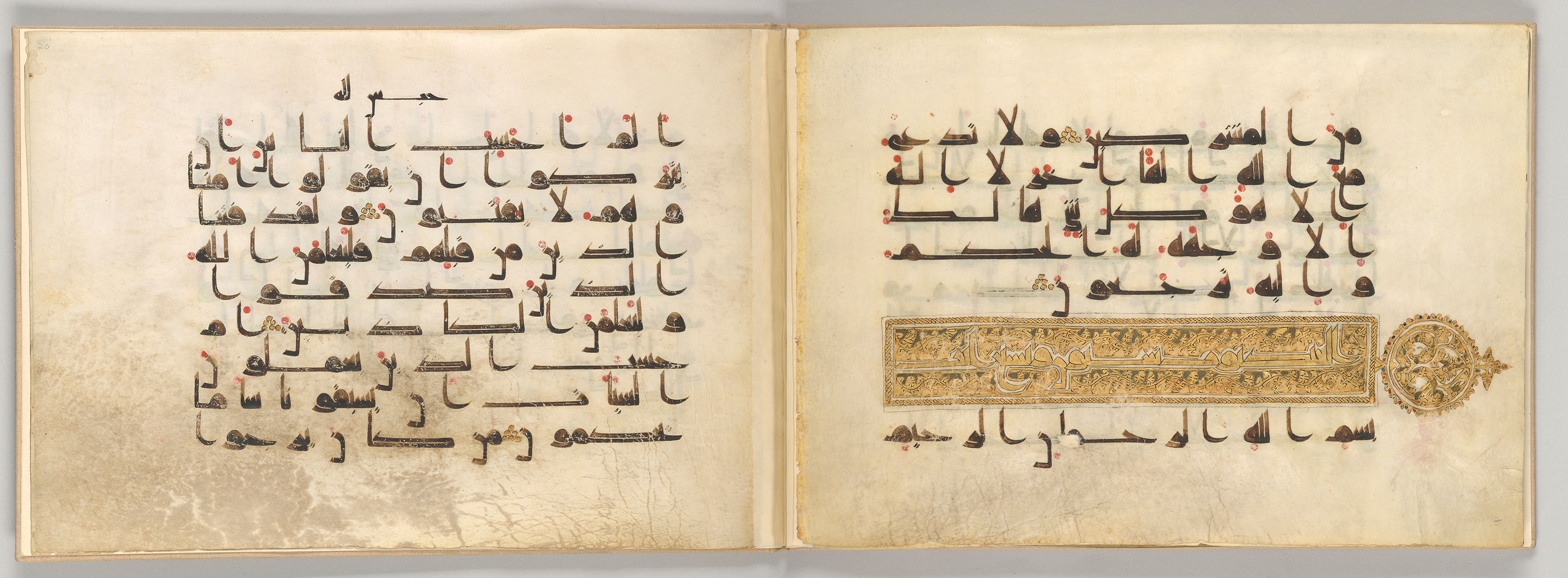
Qur'an folio, Arabic, vellum, possibly Iraq (The Morgan Library and Museum, New York)
- Abbasid; from Arab, North Africa, or the Near East; c. eighth to ninth century CE.
- Ink, color, and gold on parchment.
- Calligraphy was a prominent art form used to transmit sacred texts.
- As a manuscript of sacred text, it contains calligraphy and decoration but no figural imagery.
Basin (Baptistère de St. Louis)

Muhammad ibn al-Zain, Basin (Baptistère de Saint Louis), c. 1320-1340 CE, brass inlaid with silver and gold, 22.2 x 50.2 cm (Musée du Louvre, Paris)
- By Muhammad ibn al-Zain; c. 1320-1340 CE.
- Brass inlaid with gold and silver.
- Features figural scenes such as hunting, warfare, and courtly life, which fit secular Islamic decorative arts.
- Islamic metalwork is regarded as one of the finest decorative art forms of the medieval world, and pieces like this circulated in regions bordering the Mediterranean.
Bahram Gur Fights the Karg
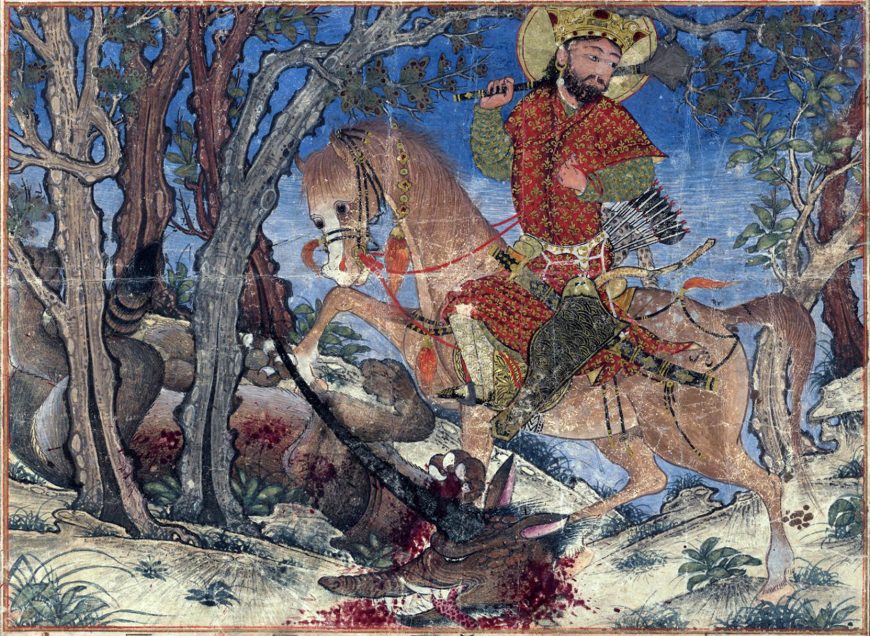
Bahram Gur Fights the Karg (Horned Wolf), from the Great Il-Khanid Shahnama, c. 1330-1340 CE, Iran, ink, colors, gold, and silver on paper (Harvard Art Museums/Arthur M. Sackler Museum)
- Islamic; Persian, Il-Khanid; c. 1330-1340 CE.
- Ink and opaque watercolor, gold, and silver on paper.
- A folio from the Great Il-Khanid Shahnama, illustrating a narrative of the Persian kings and heroes.
- A secular manuscript painting, so figural imagery is expected here.
The Court of Gayumars
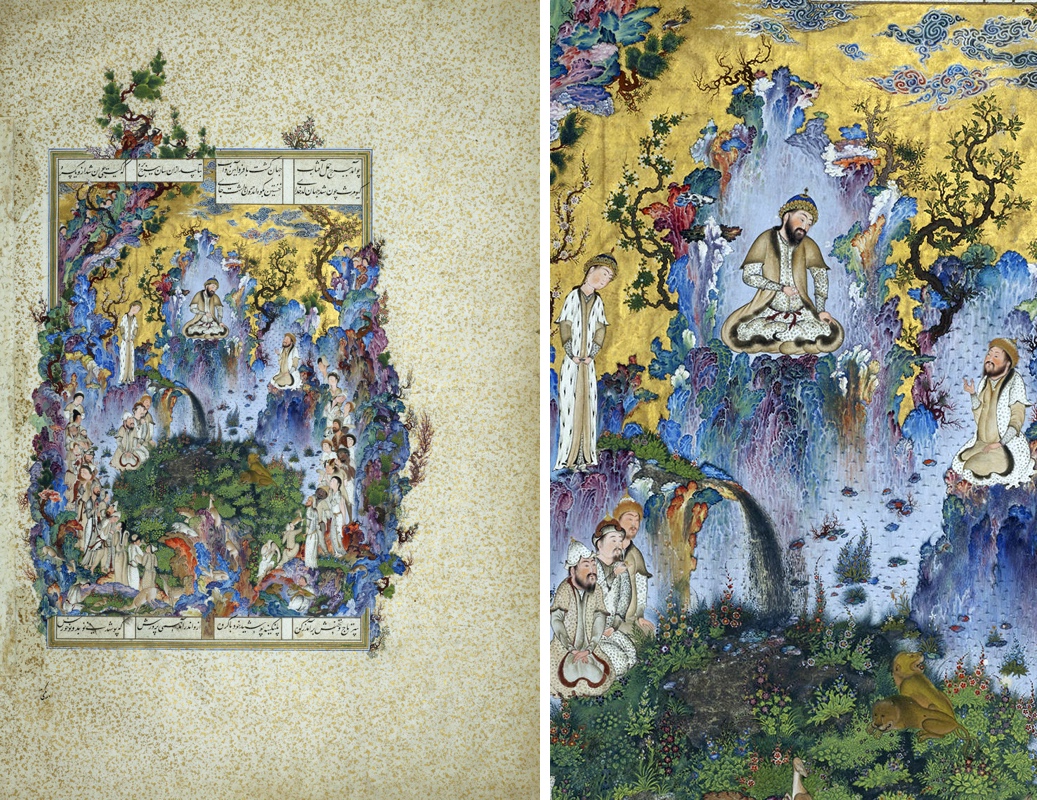
Sultan Muhammad, The Court of Gayumars, c. 1522-1525 CE, ink, opaque watercolor, and gold on paper, folio from the Shahnama of Shah Tahmasp (Safavid), Tabriz, Iran
- By Sultan Muhammad; c. 1522-1525 CE.
- Ink, opaque watercolor, and gold on paper.
- A folio from Shah Tahmasp's Shahnama, depicting the legendary first king Gayumars.
- Shows the West Asian taste for highly decorative design, with figures set in patterned landscapes and shallow space.
The Ardabil Carpet
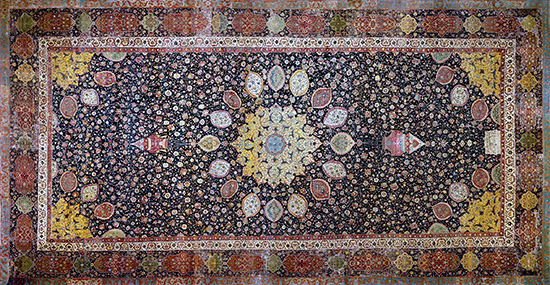
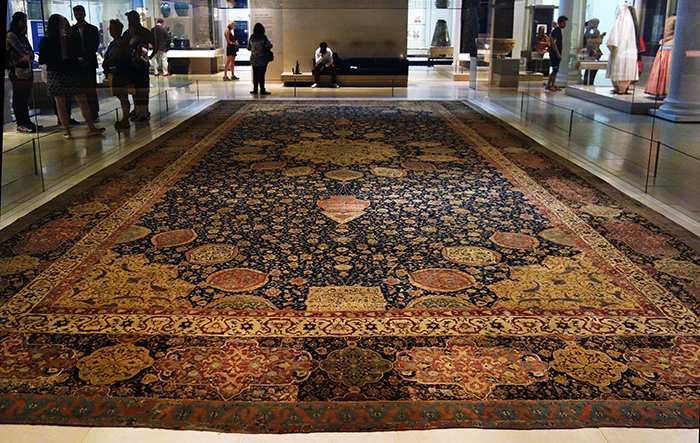
Medallion Carpet, The Ardabil Carpet, Maqsud of Kashan named in the inscription, Persian: Safavid Dynasty, silk and wool, 1539-1540 CE, Iran (Victoria and Albert Museum) (photo: Steven Zucker, CC BY-NC-SA 2.0)
- By Maqsud of Kashan; 1539-1540 CE.
- Silk and wool.
- Features a central medallion and intricate floral designs across a flat, two-dimensional surface.
- Textiles like carpets were among the most important art forms in the region and a major part of trade between Europe and Asia.
How to Use This on the AP Art History Exam
Identification and Attribution
Memorize the four basics for each work: title, date, location or culture, and medium. If a question shows you an unlabeled image, use medium and style clues to attribute it. Brass inlaid with gold and silver points to Islamic metalwork; silk and wool with a central medallion points to a Safavid carpet.
Contextual Analysis
Connect form to function. Ask what the work was for and who used it. For the Kaaba, Dome of the Rock, and Jowo Rinpoche, pilgrimage is the function to name. For mosque architecture, point to the Qibla wall facing Mecca and the central courtyard for gathering worshippers.
Comparison
These works compare well with the ancient Mediterranean, medieval Europe, and South, East, and Southeast Asia. A strong comparison uses specific evidence from form, function, content, and context on both works, not just surface similarities.
Common Trap
When asked about continuity and change, do not stop at "this changed." Explain what the change tells you about the culture, patron, or belief system. That explanation is where points are won.
Common Misconceptions
- Misconception: All Islamic art avoids figures.Actually: Religious Islamic art avoids figural imagery, but secular works like the Shahnama folios and the Basin are full of figures.
- Misconception: The Bamiyan Buddha was just damaged.Actually: It was destroyed in 2001, not simply harmed.
- Misconception: These dates are recent.Actually: Most of these works span the ancient and medieval periods; the Court of Gayumars and the Ardabil Carpet are 16th century, but Petra and the Bamiyan Buddha are far older.
- Misconception: The Kaaba was built by Muhammad.Actually: It is a pre-Islamic monument that Muhammad rededicated in 631-632 CE, with multiple later renovations.
- Misconception: Carpets and textiles were minor crafts.Actually: Textiles were among the most important art forms in this region and led much of the trade between Europe and Asia.
- Misconception: Jowo Rinpoche is a painting.Actually: It is a metal sculpture of the Buddha in gilt metals with semiprecious stones, pearls, and paint.
Related AP Art History Guides
Frequently Asked Questions
What is AP Art History Unit 7 about?
AP Art History Unit 7 covers required works from West and Central Asia, roughly 500 BCE to 1980 CE. The unit emphasizes Silk Route exchange, Buddhist and Islamic religious art, pilgrimage, calligraphy, textiles, metalwork, manuscripts, and mosque architecture.
How many required works are in AP Art History Unit 7?
This guide reviews 11 required works from Unit 7, including Petra, the Bamiyan Buddha, the Kaaba, Jowo Rinpoche, Dome of the Rock, Great Mosque of Isfahan, a Qur'an folio, the Basin, two Shahnama folios, and the Ardabil Carpet.
What should I memorize for each Unit 7 required work?
Start with title, date, location or culture, and medium. Then add function, patron or audience when known, and one or two visual features that help you identify or compare the work.
Why is the Silk Route important for Unit 7?
The Silk Route helps explain cultural exchange across West and Central Asia. It connects Buddhist sculpture, Islamic architecture, Persian manuscripts, luxury textiles, and the movement of forms and techniques across regions.
Does Islamic art always avoid figures?
No. Religious Islamic art often avoids figural imagery and emphasizes calligraphy, geometric designs, and vegetal forms, but secular works such as Shahnama manuscript pages and luxury metalwork can include figures.
How can Unit 7 works appear on the AP Art History exam?
They can appear in identification, contextual analysis, comparison, and continuity-and-change questions. Use form, function, content, and context to explain why a work mattered in its cultural setting.
See Fiveable more often in Google
Mark Fiveable as a preferred source and Google is more likely to show you our guides in Top Stories, with a "preferred" badge in AI Mode and AI Overviews.