10.4 Theories and Interpretations of Global Contemporary Art

🖼AP Art History Unit 10 Review
10.4 Theories and Interpretations of Global Contemporary Art
🖼 AP Art History
Interpretations of global contemporary art come from close looking, scholarship, and other fields rather than one fixed "correct" meaning. The required works here are The Gates by Christo and Jeanne-Claude and The Crossing by Bill Viola, both of which invite multiple, open-ended readings.
How Do You Interpret Global Contemporary Art?
Interpret global contemporary art by making a defensible claim about meaning, then supporting it with visual, contextual, and scholarly evidence. Many contemporary works are open-ended, so the goal is not to memorize one meaning. The goal is to explain why a reasonable interpretation fits the work.
For AP Art History, pair the interpretation with evidence from form, medium, site, audience experience, technology, or reception.
Why This Matters for the AP Art History Exam
This topic builds the interpretation and argument skills you need for the free-response section. Contemporary works often have meanings that are open-ended and can be read in more than one way, so the exam rewards you for explaining a reasonable interpretation and supporting it with evidence, not for guessing a single "right" answer.
Practicing with The Gates and The Crossing helps you:
- Describe one or more art historically relevant interpretations of a work, its reception, or its meaning.
- Make a defensible claim about a work and connect it to specific evidence.
- Explain how interpretations come from visual analysis, scholarship, technology, or available evidence, which can also strengthen comparison and continuity-and-change responses.
Key Takeaways
- Interpretations of art change over time and can come from both visual analysis and scholarship.
- A single work can support multiple valid readings; intended meaning is often open-ended.
- Strong responses pair a clear claim with specific evidence from form, content, and context, often using "because" or "through" to link the two.
- The Crossing (Bill Viola, 1996, video/sound installation) uses video, sound, and elemental imagery to explore themes like life, death, and transformation.
- The Gates (Christo and Jeanne-Claude, New York City, 1979-2005, mixed-media installation) was a temporary, site-specific work in Central Park that reshaped how viewers experienced the space.
- Avoid vague statements. The difference between an average and a strong answer is usually specific, relevant detail.
The Two Required Works for This Topic
The Crossing (Bill Viola, 1996)
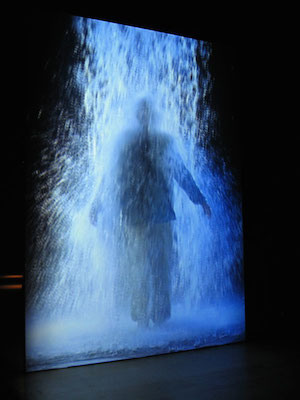
- Medium: video/sound installation.
- Viola uses video, sound, and elemental imagery (such as water and fire) to explore broad human themes like life, death, transformation, and spiritual experience.
- Because the work is open-ended, viewers can read it through different lenses, for example as a meditation on rebirth, destruction, or inner change. That openness is exactly what this topic is about.
- The slow, immersive pacing pulls viewers in and encourages personal reflection, which is part of why different people interpret it differently.
When you write about The Crossing, describe what you can support from form and content rather than inventing fixed symbolism. Use cautious language like "may suggest" or "one interpretation is" when the meaning is debated.
The Gates (Christo and Jeanne-Claude, 1979-2005)

- Location: New York City, U.S. Medium: mixed-media installation.
- The Gates consisted of thousands of gates hung with saffron-colored fabric placed along pathways in Central Park, on view temporarily in 2005.
- The project let people walk through the gates and experience a familiar public space in a new way, which is central to many interpretations of the work.
- Because it was temporary and site-specific, The Gates raises questions about what counts as art, how art interacts with public space, and how an artwork's meaning depends on the experience of moving through it.
The Gates is useful for discussing how interpretation connects to context: the setting, the temporary nature, and the public participation all shape how the work is understood.
How to Use This on the AP Art History Exam
Describing Interpretations
When a question asks for an interpretation, name a reasonable reading and tie it to what you actually see or know. For example, you might argue The Crossing explores transformation, then point to its use of elemental imagery and slow, immersive video as your support.
Making and Supporting a Claim
Strong responses follow a simple pattern:
- State a defensible claim (one clear interpretation).
- Give specific evidence from form, content, or context.
- Explain the link, often with "because" or "through."
Example structure: "The Gates changes how viewers experience Central Park because the saffron fabric and the path of gates guide movement and frame familiar views in new ways."
Comparison and Continuity
Because interpretations connect to scholarship, technology, and context, this topic helps on comparison and continuity-and-change questions too. You can compare how two contemporary works are interpreted, or explain how a work continues or breaks from earlier traditions, as long as you support each point with evidence.
Common Trap
Do not just describe a work and stop. Description alone is not interpretation. Always connect your evidence back to a claim about meaning, reception, or significance.
Common Misconceptions
- Misconception: There is one correct meaning.Actually: Contemporary art interpretations are often open-ended, and the exam expects you to support a reasonable reading, not find a single right answer.
- Misconception: Interpretation means personal opinion.Actually: Your interpretation needs to be art historically relevant and backed by evidence, not just how the work makes you feel.
- Misconception: Listing facts is enough.Actually: Identifying the medium or location does not interpret the work. You still need a claim plus specific support.
- Misconception: The Gates is permanent.Actually: It was a temporary, site-specific installation on view for a short time, which is part of its meaning.
- Misconception: The Crossing has fixed symbolism you must memorize.Actually: Its meaning is debated and open-ended, so use cautious language and focus on evidence you can defend.
Related AP Art History Guides
Practice Questions for 10.4
1 of 10
Hagia Sophia's pendentives influenced Ottoman mosque domes after 1453. Which factor most directly enabled that transmission?
A.
Some Byzantine craftsmen worked for Ottomans but formal apprenticeships were rare
B.
Islamic treatises preserved classical engineering but lacked detailed pendentive plans
C.
Ottoman conquest and conversion of Hagia Sophia gave architects direct access
D.
Ottoman architects independently reinvented pendentives without influence from Hagia Sophia
Vocabulary
The following words are mentioned explicitly in the AP® course framework for this topic.Term | Definition |
|---|---|
art-historical argument | A reasoned explanation or interpretation about a work or group of works of art supported by evidence and analysis. |
intended meanings | The meanings and messages that an artist or artwork creator sought to communicate through their work. |
interpretations of art | Different understandings and explanations of the meaning, significance, and context of works of art. |
theories of art | Frameworks and conceptual approaches used to understand, interpret, and analyze works of art and artistic practices. |
visual analysis | The systematic examination and interpretation of a work of art's formal elements, such as color, composition, form, and technique, to understand its meaning and significance. |
Frequently Asked Questions
How do you interpret global contemporary art?
Make a defensible claim about meaning, then support it with visual, contextual, and scholarly evidence. Many contemporary works are open-ended, so a strong interpretation explains why a reading fits the work.
Why can contemporary artworks have multiple interpretations?
Contemporary works often use open-ended imagery, new media, site-specific experiences, or audience participation. Different interpretations can be valid when they are art historically relevant and supported by evidence.
How do you interpret The Crossing by Bill Viola?
One interpretation is that The Crossing explores transformation, life, death, or spiritual experience through slow video, sound, and elemental imagery such as water and fire. Use cautious language because the meaning is open-ended.
How do you interpret The Gates by Christo and Jeanne-Claude?
The Gates can be interpreted as transforming how viewers experience Central Park. Its temporary, site-specific gates and saffron fabric guide movement through public space and make a familiar setting feel new.
What is a defensible claim in AP Art History interpretation?
A defensible claim is a reasonable interpretation that can be supported with specific evidence from form, content, context, medium, site, reception, or scholarship.
How is interpretation tested on the AP Art History exam?
AP questions may ask you to describe an interpretation, support a claim, or explain how scholarship and visual analysis shape meaning. Pair every claim with specific evidence.
See Fiveable more often in Google
Mark Fiveable as a preferred source and Google is more likely to show you our guides in Top Stories, with a "preferred" badge in AI Mode and AI Overviews.