4.5 Unit 4 Required Works

🖼AP Art History Unit 4 Review
4.5 Unit 4 Required Works
🖼 AP Art History
TLDR
Unit 4 of AP Art History covers Later Europe and the Americas from 1750 to 1980 CE, a stretch of fast change shaped by the Enlightenment, industrialization, revolutions, and new technologies like photography and steel-frame building. The required works run from Neoclassicism and Romanticism through Impressionism, Cubism, Surrealism, Abstract Expressionism, Pop Art, and earthworks, so you need to recognize each work and connect it to its style, purpose, and historical context.
Why This Matters for the AP Art History Exam
Unit 4 is one of the most heavily represented periods on the exam, accounting for about 21% of the course. The works span Neoclassicism to environmental art, which gives you a wide pool to pull from for visual analysis, contextual analysis, and comparison.
This unit is also where attribution skills pay off. On free-response prompts that ask you to analyze a work outside the required image set, you can compare an unfamiliar piece to a Unit 4 work you know well by matching style, technique, purpose, or function. Because so many of these movements introduce specific visual features (broken brushwork, geometric fracturing, flattened color, readymade objects), Unit 4 gives you clear evidence to support claims.
When you write about these works, push past generic statements. Instead of saying many things influenced art, connect a specific cause to a specific effect, such as how industrialization shaped subject matter in nineteenth-century European painting or how new steel and concrete made skyscrapers and open modern buildings possible.
Key Takeaways
- Unit 4 spans 1750 to 1980 CE and includes required works numbered 99 through 152, covering Europe and the Americas.
- The Enlightenment set the stage with a focus on reason, science, and human rights, and Romanticism later pushed back against Enlightenment ideals and industrialization.
- Many movements fall under the broad heading of modernism, including Neoclassicism, Romanticism, Realism, Impressionism, Post-Impressionism, Symbolism, Expressionism, Cubism, Constructivism, abstraction, Surrealism, Abstract Expressionism, Pop Art, performance art, and earth and environmental art.
- New media and methods reshaped art making, including lithography, photography, film, serigraphy, steel-frame and ferroconcrete construction, cantilevering, mass production, and large-scale earthworks.
- Patronage shifted from churches and academies to public exhibitions, commercial galleries, museums, and corporate buyers, and after World War II the United States led the art market.
- Practice connecting each work to a specific cause and effect rather than using vague influence statements.
Unit 4 Required Works Reference Table
Use this table to check that you can identify each required work by title, artist, date, and medium. These identifying details are exactly what you need for attribution and contextual analysis.
| # | Title | Artist | Date | Medium |
|---|---|---|---|---|
| 99 | Portrait of Sor Juana Inés de la Cruz | Miguel Cabrera | c. 1750 ce | Oil on canvas |
| 100 | A Philosopher Giving a Lecture on the Orrery | Joseph Wright of Derby | c. 1763-1765 ce | Oil on canvas |
| 101 | The Swing | Jean-Honoré Fragonard | 1767 ce | Oil on canvas |
| 102 | Monticello | Thomas Jefferson (architect), Virginia, U.S. | 1768-1809 ce | Brick, glass, stone, and wood |
| 103 | The Oath of the Horatii | Jacques-Louis David | 1784 ce | Oil on canvas |
| 104 | George Washington | Jean-Antoine Houdon | 1788-1792 ce | Marble |
| 105 | Self-Portrait | Elisabeth Louise Vigée Le Brun | 1790 ce | Oil on canvas |
| 106 | Y no hai remedio (And There's Nothing to Be Done), from Los Desastres de la Guerra, plate 15 | Francisco de Goya | 1810-1823 ce (published 1863) | Etching, drypoint, burin, and burnishing |
| 107 | La Grande Odalisque | Jean-Auguste-Dominique Ingres | 1814 ce | Oil on canvas |
| 108 | Liberty Leading the People | Eugène Delacroix | 1830 ce | Oil on canvas |
| 109 | The Oxbow (View from Mount Holyoke, Northampton, Massachusetts, after a Thunderstorm) | Thomas Cole | 1836 ce | Oil on canvas |
| 110 | Still Life in Studio | Louis-Jacques-Mandé Daguerre | 1837 ce | Daguerreotype |
| 111 | Slave Ship (Slavers Throwing Overboard the Dead and Dying, Typhoon Coming On) | Joseph Mallord William Turner | 1840 ce | Oil on canvas |
| 112 | Palace of Westminster (Houses of Parliament) | Charles Barry and Augustus W. N. Pugin (architects), London, England | 1840-1870 ce | Limestone masonry and glass |
| 113 | The Stone Breakers | Gustave Courbet | 1849 ce (destroyed in 1945) | Oil on canvas |
| 114 | Nadar Raising Photography to the Height of Art | Honoré Daumier | 1862 ce | Lithograph |
| 115 | Olympia | Édouard Manet | 1863 ce | Oil on canvas |
| 116 | The Saint-Lazare Station | Claude Monet | 1877 ce | Oil on canvas |
| 117 | The Horse in Motion | Eadweard Muybridge | 1878 ce | Albumen print |
| 118 | The Valley of Mexico from the Hillside of Santa Isabel | Jose María Velasco | 1882 ce | Oil on canvas |
| 119 | The Burghers of Calais | Auguste Rodin | 1884-1895 ce | Bronze |
| 120 | The Starry Night | Vincent van Gogh | 1889 ce | Oil on canvas |
| 121 | The Coiffure | Mary Cassatt | 1890-1891 ce | Drypoint and aquatint |
| 122 | The Scream | Edvard Munch | 1893 ce | Tempera and pastels on cardboard |
| 123 | Where Do We Come From? What Are We? Where Are We Going? | Paul Gauguin | 1897-1898 ce | Oil on canvas |
| 124 | Carson, Pirie, Scott and Company Building | Louis Sullivan (architect), Chicago, Illinois, U.S. | 1899-1903 ce | Iron, steel, glass, and terra cotta |
| 125 | Mont Sainte-Victoire | Paul Cézanne | 1902-1904 ce | Oil on canvas |
| 126 | Les Demoiselles d'Avignon | Pablo Picasso | 1907 ce | Oil on canvas |
| 127 | The Steerage | Alfred Stieglitz | 1907 ce | Photogravure |
| 128 | The Kiss | Gustav Klimt | 1907-1908 ce | Oil and gold leaf on canvas |
| 129 | The Kiss | Constantin Brancusi | original 1907-1908 ce | Stone |
| 130 | The Portuguese | Georges Braque | 1911 ce | Oil on canvas |
| 131 | Goldfish | Henri Matisse | 1912 ce | Oil on canvas |
| 132 | Improvisation 28 (second version) | Vassily Kandinsky | 1912 ce | Oil on canvas |
| 133 | Self-Portrait as a Soldier | Ernst Ludwig Kirchner | 1915 ce | Oil on canvas |
| 134 | Memorial Sheet for Karl Liebknecht | Käthe Kollwitz | 1919-1920 ce | Woodcut |
| 135 | Villa Savoye | Le Corbusier (architect), Poissy-sur-Seine, France | 1929 ce | Steel and reinforced concrete |
| 136 | Composition with Red, Blue and Yellow | Piet Mondrian | 1930 ce | Oil on canvas |
| 137 | Illustration from The Results of the First Five-Year Plan | Varvara Stepanova | 1932 ce | Photomontage |
| 138 | Object (Le Déjeuner en fourrure) | Meret Oppenheim | 1936 ce | Fur-covered cup, saucer, and spoon |
| 139 | Fallingwater | Frank Lloyd Wright (architect), Pennsylvania, U.S. | 1936-1939 ce | Reinforced concrete, sandstone, steel, and glass |
| 140 | The Two Fridas | Frida Kahlo | 1939 ce | Oil on canvas |
| 141 | The Migration of the Negro, Panel no. 49 | Jacob Lawrence | 1940-1941 ce | Casein tempera on hardboard |
| 142 | The Jungle | Wifredo Lam | 1943 ce | Gouache on paper mounted on canvas |
| 143 | Dream of a Sunday Afternoon in the Alameda Park | Diego Rivera | 1947-1948 ce | Fresco |
| 144 | Fountain (second version) | Marcel Duchamp | 1950 ce (original 1917) | Readymade glazed sanitary china with black paint |
| 145 | Woman, I | Willem de Kooning | 1950-1952 ce | Oil on canvas |
| 146 | Seagram Building | Ludwig Mies van der Rohe and Philip Johnson (architects), New York City, U.S. | 1954-1958 ce | Steel frame with glass curtain wall and bronze |
| 147 | Marilyn Diptych | Andy Warhol | 1962 ce | Oil, acrylic, and silkscreen enamel on canvas |
| 148 | Narcissus Garden | Yayoi Kusama | original installation and performance 1966 | Mirror balls |
| 149 | The Bay | Helen Frankenthaler | 1963 ce | Acrylic on canvas |
| 150 | Lipstick (Ascending) on Caterpillar Tracks | Claes Oldenburg | 1969-1974 ce | Cor-Ten steel, steel, aluminum, and cast resin; painted with polyurethane enamel |
| 151 | Spiral Jetty | Robert Smithson | 1970 ce | Earthwork: mud, precipitated salt crystals, rocks, and water coil |
| 152 | House in New Castle County | Robert Venturi, John Rauch, and Denise Scott Brown (architects), Delaware, U.S. | 1978-1983 ce | Wood frame and stucco |
Selected Work Notes
These notes hit details that are useful for identification and analysis. Use them as a starting point, then build out the rest of the works using the reference table above.
Portrait of Sor Juana Inés de la Cruz, Miguel Cabrera (c. 1750, Mexico City)
- Oil on canvas portrait of a nun seated among books, which signal her education and intellect.
- Includes religious references such as a painting of the Virgin Mary and a rosary held in her hand.
- Red curtains suggest higher status, and she makes direct eye contact with the viewer.
- Function: conveys her intellectual and religious standing as a respected scholar and nun.
A Philosopher Giving a Lecture on the Orrery, Joseph Wright of Derby (c. 1763-1765)
- Oil on canvas scene of a lecturer demonstrating an orrery, a mechanical model of the solar system.
- Reflects Enlightenment values: scientific inquiry, observation, and the spread of knowledge.
- Strong contrast of light and dark draws attention to the faces of viewers watching the demonstration.
The Swing, Jean-Honoré Fragonard (1767)
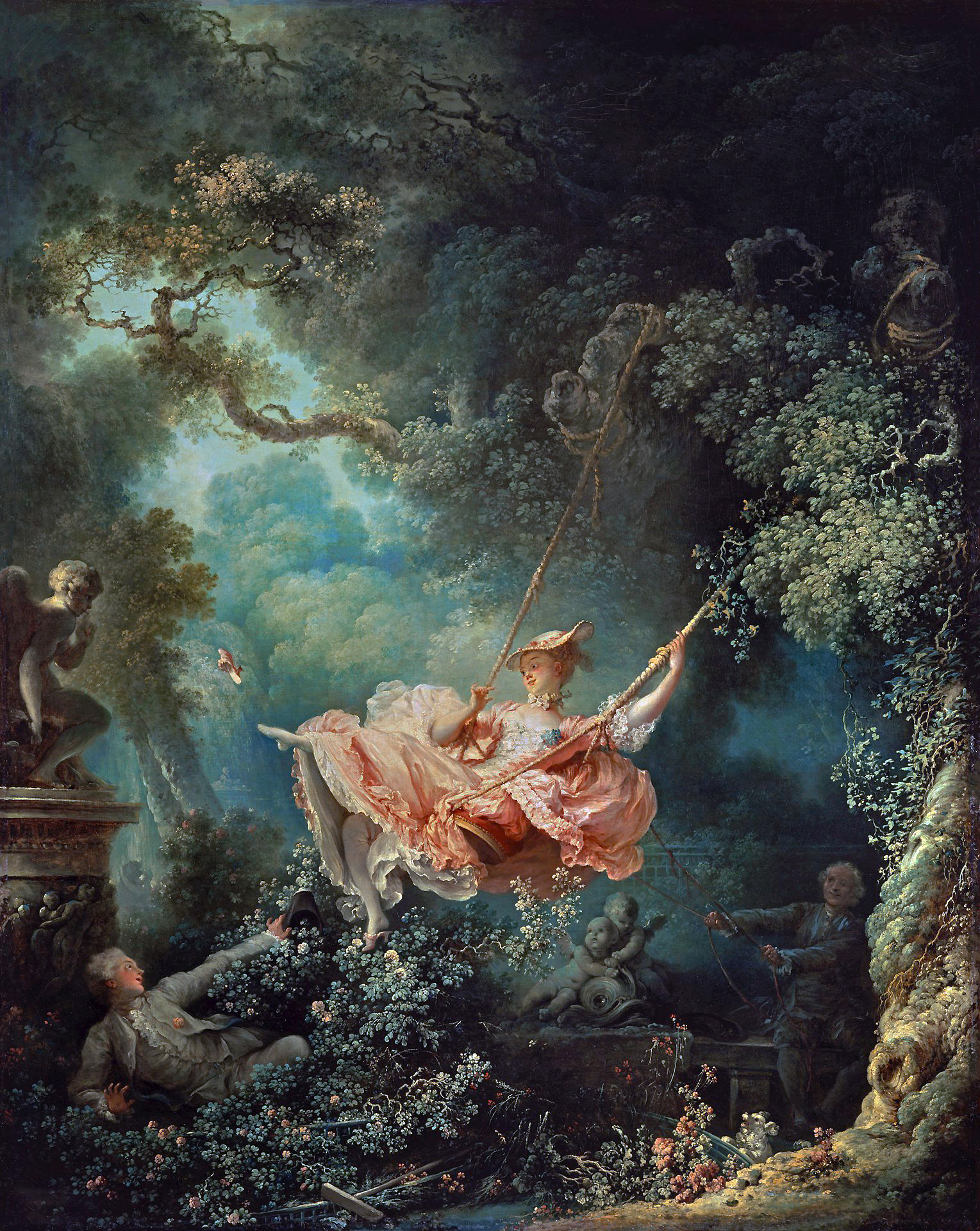
- Rococo oil on canvas with pastel color, delicate brushwork, and playful aristocratic themes.
- Shows an elegant garden with sculptures, a woman on a swing, and a hidden admirer below.
- Function: decorates elite spaces and displays the leisure and decadence enjoyed by the aristocracy.
Still Life in Studio, Louis-Jacques-Mandé Daguerre (1837)
- Daguerreotype, an early photographic process with precise detail.
- Long exposure means moving objects would not record, and the image reads as reversed.
- Function: helps elevate photography toward the status of fine art.
The Starry Night, Vincent van Gogh (1889, Saint-Rémy)
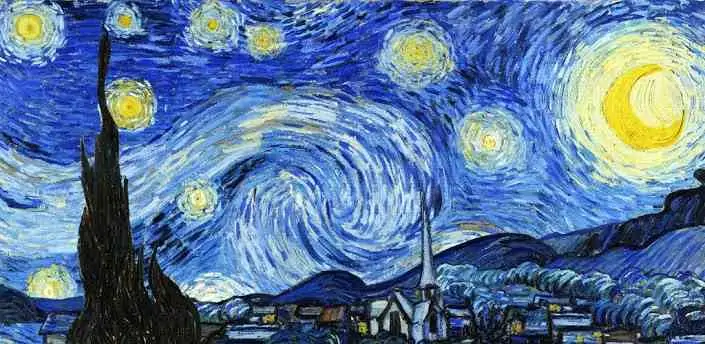
- Post-Impressionist oil on canvas painted while van Gogh was at a hospital in Saint-Rémy.
- Swirling, pulsing brushwork gives the night sky a sense of movement and energy.
- Includes a church and a tall cypress tree rising into the sky.
- Color and expressive marks convey inner feeling rather than a literal record of the scene.
Les Demoiselles d'Avignon, Pablo Picasso (1907)
- Oil on canvas often described as proto-Cubist, breaking with traditional perspective.
- Five women confront the viewer directly with angular, fractured bodies.
- Draws on varied sources, including ancient sculpture and African masks, to rework the figure.
- Function: opens a new approach to space, form, and representation in modern art.
The Kiss, Constantin Brancusi (original 1907-1908)
- Stone sculpture with simplified, blocklike forms and little surface detail.
- Two figures interlock into a nearly single mass, separated by minimal carved lines.
- Compare with Klimt's painted The Kiss (1907-1908, oil and gold leaf) to contrast medium and style.
The Two Fridas (Las dos Fridas), Frida Kahlo (1939)
- Oil on canvas double self-portrait made around the time of her divorce from Diego Rivera.
- One Frida wears European-style Victorian dress, the other wears Mexican clothing, showing her mixed heritage.
- Their hearts are connected by a vein; one figure holds a surgical clamp, the other a small portrait.
- A stormy sky in the background adds to the emotional tension.
Dream of a Sunday Afternoon in the Alameda Park, Diego Rivera (1947-1948)
- Large fresco, roughly 50 feet long and 13 feet high, made for a hotel near the Alameda Park.
- Brings together figures from several periods of Mexican history in one dreamlike scene.
- Includes a skeletal figure and a young version of Rivera, along with a portrait referencing Frida Kahlo.
- Function: works as a historical narrative tied to Mexican identity and memory.
How to Use This on the AP Art History Exam
Visual Analysis
Start with what you can see. Name the medium, then describe specific formal choices: brushwork, color, line, composition, and scale. For example, the swirling marks in The Starry Night or the fractured planes in The Portuguese are concrete evidence you can point to. Tie each formal feature to an effect on the viewer.
Contextual Analysis
Connect the work to its moment. Many Unit 4 works respond directly to events like industrialization, war, revolution, and shifting social roles. Link a specific cause to a specific result rather than making broad claims.
Comparison and Attribution
For prompts that use a work outside the required set, find the closest match among works you know. Compare style, technique, function, and purpose, then explain how those shared traits support your attribution. The wide range of clearly defined movements in Unit 4 makes it a strong source set for these comparisons.
Common Trap
Watch out for the two works both titled The Kiss. Klimt's version is an oil and gold leaf painting from 1907-1908, while Brancusi's is a stone sculpture from the same period. Mixing up the artist, medium, or style is an easy way to lose points.
Common Misconceptions
- Misconception: Modernism is one single style.Actually: Modernism is a broad heading that covers many movements with different goals, from Realism to Surrealism to Abstract Expressionism. Treating it as one look will hurt your analysis.
- Misconception: Photography does not count as real art in this period.Actually: Works like Daguerre's Still Life in Studio and Daumier's Nadar Raising Photography to the Height of Art show that artists were actively pushing photography toward fine-art status.
- Misconception: All Unit 4 art comes from Europe.Actually: The required works include pieces tied to the Americas, such as Monticello, The Oxbow, The Valley of Mexico, The Two Fridas, and Dream of a Sunday Afternoon in the Alameda Park.
- Misconception: Patronage stayed the same.Actually: Over this period, support shifted from churches and academies toward public exhibitions, commercial galleries, museums, and corporate buyers, which changed what artists made and for whom.
- Misconception: Brancusi's The Kiss is just a copy of Klimt's.Actually: They share a title and subject but differ in medium, style, and form. Brancusi's is a simplified stone sculpture, not a version of Klimt's gold-leaf painting.
Related AP Art History Guides
- Unit 4 Review: Later Europe and Americas, 1750-1980 CE
- 4.3 Materials, Processes, and Techniques in Later European and American Art
- 4.4 Theories and Interpretations of Later European and American Art
- 4.2 Purpose and Audience in Later European and American Art
- 4.1 Interactions Within and Across Cultures in Later European and American Art
Frequently Asked Questions
What is AP Art History Unit 4 about?
AP Art History Unit 4 covers Later Europe and the Americas from 1750 to 1980 CE. It includes required works 99 through 152 and major changes in style, patronage, media, and historical context.
How many required works are in AP Art History Unit 4?
Unit 4 includes required works numbered 99 through 152. Students should know identifying information, medium, style, function, and context for each work.
What movements appear in Unit 4?
Unit 4 includes movements and approaches such as Neoclassicism, Romanticism, Realism, Impressionism, Post-Impressionism, Cubism, Surrealism, Abstract Expressionism, Pop Art, performance art, and earthworks.
Why is Unit 4 important for AP Art History?
Unit 4 is heavily represented on the AP Art History exam and gives students many works for visual analysis, contextual analysis, attribution, and comparison across modern European and American art.
What should I memorize for Unit 4 required works?
Know each work's title, artist or culture, date, medium, location when relevant, and major contextual points. Also practice recognizing visual features tied to each movement or artist.
How is Unit 4 tested on AP Art History?
Unit 4 can appear in image identification, short response, comparison, attribution, and longer essay prompts. Strong answers connect form, function, content, context, and artistic choices.
See Fiveable more often in Google
Mark Fiveable as a preferred source and Google is more likely to show you our guides in Top Stories, with a "preferred" badge in AI Mode and AI Overviews.