3.4 Purpose and Audience in Early European and Colonial American Art

🖼AP Art History Unit 3 Review
3.4 Purpose and Audience in Early European and Colonial American Art
🖼 AP Art History
3.1
Cultural Contexts of Early European and Colonial American Art
3.2
Interactions Within and Across Cultures in Early European and Colonial American Art
3.3
Materials, Processes, and Techniques in Early European and Colonial American Art
3.4
Purpose and Audience in Early European and Colonial American Art
3.5
Theories and Interpretations of Early European and Colonial American Art
3.6
Unit 3 Required Works
TLDR
In AP Art History, purpose and audience means asking who paid for a work, who was meant to see it, and what job it was supposed to do. For Early Europe and the Colonial Americas, that ranges from church altarpieces and reliquaries meant for worship to royal palaces and portrait cycles built to project power. When you can connect a work's patron, function, and intended viewers to its form and content, you can explain why it looks the way it does.
How Do Purpose and Audience Shape Unit 3 Art?
Purpose and audience shape Unit 3 art through patronage, worship, devotional use, public display, royal propaganda, education, and colonial Catholic practice. A work made for a church, palace, convent, civic building, academy, or private viewer will use different materials, scale, imagery, and display strategies.
On the AP Art History exam, name the patron or audience when you can, then explain how the work's form, content, location, or medium serves that purpose.
Why This Matters for the AP Art History Exam
This topic builds the contextual analysis skill the exam rewards. You are not just describing what a work looks like; you are explaining how patronage, intended audience, and function shaped its production, content, form, and display.
Both multiple-choice and free-response questions ask you to use evidence from form, function, content, and context. Purpose and audience give you ready-made context evidence. They also support attribution and comparison: knowing that a work was made for guild or individual patrons, for a church versus a palace, or for a colonial Catholic audience helps you place it in the right tradition and explain continuity or change.
Key Takeaways
- Patronage can be corporate (guilds, confraternities, the Church) or individual, and it shaped what art was made, how it looked, and where it was displayed.
- Art in this period performed many functions: propagandistic, commemorative, didactic, devotional, ritual, recreational, and decorative.
- Surviving architecture is mostly religious, and church ground plans and elevations were built to accommodate worship, often using symbolic numbers, shapes, and ornament.
- All three major medieval religions (Judaism, Christianity, Islam) at times rejected figural religious imagery on theological grounds, which affected what art looked like.
- Icons and reliquaries could help worshippers connect with the divine through their imagery or their sacred contents.
- The rise of academies changed how artists were trained and how the identity of "the artist" was understood, using more structured, theoretical programs in centralized institutions.
Patronage: Who Paid and Why It Matters
Corporate and individual patrons funded a huge range of art, from panel paintings, altarpieces, sculpture, and prints to decorative arts like metalwork and textiles. The patron usually had a say in the subject, materials, and where the work would go.
Display location tells you a lot about audience. Works were placed in churches, chapels, convents, palaces, and civic buildings, and each setting points to a different intended viewer and a different job for the art.
Functions to keep in your vocabulary:
- Propagandistic: promotes the power or message of a ruler, church, or group
- Commemorative: marks a person or event
- Didactic: teaches, often religious stories or lessons
- Devotional: supports prayer and worship
- Ritual: used in ceremonies
- Recreational and decorative: meant to please or adorn
Religious Art, Architecture, and Audience
Most surviving architecture from this period is religious. Church ground plans and elevations were designed to support worship, and they often built in symbolic numbers, shapes, and ornament that carried meaning for the faithful.
The Church of Sainte-Foy (Conques, France, Romanesque, church c. 1050-1130 ce) is a strong example of how audience shaped design. As a pilgrimage church, it served traveling worshippers, and its reliquary of Saint Foy (gold, silver, gemstones, and enamel over wood) shows how a reliquary's sacred contents drew pilgrims and connected them to the divine.
Devotional works helped viewers focus on faith. The Röttgen Pietà (Late medieval Europe, c. 1300-1325 ce, painted wood) was made to provoke an emotional, prayerful response. The Isenheim altarpiece by Matthias Grünewald (c. 1512-1516 ce, oil on wood) was created for a specific viewing audience and shows how an altarpiece's content can be matched to the people meant to see it.
Icons and Sacred Imagery
Icons could facilitate a connection with the divine through their imagery. The Virgin (Theotokos) and Child between Saints Theodore and George (Early Byzantine Europe, sixth or early seventh century ce, encaustic on wood) is a devotional icon meant to direct the viewer toward holy figures.
When Audiences Rejected Images
Periodic rejection of figural religious imagery on theological grounds happened in all three major medieval religions: Judaism, Christianity, and Islam. This is a key idea for explaining why some religious art avoids the human figure and leans on text, geometry, or ornament instead.
Manuscripts Made for Specific Patrons
Illuminated manuscripts combine image and text, and many were made for named patrons. The Bibles moralisées dedication page shows Blanche of Castile and King Louis IX of France (Gothic Europe, c. 1225-1245 ce, ink, tempera, and gold leaf on vellum). The presence of royal patrons in the work itself signals who commissioned it and who the intended audience was.
Power, Spectacle, and Royal Patronage
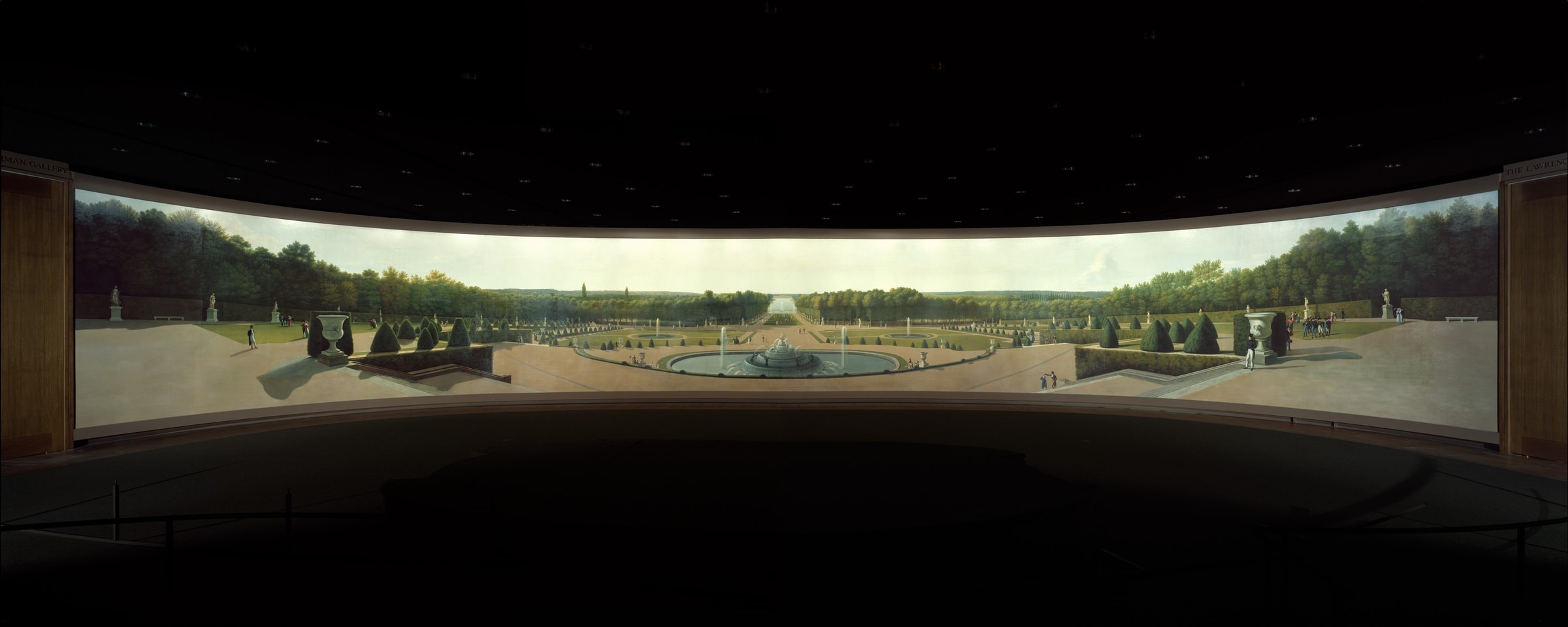
By the Baroque period, individual rulers used art to project status and authority.
- Henri IV Receives the Portrait of Marie de' Medici, from the Marie de' Medici Cycle, by Peter Paul Rubens (1621-1625 ce, oil on canvas) is part of a cycle that glorifies a royal patron. It is a clear case of art functioning as dynastic promotion for an elite audience.
- The Palace at Versailles (Versailles, France, architects Louis Le Vau and Jules Hardouin-Mansart, begun 1669 ce) was built as a setting for royal spectacle and state power, using masonry, stone, gold leaf, marble and bronze sculpture, and gardens to overwhelm visitors.
Academies and the Identity of the Artist
The emergence of academies redefined art training and the identity of the artist. Instead of learning only through a workshop, artists could study in centralized institutions with more structured, theoretical curricula. This shift changed how artists were viewed and how art was produced.
Colonial Americas: Patron, Audience, and Function
Art in the Spanish viceroyalties had its own patrons and audiences, and much of it was religious within a Spanish Catholic context.
- The Virgin of Guadalupe by Miguel González (c. 1698 ce, oil on canvas on wood, inlaid with mother-of-pearl), based on the original Virgin of Guadalupe (Basilica of Guadalupe, Mexico City, 16th century ce), served devotional purposes for colonial audiences.
- Spaniard and Indian Produce a Mestizo, attributed to Juan Rodríguez Juárez (c. 1715 ce, oil on canvas), is a casta painting. As an example of how purpose shapes content, casta works were made to depict and categorize social groups for their intended viewers.
A Secular Audience in Europe
Not all purpose-driven art was religious or royal. The Tête à Tête, from Marriage à la Mode by William Hogarth (c. 1743 ce, oil on canvas), was made for an audience that could read its social commentary. It shows how a work's intended viewers shape its content, here a pointed look at marriage and class.
How to Use This on the AP Art History Exam
Multiple Choice
When a question gives you a work, quickly ask: who was the patron, who was the audience, and what was the function? Many answer choices test whether you can connect a religious setting to devotional or didactic functions, or a palace setting to propaganda and prestige.
Free Response
Use purpose and audience as your context evidence. A strong response names the patron or intended viewer, states the function, and ties both to specific visual choices. For example, link a pilgrimage church's design to the traveling worshippers it served, or link a royal cycle's grandeur to the ruler it was meant to glorify.
If a question asks about continuity and change, purpose can anchor your claim. You can show how religious patronage continued across the period while audiences and functions shifted, such as the rise of secular subjects or colonial devotional images.
Common Trap
Do not stop at describing how a work looks. The skill here is explaining why purpose, patron, or audience produced those visual choices. Always connect the function back to the form and content.
Common Misconceptions
- Misconception: All art in this period was religious.Actually: Much of it was, but patrons also commissioned portraits, royal cycles, social satire, and decorative arts for nonreligious purposes.
- Misconception: Patron and audience are the same thing.Actually: The patron pays for and often shapes the work; the audience is who was meant to see it. They can overlap, but they are not identical.
- Misconception: Avoiding the human figure was only an Islamic concern.Actually: Periodic rejection of figural religious imagery on theological grounds occurred in all three major medieval religions.
- Misconception: Academies always existed the way we picture them.Actually: Academies emerged and changed art training, introducing more structured, theoretical curricula and reshaping the identity of the artist.
- Misconception: Colonial art was just a copy of European art.Actually: It developed within a Spanish Catholic context and served its own patrons and audiences, including devotional images and casta paintings made for colonial society.
- Misconception: Function is just background info.Actually: On the exam, function is evidence. Naming it and tying it to form is exactly the analysis you are being asked to do.
Related AP Art History Guides
- Unit 3 Review: Early Europe and Colonial Americas, 200-1750 CE
- 3.3 Materials, Processes, and Techniques in Early European and Colonial American Art
- 3.5 Theories and Interpretations of Early European and Colonial American Art
- 3.2 Interactions Within and Across Cultures in Early European and Colonial American Art
- 3.6 Unit 3 Required Works
- 3.1 Cultural Contexts of Early European and Colonial American Art
Practice Questions for 3.4
1 of 10
A panel painting shows the Virgin and Child enthroned between two saints, rendered in gold leaf with hierarchical scale and frontal poses. Identify at least two visual similarities with the Theotokos and Child between Saints Theodore and George that justify a Byzantine attribution.
A.
Elaborate pointed-arch framing and flying buttresses typical of Gothic churches.
B.
Narrative horizontal registers that tell continuous stories like manuscript illumination.
C.
Gold ground and hierarchical scale with frontal, iconic poses for devotional viewing.
D.
Tempera paired with oil glazes and linear perspective from the Renaissance.
Vocabulary
The following words are mentioned explicitly in the AP® course framework for this topic.Term | Definition |
|---|---|
academy | A sanctioned institution that trained artists and controlled access to major exhibition venues through juried selection. |
altarpiece | A work of art, typically a panel painting or sculpture, displayed above or behind an altar in a religious setting. |
commemorative | Art created to honor, remember, or celebrate a person, event, or historical moment. |
devotional | Art created to inspire or support religious worship and personal spiritual practice. |
didactic | Art created with the primary purpose of teaching or instructing viewers about religious, moral, or historical subjects. |
elevation | An architectural drawing or view showing the vertical face or exterior design of a building. |
figural imagery | Representations of human or divine figures used prominently in Asian religious art for veneration and spiritual practice. |
ground plan | The architectural layout or floor plan of a building viewed from above, showing the arrangement of spaces and structural elements. |
icon | A religious image or representation, typically of a sacred figure or event, used to facilitate spiritual connection and devotion. |
iconography | The study of symbols, images, and their meanings in artworks, particularly how they convey cultural and religious significance. |
metalwork | The process of shaping and working with metal to create artistic objects in Indigenous American art traditions. |
patronage | The financial support and commissioning of artworks by individuals, institutions, or corporations that influenced the production, content, and display of art. |
propagandistic | Art created to promote or advance a particular ideology, political message, or institutional authority. |
reliquary | A container or shrine designed to hold and display sacred relics, often decorated with precious materials and religious imagery. |
textiles | Woven or fabric art forms that were the most important art medium in West and Central Asia and dominated international trade between Europe and Asia. |
Frequently Asked Questions
How do purpose and audience shape Unit 3 art?
Purpose and audience shape Unit 3 art through patronage, worship, public display, royal propaganda, devotional use, education, and colonial Catholic practice. The work’s setting and viewers affect its form and content.
What is the difference between patron and audience?
The patron pays for or commissions the work, while the audience is who was meant to see or use it. They can overlap, but they are not always the same.
How did churches shape art in this period?
Churches shaped art by commissioning architecture, altarpieces, reliquaries, icons, and devotional images for worship, teaching, ritual, and connection with the divine.
Why are reliquaries important for purpose and audience?
Reliquaries housed sacred contents and attracted devotional attention. Their precious materials and display helped worshippers connect with holy figures or places.
How did academies change art training?
Academies introduced structured, theoretical curricula and helped redefine the identity of the artist beyond workshop training.
How is purpose and audience tested on the AP Art History exam?
AP questions may ask how patron, function, or audience shaped a work. Strong answers name the purpose and connect it to specific form, content, medium, or display evidence.
See Fiveable more often in Google
Mark Fiveable as a preferred source and Google is more likely to show you our guides in Top Stories, with a "preferred" badge in AI Mode and AI Overviews.