2.5 Unit 2 Required Works

🖼AP Art History Unit 2 Review
2.5 Unit 2 Required Works
🖼 AP Art History
TLDR
Unit 2 of AP Art History covers 36 required works from the Ancient Mediterranean (3500 bce to 300 ce), spanning Sumerian, Egyptian, Persian, Greek, Etruscan, and Roman art. For each work you need to know its title, date, location or culture, medium, and how form, function, content, and context connect to the values of the society that made it. This unit is the foundation for tracing artistic traditions and influences across later units.
Why This Matters for the AP Art History Exam
Unit 2 is worth roughly 15% of the course and gives you the largest set of well-documented works so far, which makes it ideal for practicing the core skills the exam tests. Both visual analysis and contextual analysis show up across multiple-choice and free-response questions, and this unit pushes you to explain how a work's context shaped artistic choices about form, style, materials, content, and function.
You will use these works to:
- Identify and attribute pieces by culture, period, or object type.
- Compare works within the Mediterranean and across units.
- Explain how purpose, patron, or audience shaped a work.
- Trace continuity and change within an artistic tradition, especially how Greek, Etruscan, and Roman artists adapted earlier Mediterranean forms.
A common exam challenge is telling visual description apart from contextual description. Read each question carefully to decide whether it wants what you see, what you know, or both.
Key Takeaways
- Ancient Near Eastern and Egyptian art set up conventions like hierarchical scale, registers, and combined profile and three-quarter views that later cultures built on.
- Egyptian art was made for permanence and the afterlife, using a strict canon and clear distinctions between deified pharaohs and lower-class people.
- Greek art moved toward idealized proportions and harmony, organized by style into Archaic, Classical, and Hellenistic periods.
- Etruscan and Roman art is known for portraiture, eclecticism, and borrowing from Greek and Etruscan predecessors, plus Roman technical innovation in concrete architecture.
- Greek, Etruscan, and Roman cultures are grounded in civic ideals, polytheism, and public display.
- For every required work, be ready to connect identifying details to function and cultural context.
How to Use This on the AP Art History Exam
Identification and Attribution
Lock in the basics first: title, date, location or culture, and medium. Many points come from correctly attributing a work to a culture, period, or object type and then justifying that attribution with visual evidence. For example, an archaic smile and rigid frontal stance point to Archaic Greek kouroi, while veristic wrinkles point to a Republican Roman patrician portrait.
Visual Analysis
Describe what you actually see: scale, pose, material, composition, registers, and level of idealization or naturalism. Use specific terms like hierarchical scale, contrapposto, twisted perspective, and clerestory accurately.
Contextual Analysis
Connect the work to belief systems, politics, or physical setting. Egyptian funerary works tie to a focus on rebirth and eternity. Roman public architecture ties to imperial power and conspicuous display. Make sure your context explains an artistic decision, not just background facts.
Comparison
Practice pairing works that share function or form. A grave marker like the Anavysos Kouros can be compared with the Grave stele of Hegeso. A ruler portrait like Augustus of Prima Porta can be set against the Head of a Roman patrician to show different approaches to leadership imagery.
Continuity and Change
Be ready to explain how later artists adapted earlier ideas. The Doryphoros canon influenced later figures like Augustus of Prima Porta, and Roman architects reworked Greek and Etruscan forms with new technology.
Common Misconceptions
- Misconception: A ziggurat is the same as a pyramid.Actually: A ziggurat is not the same as a pyramid. A ziggurat is a stepped platform that raised a temple; Egyptian pyramids are tombs that held and protected a pharaoh's body.
- Misconception: Hellenistic always means Greek-made.Actually: "Hellenistic" does not always mean Greek-made. Many Hellenistic-style works survive as Roman versions, so date and origin can differ from style.
- Misconception: Greek and Roman periods are defined by the same criteria.Actually: Greek periods (Archaic, Classical, Hellenistic) are defined by style, while Roman periods (republican, imperial, late antique) are defined by government and dynasty.
- Misconception: Idealization reflects an artist's skill level.Actually: Idealization is a choice, not a skill level. Egyptian and Greek artists could show naturalism, as in the Seated scribe or Hellenistic works, but often chose idealized forms for status or religious reasons.
- Misconception: Any fact about a work counts as context.Actually: Context is not just any fact about a work. It only counts as contextual analysis when it explains an artistic decision about form, materials, content, or function.
Complete Unit 2 Required Works Reference
| # | Work | Culture / Period | Date | Medium |
|---|---|---|---|---|
| 12 | White Temple and its ziggurat (Uruk) | Sumerian | c. 3500-3000 bce | Mud brick |
| 13 | Palette of King Narmer | Predynastic Egypt | c. 3000-2920 bce | Greywacke |
| 14 | Statues of votive figures (Eshnunna) | Sumerian | c. 2700 bce | Gypsum inlaid with shell and black limestone |
| 15 | Seated scribe (Saqqara) | Old Kingdom, 4th Dynasty | c. 2620-2500 bce | Painted limestone |
| 16 | Standard of Ur | Sumerian | c. 2600-2400 bce | Wood inlaid with shell, lapis lazuli, red limestone |
| 17 | Great Pyramids and Great Sphinx (Giza) | Old Kingdom, 4th Dynasty | c. 2550-2490 bce | Cut limestone |
| 18 | King Menkaura and queen | Old Kingdom, 4th Dynasty | c. 2490-2472 bce | Greywacke |
| 19 | Code of Hammurabi | Susian (Babylon) | c. 1792-1750 bce | Basalt |
| 20 | Temple of Amun-Re and Hypostyle Hall (Karnak) | New Kingdom, 18th-19th Dynasties | Temple c. 1550 bce; hall c. 1250 bce | Cut sandstone and mud brick |
| 21 | Mortuary temple of Hatshepsut | New Kingdom, 18th Dynasty | c. 1473-1458 bce | Sandstone and red granite |
| 22 | Akhenaten, Nefertiti, and three daughters | New Kingdom (Amarna), 18th Dynasty | c. 1353-1335 bce | Limestone |
| 23 | Tutankhamun's tomb, innermost coffin | New Kingdom, 18th Dynasty | c. 1323 bce | Gold with inlay of enamel and semiprecious stones |
| 24 | Last judgment of Hunefer (Book of the Dead) | New Kingdom, 19th Dynasty | c. 1275 bce | Painted papyrus scroll |
| 25 | Lamassu (citadel of Sargon II) | Neo-Assyrian | c. 720-705 bce | Alabaster |
| 26 | Athenian agora | Archaic through Hellenistic Greek | 600 bce-150 ce | Plan |
| 27 | Anavysos Kouros | Archaic Greek | c. 530 bce | Marble with remnants of paint |
| 28 | Peplos Kore (Acropolis) | Archaic Greek | c. 530 bce | Marble, painted details |
| 29 | Sarcophagus of the Spouses | Etruscan | c. 520 bce | Terra cotta |
| 30 | Audience Hall (apadana) of Darius and Xerxes | Persian | c. 520-465 bce | Limestone |
| 31 | Temple of Minerva and sculpture of Apollo (Veii) | Etruscan; attributed to sculptor Vulca | c. 510-500 bce | Wood, mud brick, or tufa; terra cotta sculpture |
| 32 | Tomb of the Triclinium (Tarquinia) | Etruscan | c. 480-470 bce | Tufa and fresco |
| 33 | Niobides Krater | Classical Greek (Niobid Painter) | c. 460-450 bce | Clay, red-figure technique |
| 34 | Doryphoros (Spear Bearer) | Polykleitos | Original 450-440 bce | Roman marble copy of Greek bronze |
| 35 | Acropolis | Iktinos and Kallikrates | c. 447-410 bce | Marble |
| 36 | Grave stele of Hegeso | Attributed to Kallimachos | c. 410 bce | Marble and paint |
| 37 | Winged Victory of Samothrace | Hellenistic Greek | c. 190 bce | Marble |
| 38 | Great Altar of Zeus and Athena at Pergamon | Hellenistic Greek | c. 175 bce | Marble |
| 39 | House of the Vettii (Pompeii) | Imperial Roman | c. 2nd century bce; rebuilt 62-79 ce | Cut stone and fresco |
| 40 | Alexander Mosaic (House of the Faun) | Republican Roman | c. 100 bce | Mosaic |
| 41 | Seated boxer | Hellenistic Greek | c. 100 bce | Bronze |
| 42 | Head of a Roman patrician | Republican Roman | c. 75-50 bce | Marble |
| 43 | Augustus of Prima Porta | Imperial Roman | Early 1st century ce | Marble |
| 44 | Colosseum (Flavian Amphitheater) | Imperial Roman | 70-80 ce | Stone and concrete |
| 45 | Forum of Trajan | Apollodorus of Damascus | Forum and markets: 106-112 ce; column completed 113 ce | Brick and concrete; marble column |
| 46 | Pantheon | Imperial Roman | 118-125 ce | Concrete with stone facing |
| 47 | Ludovisi Battle Sarcophagus | Late Imperial Roman | c. 250 ce | Marble |
Ancient Near Eastern Works (Sumerian, Babylonian, Assyrian, Persian)
Art of the ancient Near East centers on religion, kingship, and the power of rulers who often take on divine attributes.
White Temple and its ziggurat (Sumerian, Uruk)

- Form: Mud brick; a stepped platform with sloping sides and vertical bands.
- Function: A religious structure. The raised temple may have been meant to bring worshippers closer to the deity. Access was limited, likely to priests and high-status people.
- Content: A ziggurat supporting a temple with a cella, the inner chamber for worship.
- Context: Located at Uruk and one of the oldest ziggurats. Sumerian cities were associated with protective deities; Uruk was linked to the sky god Anu.
Statues of votive figures (Sumerian, Eshnunna)
- Form: Gypsum inlaid with shell and black limestone; somewhat stylized figures.
- Function: Stand-in worshippers. A person placed a statue in the temple to pray on their behalf in their absence.
- Content: Figures with hands clasped in prayer and large, wide-open eyes that may suggest constant attentiveness. Hierarchical scale appears, with some figures larger than others.
- Context: Sumerian, around 2700 bce. Many were found buried beneath a temple floor.
Standard of Ur (Sumerian)

- Form: Wood inlaid with shell, lapis lazuli, and red limestone.
- Function: Narrative imagery of royal accomplishments. Because it came from the Royal Tombs at Ur, it may also be funerary.
- Content: Organized in registers with hierarchical scale; the king is shown slightly larger. Figures appear in twisted perspective. One side shows war (soldiers and captives), the other a peaceful feast with a lyre player.
- Context: The imported materials reflect a wide Sumerian trade network.
Code of Hammurabi (Susian, Babylon)

- Form: Basalt stele.
- Function: Displays Hammurabi's authority and presents a written law code.
- Content: The sun god Shamash hands Hammurabi symbols of authority. Hierarchical cues emphasize Shamash, who sits yet still appears larger. Laws are inscribed in cuneiform.
- Context: Babylon. The image presents Hammurabi's laws as blessed by the gods, following the tradition of rulers shown interacting with deities.
Lamassu (Neo-Assyrian, citadel of Sargon II)
- Form: Alabaster.
- Function: Guardian figures placed at city gates to protect and intimidate, while signaling the king's power.
- Content: A large composite figure that is part human, part bull or lion, with wings, carved so it reads correctly from front and side.
- Context: From the citadel of Sargon II, c. 720-705 bce, reflecting the militaristic Assyrian state.
Audience Hall (apadana) of Darius and Xerxes (Persian, Persepolis)
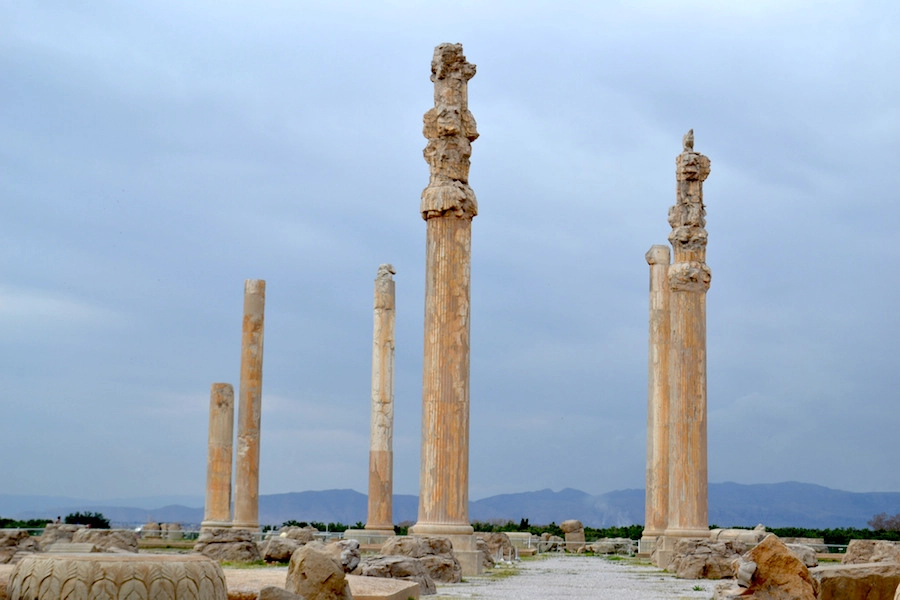
- Form: Limestone.
- Function: A grand audience hall where the Persian king received visitors and tribute, projecting imperial power.
- Content: A large columned hall; relief sculpture associated with the complex shows processions of subjects.
- Context: Persepolis, c. 520-465 bce, built under Darius and Xerxes.
Egyptian Works
Egyptian art was made for permanence and the afterlife, with a strict canon and clear visual distinctions between the deified pharaoh and ordinary people.
Palette of King Narmer (Predynastic Egypt)
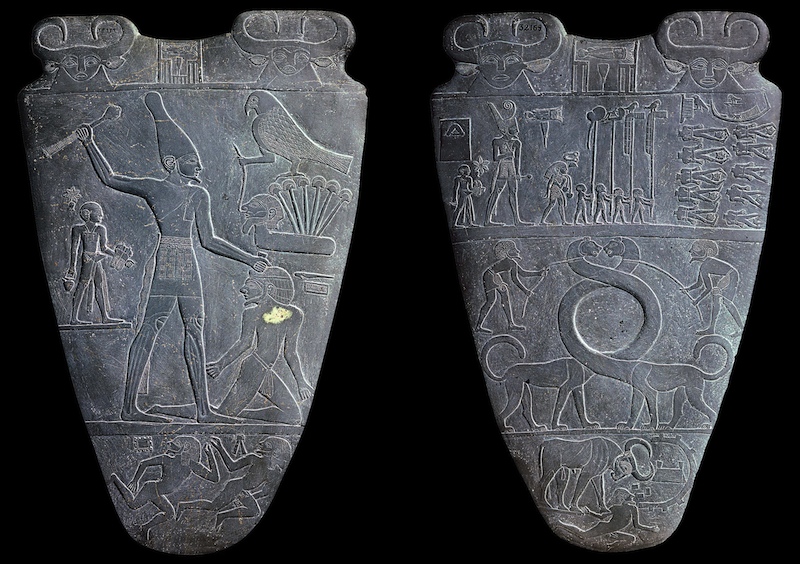
- Form: Greywacke.
- Function: Commemorates Narmer uniting Upper and Lower Egypt (narrative art) and also served as a ceremonial palette.
- Content: Uses hierarchical scale and registers. A bovine goddess, often identified as Hathor, appears at the top. Narmer wears the white crown of Upper Egypt on one side and the red crown of Lower Egypt on the other. He raises his arm to strike an enemy, and Horus the falcon appears with papyrus. A bull tramples an enemy on the lower register.
- Context: Marks the unification of Egypt.
Seated scribe (Old Kingdom, Saqqara)

- Form: Painted limestone with inlaid eyes.
- Function: A funerary ka statue meant to house the soul. It honors the scribe's role in writing and recording.
- Content: A more naturalistic, non-idealized seated figure with a papyrus scroll and writing posture.
- Context: From Saqqara, Egypt. Portrayal varies with a figure's rank, so a scribe is shown differently than a pharaoh.
Great Pyramids and Great Sphinx (Old Kingdom, Giza)
- Form: Cut limestone.
- Function: The pyramids are monumental tombs that protect and preserve the pharaohs' bodies. The Sphinx acts as a guardian and symbol of royal power.
- Content: Massive pyramid tombs with interior chambers; the Sphinx is a composite figure with a human head and a lion's body.
- Context: Connected to sun worship and reverence for the sun god, reflecting the pharaoh's status as a god-king.
King Menkaura and queen (Old Kingdom)
- Form: Greywacke.
- Function: A funerary ka statue meant to preserve the king and his queen.
- Content: Two idealized figures in royal attire, standing close together. The forward stride and rigid pose follow Egyptian convention.
- Context: The hard greywacke stone suits the Egyptian goal of permanence.
Temple of Amun-Re and Hypostyle Hall (New Kingdom, Karnak)
- Form: Cut sandstone and mud brick.
- Function: A major religious center dedicated to Amun-Re. Access to inner chambers was restricted by status.
- Content: A hypostyle hall packed with tall columns resembling papyrus plants.
- Context: At Karnak, built and expanded over many generations, with pharaohs adding to it over time.
Mortuary temple of Hatshepsut (New Kingdom)

- Form: Sandstone partly carved into a rock cliff, with red granite.
- Function: A mortuary temple that commemorates Hatshepsut, a female pharaoh.
- Content: Terraced architecture set against a cliff, decorated with relief and statues showing Hatshepsut in traditional pharaonic attire to validate her rule.
- Context: A notable example of a powerful female pharaoh presenting herself using established royal conventions.
Akhenaten, Nefertiti, and three daughters (New Kingdom, Amarna)
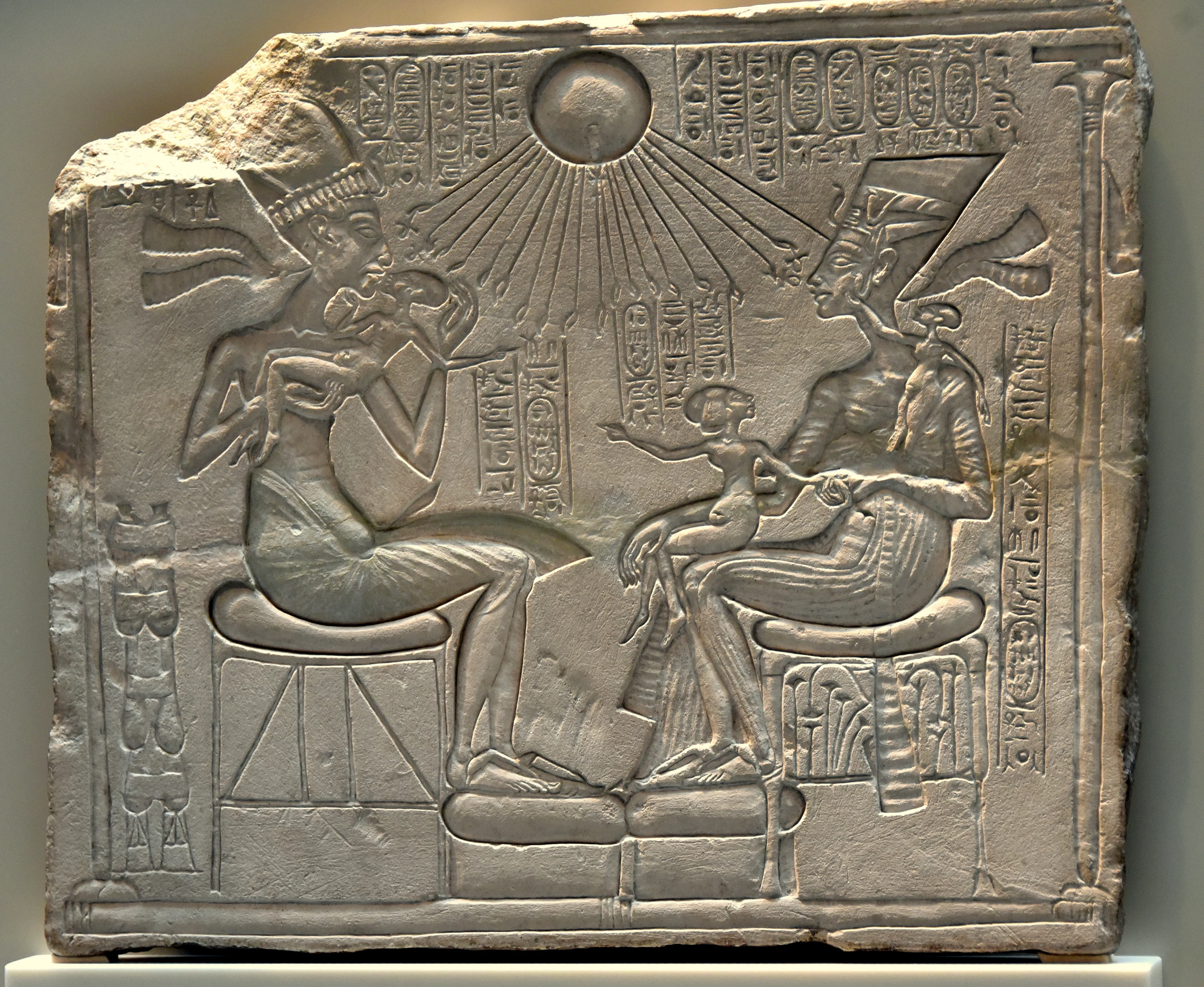
- Form: Limestone, carved in sunken (incised) relief.
- Function: Found in a domestic setting, so it may have served as a household image; it also reflects the new Amarna style.
- Content: Akhenaten and Nefertiti sit with their daughters as the sun disk Aten extends rays ending in hands, some holding ankhs (symbols of life). The figures show the elongated, softer Amarna body style.
- Context: During the Amarna period, Akhenaten shifted worship toward the sun god Aten, breaking from earlier convention.
Tutankhamun's tomb, innermost coffin (New Kingdom)
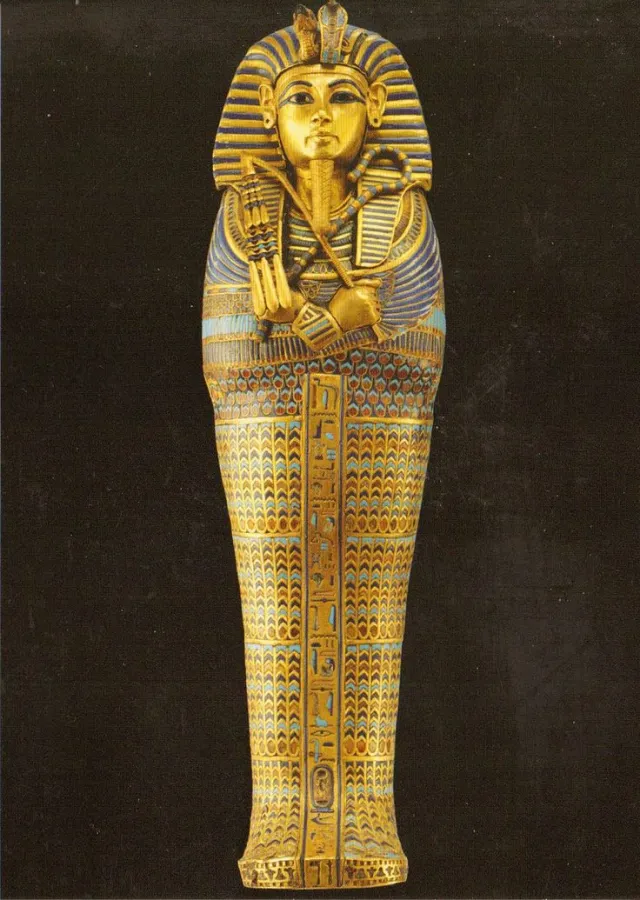
- Form: Gold with inlay of enamel and semiprecious stones.
- Function: The innermost coffin for King Tutankhamun's body.
- Content: An idealized image of the king in royal attire holding the crook and flail crossed on his chest, symbols of rule.
- Context: Reflects elaborate Egyptian funerary practices meant to ensure preservation and rebirth in the afterlife.
Last judgment of Hunefer (New Kingdom, Book of the Dead)
- Form: Painted papyrus scroll.
- Function: A funerary text guiding Hunefer through judgment toward the afterlife.
- Content: Registers with figures in twisted perspective. Anubis weighs Hunefer's heart against a feather, Ammit waits to devour an unworthy heart, Thoth records the result, and Osiris presides over the judgment.
- Context: The Book of the Dead was a collection of spells meant to help the deceased reach the afterlife.
Greek Works
Greek art is organized by style into Archaic, Classical, and Hellenistic periods and emphasizes idealized proportion, harmony, and order.
Athenian agora (Archaic through Hellenistic)

- Form: Plan; buildings in stone and marble.
- Function: A civic center for government, commerce, and public life.
- Content: A mix of structures including stoas (columned walkways), a tholos, council meeting spaces, temples, and the Panathenaic Way.
- Context: In Athens, used from roughly 600 bce to 150 ce, reflecting Greek civic ideals.
Anavysos Kouros (Archaic)
- Form: Marble with remnants of paint.
- Function: A grave marker.
- Content: A nude, idealized standing kouros (young man) with a rigid frontal stance and the archaic smile.
- Context: Archaic Greek; reflects an interest in the idealized human form.
Peplos Kore (Archaic, Acropolis)

- Form: Marble with painted details.
- Function: Possibly a votive or commemorative figure connected to religious use.
- Content: An idealized kore (young woman) wearing a peplos, with the archaic smile and one arm originally extended.
- Context: From the Acropolis, a sacred elevated site honoring the gods.
Niobides Krater (Classical, Niobid Painter)
- Form: Clay, red-figure technique with white highlights.
- Function: A krater (vessel for mixing wine and water) decorated with mythological narrative.
- Content: Figures placed at different levels suggest a sense of space, a shift from earlier flat ground lines.
- Context: Classical Greek vase painting attributed to the Niobid Painter.
Doryphoros (Polykleitos)
- Form: Roman marble copy of a Greek bronze original.
- Function: A statue demonstrating Polykleitos's canon of ideal proportions.
- Content: A nude male figure in contrapposto, with balanced weight shift expressing harmony and order.
- Context: Embodies Classical Greek ideals; this canon influenced later figures across the Mediterranean.
Acropolis (Iktinos and Kallikrates)
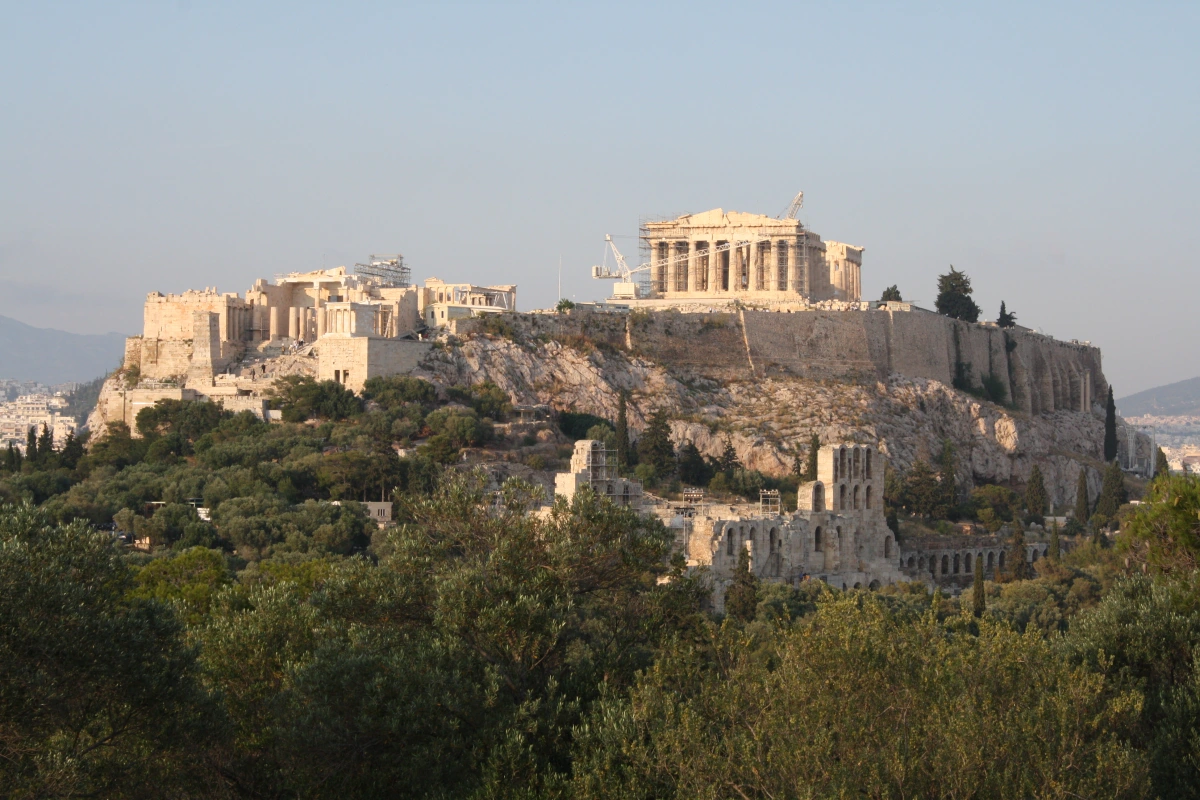
- Form: Marble.
- Function: A sacred precinct in Athens with temples honoring the gods, especially Athena.
- Content: Includes major temple architecture using refined proportions and order.
- Context: Built c. 447-410 bce, reflecting Athenian civic and religious pride.
Grave stele of Hegeso (attributed to Kallimachos)

- Form: Marble and paint.
- Function: A grave marker commemorating a woman named Hegeso.
- Content: A calm domestic scene with Hegeso and a servant, framed by an architectural border.
- Context: Classical Greek funerary art; pairs well with the Anavysos Kouros as a comparison of grave markers.
Winged Victory of Samothrace (Hellenistic)

- Form: Marble.
- Function: A commemorative monument, likely celebrating a naval victory.
- Content: The goddess Nike alighting on a ship's prow, with dramatic movement and wind-blown drapery.
- Context: Hellenistic Greek, c. 190 bce, showing the period's drama and energy.
Great Altar of Zeus and Athena at Pergamon (Hellenistic)
- Form: Marble architecture and sculpture.
- Function: A monumental altar honoring Zeus and Athena.
- Content: A large frieze with high-relief figures in intense, dynamic battle (the gods versus giants).
- Context: Hellenistic Greek in Asia Minor, c. 175 bce, known for emotional drama.
Seated boxer (Hellenistic)
- Form: Bronze.
- Function: A sculpture of an athlete shown after combat.
- Content: A naturalistic, weary boxer with cuts and swelling, an example of Hellenistic realism and emotion.
- Context: Hellenistic Greek, c. 100 bce; contrasts with the idealized Classical body.
Etruscan Works
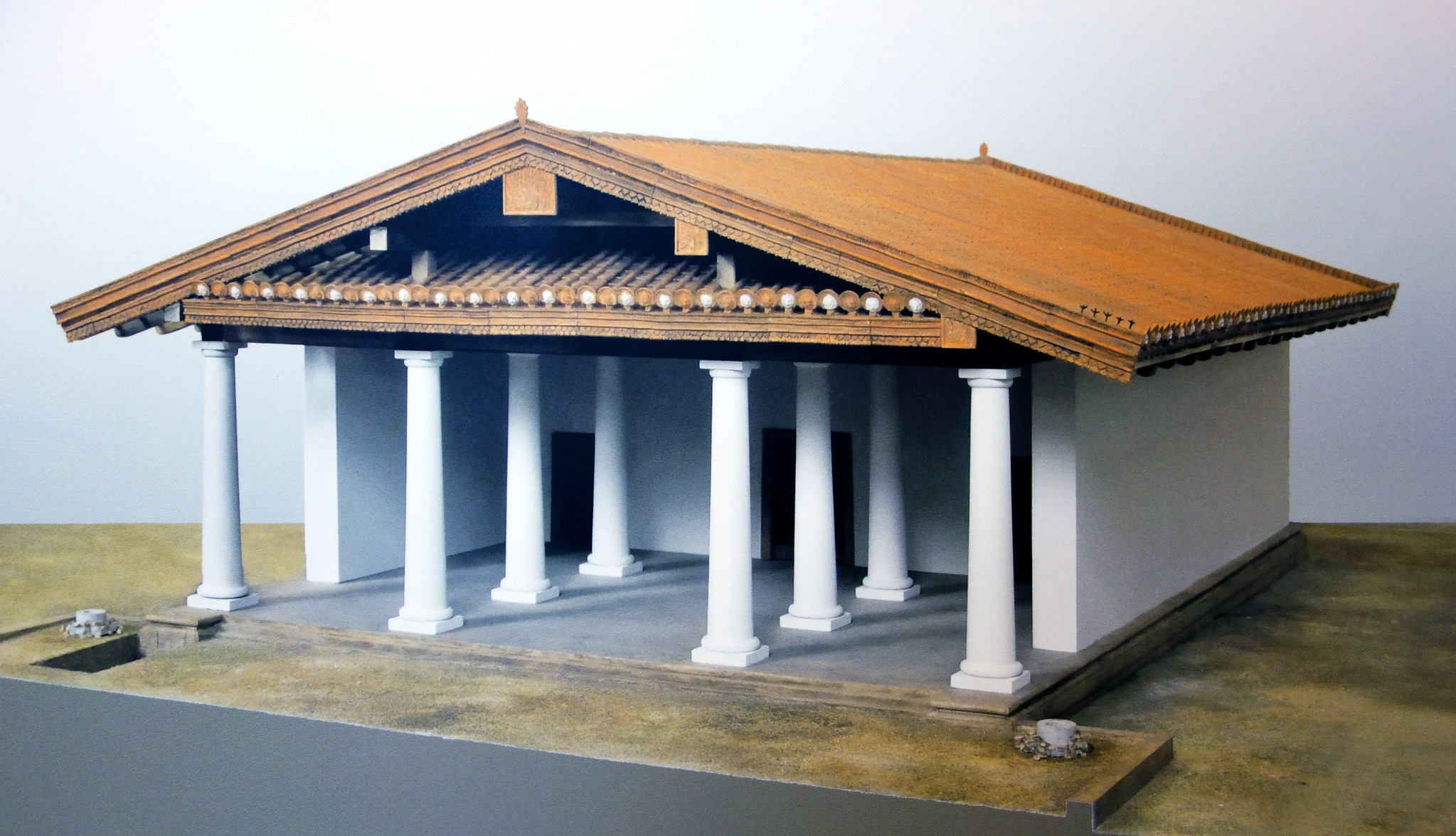

Etruscan art is treated as a single cultural unit and is known for terra cotta sculpture and tomb art.
Sarcophagus of the Spouses (Etruscan)
- Form: Terra cotta.
- Function: A sarcophagus holding the remains of a married couple.
- Content: A reclining husband and wife shown together as if at a banquet, with lively gestures and archaic-style faces.
- Context: Etruscan, c. 520 bce, reflecting Etruscan funerary customs and the prominence of couples.
Temple of Minerva and sculpture of Apollo (Vulca, Veii)
- Form: Original temple of wood, mud brick, or tufa; terra cotta sculpture.
- Function: A temple with roofline sculpture, including the figure of Apollo.
- Content: Terra cotta statues placed on the roof rather than in pediments, with archaic-style movement and smiles.
- Context: Attributed to sculptor Vulca; shows Etruscan building materials and sculpture placement.
Tomb of the Triclinium (Etruscan, Tarquinia)
- Form: Tufa with fresco.
- Function: A tomb decorated with painted scenes.
- Content: Frescoes of banqueting, dancing, and music celebrating life.
- Context: Etruscan, c. 480-470 bce; known mainly through archaeological evidence.
Roman Works
Roman art borrows from Greek and Etruscan predecessors and is known for portraiture, public architecture, and technical innovation in concrete.
House of the Vettii (Imperial Roman, Pompeii)
- Form: Cut stone and fresco.
- Function: A wealthy private home that displayed the owners' status.
- Content: Rooms arranged around open courts, decorated with detailed wall frescoes.
- Context: In Pompeii, rebuilt c. 62-79 ce and preserved by the eruption of Vesuvius.
Alexander Mosaic (Republican Roman, House of the Faun)
- Form: Mosaic of small tiles (tesserae).
- Function: A floor mosaic depicting a historic battle.
- Content: Alexander the Great charging against the Persian king Darius III, with foreshortening and a sense of chaos and depth.
- Context: From the House of the Faun in Pompeii; based on an earlier Greek painting, showing Greek influence on Roman art.
Head of a Roman patrician (Republican Roman)
- Form: Marble.
- Function: A portrait honoring an older elite Roman man.
- Content: A highly veristic face with wrinkles and sagging skin, emphasizing age, experience, and dignity.
- Context: Republican Roman values prized age and public service, so the portrait avoids idealization.
Augustus of Prima Porta (Imperial Roman)
- Form: Marble.
- Function: A propaganda portrait presenting Augustus as an ideal leader.
- Content: Augustus in an idealized, youthful body using a Polykleitan stance, with a decorated breastplate and a small Cupid figure.
- Context: Adapts the Doryphoros canon to imperial messaging, blending Greek idealism with Roman political goals.
Colosseum (Imperial Roman)
- Form: Stone and concrete.
- Function: A large amphitheater for public games and spectacles.
- Content: A tiered exterior with stacked arches and engaged columns of different orders.
- Context: Built 70-80 ce; reflects Roman investment in public structures and concrete engineering.
Forum of Trajan (Apollodorus of Damascus)
- Form: Brick and concrete architecture; marble column.
- Function: A monumental public forum and market complex celebrating Trajan's achievements.
- Content: Open public spaces, markets, and the Column of Trajan with a spiraling relief narrative of military campaigns.
- Context: Designed by Apollodorus of Damascus; the forum and markets date 106-112 ce, with the column completed 113 ce.
Pantheon (Imperial Roman)
- Form: Concrete with stone facing.
- Function: A temple dedicated to the Roman gods.
- Content: A traditional columned porch leading to a vast domed rotunda with a central oculus.
- Context: Built 118-125 ce; a landmark of Roman concrete engineering and interior space.
Ludovisi Battle Sarcophagus (Late Imperial Roman)
- Form: Marble.
- Function: A sarcophagus carved with a chaotic battle scene.
- Content: A dense, deeply carved tangle of Roman soldiers and defeated enemies with strong emotion and movement.
- Context: Late Imperial Roman, c. 250 ce, reflecting a period of conflict and shifting style.
Related AP Art History Guides
Frequently Asked Questions
What is on AP Art History Unit 2?
AP Art History Unit 2 covers Ancient Mediterranean art from about 3500 BCE to 300 CE. It includes required works from Sumerian, Egyptian, Babylonian, Assyrian, Persian, Greek, Etruscan, and Roman cultures.
How many required works are in AP Art History Unit 2?
Unit 2 includes 36 required works, numbered 12 through 47 in the AP Art History required works list. You should know each work’s title, culture or location, date, medium, and major form-function-content-context connections.
What are the biggest Unit 2 AP Art History themes?
The biggest themes are religion, rulership, burial and the afterlife, civic identity, idealized bodies, realism, public display, and cultural borrowing across the Ancient Mediterranean.
How should I study the Unit 2 required works?
Start by memorizing identifiers, then group works by culture and function. Practice explaining why visual choices such as scale, pose, material, and setting connect to the work’s purpose and historical context.
Which Unit 2 works are useful for comparison?
Useful comparisons include Anavysos Kouros and Grave stele of Hegeso for Greek funerary art, Doryphoros and Augustus of Prima Porta for idealized bodies, and ziggurats versus Egyptian pyramids for religious architecture and function.
How is AP Art History Unit 2 tested?
Unit 2 appears in image-based multiple-choice questions and free-response tasks that ask for visual analysis, contextual analysis, attribution, comparison, and continuity or change across cultures.
See Fiveable more often in Google
Mark Fiveable as a preferred source and Google is more likely to show you our guides in Top Stories, with a "preferred" badge in AI Mode and AI Overviews.