AP Art History Unit 3 Cheatsheet: Early Europe and Colonial Americas, 200-1750 CE

AP Art History Unit 3 Cheatsheet: Early Europe and Colonial Americas, 200-1750 CE

Start with the first 2 sections of the Unit 3 one-page cheatsheet below. The full sheet is a PDF you can print.

Medieval Art Traditions & Characteristics

Eight Major Medieval Traditions (c. 300–1400 CE)

  • Late Antique
  • Early Christian
  • Byzantine
  • Islamic
  • Migratory
  • Carolingian
  • Romanesque
  • Gothic

Shared Functions & Contexts

  • Worship (Jewish, Christian, Islamic)
  • Elite/court culture
  • Theological & literary study
  • Islamic: scientific & mathematical theory

Visual Characteristics

  • Stylistic variety across regions
  • Naturalism used selectively rather than avoided: much early medieval/Byzantine art favors flat, hierarchic, symbolic figures (e.g., Justinian mosaics, Lindisfarne Gospels), while Gothic and proto-Renaissance works revive naturalism (Reims Annunciation/Visitation, Röttgen Pietà, Giotto's Arena Chapel)
  • Religious or courtly subject matter
  • Incorporation of text in compositions
  • Figural and aniconic (avoiding figural imagery) works
Medieval Cultural Exchanges

Continuities & Shared Forms

Medieval artists drew from coexisting traditions through:

  • Early Medieval & Byzantine: Roman art; migratory motifs from East Europe, West Asia, Scandinavia
  • High Medieval: Roman, Islamic, migratory influences
  • European Islamic: Roman, migratory, Byzantine, West Asian sources

Facilitation Methods

  • Trade networks
  • Conquest & political contact

Regional Variation

Before the late Middle Ages, many coexisting regional styles made period-wide generalizations difficult. Isolated revivals of naturalism and classicism occurred, sometimes linked to Roman Christian emperors and church authority.

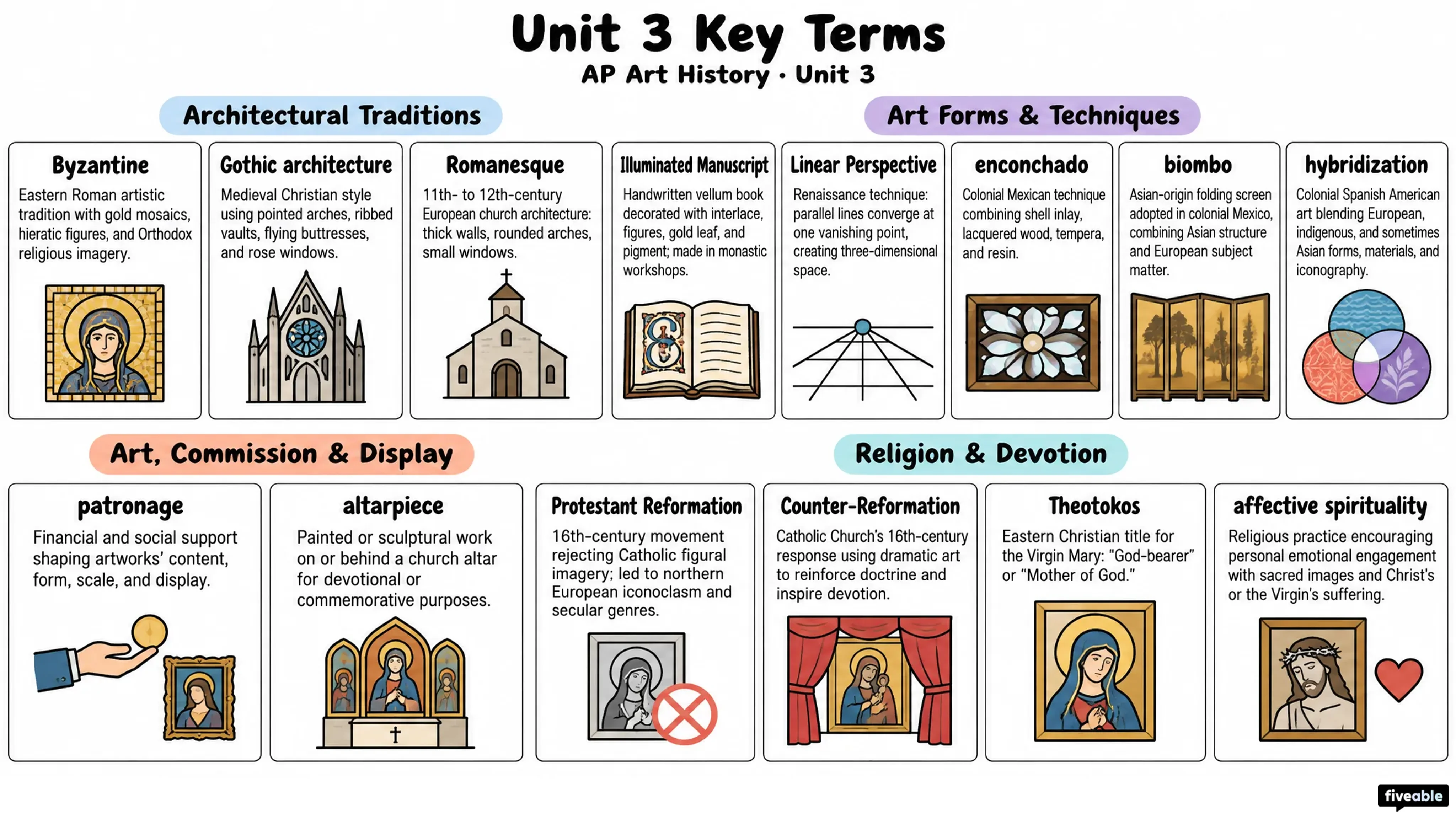
The rest of the Unit 3 sheet

5 more sections are on the one-page PDF:

  • Age of Exploration & Global Networks

  • 15th–17th Century European Developments

  • Patronage, Function & Display

  • Materials, Techniques & Naturalism

  • Interpreting Medieval & Early Modern Art

Made by Fiveable

Text-Based Cheatsheet

Unit 3: Early Europe and Colonial Americas, 200-1750 CE on one page, aligned to the 2026-2027 course. Made and checked by the Fiveable Content Team.

Or get the whole course

Made by you

Visual Cheatsheets

Pick a Unit 3 topic and a format: flowchart, comparison chart, vocab sheet, Cornell notes and more. Ready in about a minute.

Printable PDF · from the Fiveable shop

AP Art History Unit 3 Cheatsheet

1 page · Early Europe and Colonial Americas, 200-1750 CE · PDF

Visual Cheatsheets

One topic, the format you pick, ready in about a minute

Format

Topic

Takes 30–60 seconds

Preview: Standard

Unit 3: Early European and Colonial American Art, 200–1750 CE, topic by topic

Each topic has a full study guide. See the whole unit.