2.2 Interactions Across Cultures in Ancient Mediterranean Art

🖼AP Art History Unit 2 Review
2.2 Interactions Across Cultures in Ancient Mediterranean Art
🖼 AP Art History
This topic is about how Greek, Etruscan, and Roman artists borrowed and reworked ideas from earlier Mediterranean cultures, especially the ancient Near East and Egypt. You trace continuity and change across time by comparing works like the Anavysos Kouros, Doryphoros, Augustus of Prima Porta, and the Colosseum, showing how cultures shared and adapted forms, styles, and techniques.
How Did Ancient Mediterranean Cultures Influence Each Other?
Ancient Mediterranean cultures influenced each other through trade, conquest, collecting, copying, and adaptation of forms, styles, materials, and architectural ideas. Greek artists adapted earlier Egyptian and Near Eastern conventions, while Etruscan and Roman artists later adapted Greek forms for their own civic, religious, and political purposes.
For AP Art History, focus on continuity and change. Identify what is borrowed, then explain how the later culture changes it to fit a new function or audience.
Why This Matters for the AP Art History Exam
The Ancient Mediterranean unit is about 15 percent of the exam, and this topic builds a skill you will use across the whole course: explaining how contact between cultures shapes art. The big idea is the active exchange of styles and ideas around the Mediterranean and the way those ideas carried into the classical world.
On the exam you will be asked to explain how a work shows continuity with an artistic tradition or how it changes or breaks from it. That means you need to connect form, materials, and content to the cultures that influenced a work. Comparison and attribution questions reward you for spotting borrowed conventions, like Egyptian-style proportions in early Greek sculpture or Greek forms reused in Roman art.
Key Takeaways
- Greek, Etruscan, and Roman artists were influenced by earlier Mediterranean cultures, especially the ancient Near East and dynastic Egypt.
- Etruscan and Roman artists valued eclecticism and historicism, meaning they collected and creatively adapted Greek objects and forms to fit their own tastes.
- Many works called "Hellenistic" are actually Roman copies or versions, so Greek and Roman traditions are often studied together.
- Use the four anchor works for this topic to practice continuity and change: Anavysos Kouros, Doryphoros, Augustus of Prima Porta, and the Colosseum.
- When you analyze, separate what you see (visual analysis) from why it was made the way it was (contextual analysis). Exam questions often ask for one or both.
The Four Anchor Works
Anavysos Kouros

Anavysos Kouros. Archaic Greek. c. 530 bce. Marble with remnants of paint.
- A kouros is a freestanding statue of a nude young male, common in Archaic Greek art. These figures often served as grave markers or dedications.
- The rigid frontal pose, with one foot forward and arms held at the sides, echoes conventions used in earlier Egyptian standing figures. This is a clear example of one culture adapting another's formula.
- Compared to stiffer earlier kouroi, the Anavysos Kouros shows more naturalistic, rounded musculature, so it marks a step toward greater realism within the Greek tradition.
- The Archaic smile is a typical convention of this period, but how strongly it reads here is debated, so describe the face as Archaic in style rather than assuming a single expression.
- Continuity and change tip: the Egyptian-influenced pose is the continuity; the growing naturalism is the change.
Doryphoros (Spear Bearer)
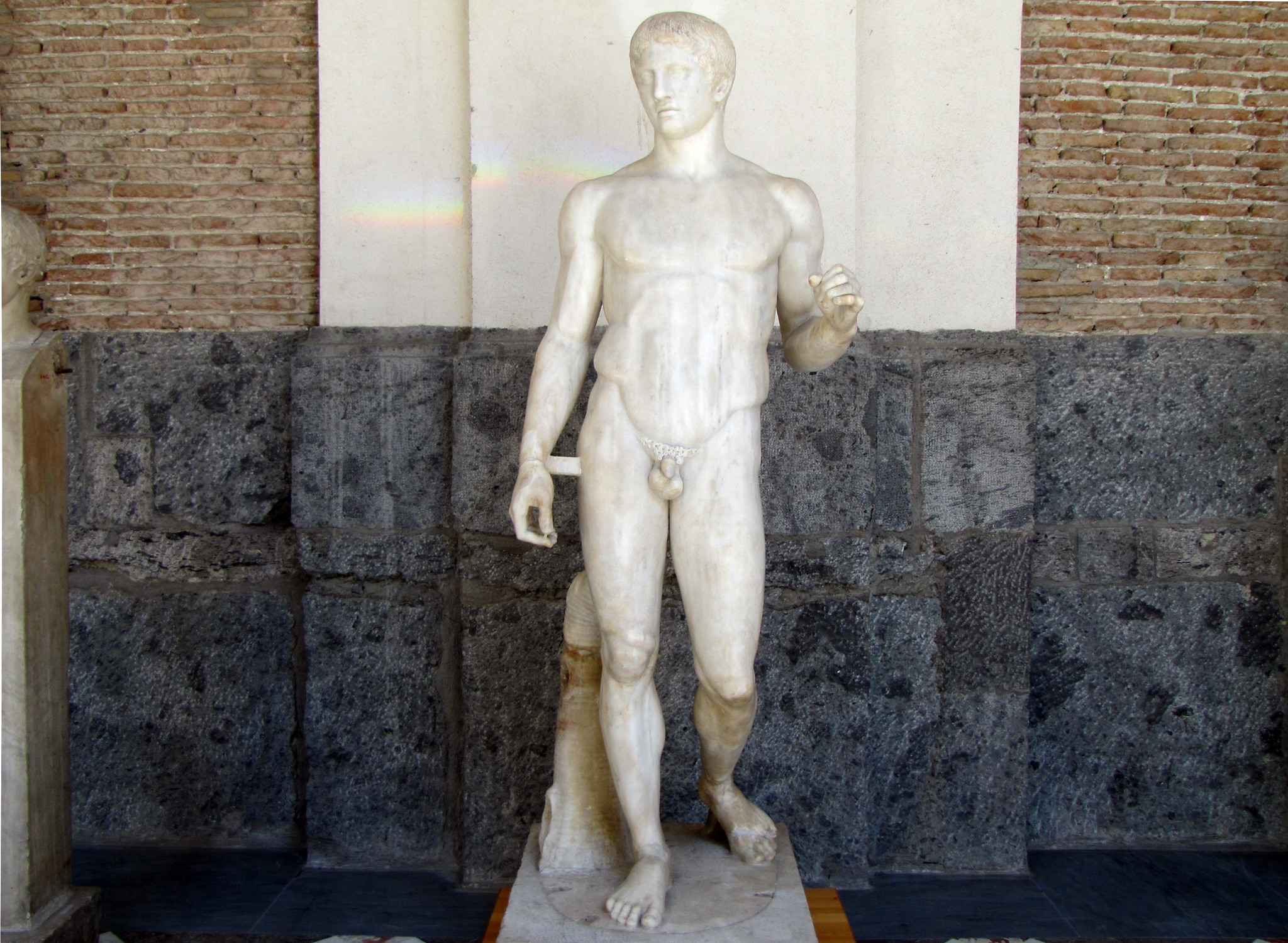
Doryphoros (Spear Bearer). Polykleitos. Original 450-440 bce. Roman copy (marble) of Greek original (bronze).
- This is a marble Roman copy of a lost Greek bronze by Polykleitos. The copy itself is evidence of how Romans collected and reproduced Greek art.
- The figure stands in contrapposto, with weight shifted onto one leg so the hips and shoulders tilt in opposite directions. This creates a relaxed, lifelike balance.
- Polykleitos designed the work as a demonstration of his Canon, a system of ideal mathematical proportions for the human body.
- Compared to the Anavysos Kouros, the Doryphoros shows how Greek sculpture moved from the stiff Archaic pose toward Classical naturalism and idealized proportion.
- The fact that this work survives mainly through Roman marble copies is a key point about how Greek and Roman traditions overlap.
Augustus of Prima Porta
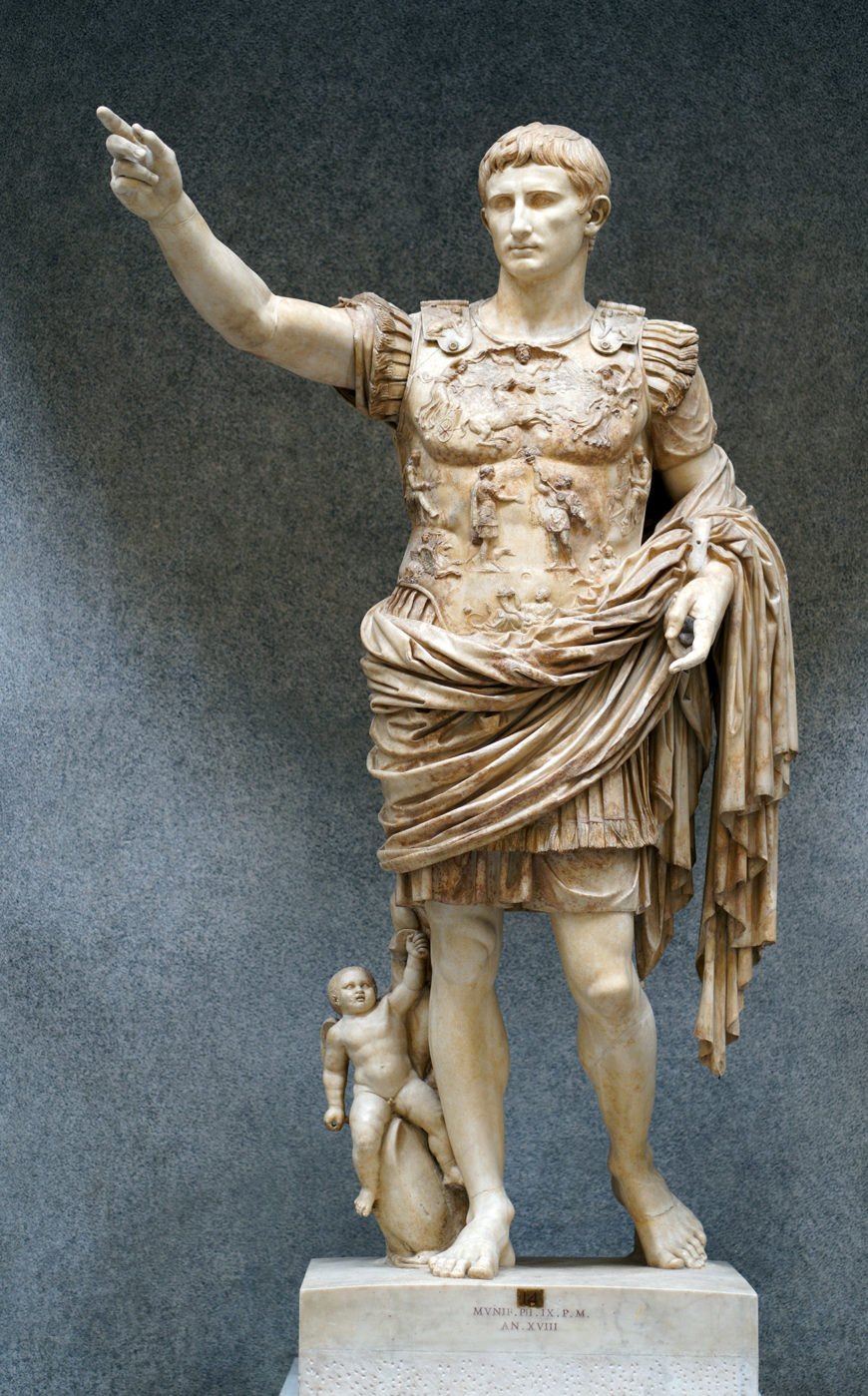
Augustus of Prima Porta. Imperial Roman. Early first century ce. Marble.
- A marble statue of the first Roman emperor, Augustus, shown as an idealized leader rather than an aged man.
- The pose and proportions borrow directly from Greek Classical sculpture, especially the balanced stance seen in the Doryphoros. This is Roman art adapting an earlier Greek model.
- The breastplate, or cuirass, carries relief decoration that is often interpreted as a sign of Roman power and a peaceful, divinely favored reign. Treat that meaning as an interpretation, not a fixed fact.
- The small Cupid figure at his leg is often read as a reference to the family's claimed descent from the goddess Venus.
- This work is strong evidence for how Romans used Greek artistic forms for imperial messaging.
Colosseum (Flavian Amphitheater)

Colosseum (Flavian Amphitheater). Rome, Italy. Imperial Roman. 70-80 ce. Stone and concrete.
- A large oval amphitheater built under the Flavian emperors and used for public spectacles like gladiatorial contests and staged events.
- It is built largely with Roman concrete, a technical innovation that allowed huge vaulted, multi-level structures.
- The exterior stacks the Greek architectural orders on its levels, moving from Doric-style at the bottom to Ionic and then Corinthian above. This is a clear case of Romans borrowing Greek design elements and reworking them.
- Continuity and change tip: the Greek orders are the borrowed tradition; the concrete engineering and massive arcaded form are the Roman innovation.
How to Use This on the AP Art History Exam
Comparison
Pair works to show influence. The Anavysos Kouros next to an Egyptian standing figure shows borrowed pose conventions. The Doryphoros next to the Augustus of Prima Porta shows Greek proportions reused for Roman purposes. Always name a specific, relevant point of comparison, not just "they are both statues."
Continuity and Change
When a question asks how a work fits or breaks from a tradition, state both sides. Example: the Colosseum continues the Greek orders but changes the scale and structure through concrete. Back each claim with a specific visual detail.
Visual vs. Contextual Analysis
Read the question carefully. Visual analysis describes what you see, like contrapposto or stacked orders. Contextual analysis explains why, like imperial messaging or cross-cultural borrowing. Many questions want both, so label your evidence clearly.
Common Trap
Do not claim an exact symbolic meaning as settled fact when it is debated. For the Augustus cuirass, use hedged wording like "often interpreted as" so you stay accurate.
Common Misconceptions
- Misconception: A Roman copy is fake or low quality.Actually: "Roman copy" does not mean fake or low quality. Roman marble copies of Greek bronzes are often the main evidence for lost Greek originals.
- Misconception: The Anavysos Kouros is simply an Egyptian statue.Actually: The Anavysos Kouros is not simply "an Egyptian statue." It uses an Egyptian-influenced pose but belongs to the Greek tradition and shows growing Greek naturalism.
- Misconception: Borrowing is copying without thought.Actually: Borrowing is not copying without thought. Etruscan and Roman artists practiced eclecticism and historicism, meaning they deliberately selected and adapted earlier forms to suit their own taste.
- Misconception: Contrapposto is just standing.Actually: Contrapposto is not just "standing." It is a specific weight shift that tilts the hips and shoulders, and it signals a move toward naturalism.
- Misconception: Hellenistic always means strictly Greek.Actually: Hellenistic does not always mean strictly Greek. Many works in that style survive as Roman versions, which is why the two traditions are studied together.
- Misconception: The Archaic smile proves a happy or specific mood.Actually: The Archaic smile is a convention, not proof of a happy or specific mood. Describe it as a stylistic feature rather than a literal emotion.
Related AP Art History Guides
Practice Questions for 2.2
1 of 10
Both Augustus of Prima Porta and the Doryphoros use contrapposto and idealized male figures. Why do they convey authority differently?
A.
The same formal vocabulary expresses different cultural ideals of beauty and power
B.
Doryphoros is a specific portrait while Augustus is a generic ideal
C.
Doryphoros expresses civic athletic ideal while Augustus adds explicit imperial symbols
D.
Chronology or technique does not determine their differing messages
Vocabulary
The following words are mentioned explicitly in the AP® course framework for this topic.Term | Definition |
|---|---|
ancient Near East | The region encompassing modern-day Iraq, Syria, Lebanon, Israel/Palestine, and surrounding areas in antiquity, known for early civilizations and artistic developments. |
artistic conventions | Established practices, techniques, and aesthetic standards that are widely accepted and followed within a particular artistic tradition or culture. |
artistic innovations | New or original developments in art-making techniques, forms, or approaches that represent departures from established conventions. |
artistic styles | Characteristic approaches to creating art that reflect particular periods, cultures, or artistic movements, often recognizable through shared techniques and aesthetic principles. |
artistic tradition | Established practices and styles in art-making that are passed down and developed over time within a culture or region. |
dynastic Egypt | Ancient Egypt during periods ruled by successive royal dynasties, characterized by distinctive artistic and architectural traditions. |
eclecticism | An artistic approach that selectively borrows and combines stylistic elements from various sources and traditions. |
exchange of ideas | The transmission and sharing of artistic concepts, techniques, and aesthetic principles between different cultures. |
Hellenistic | The artistic and cultural period following the conquests of Alexander the Great, characterized by the spread of Greek influence across the Mediterranean and Near East. |
historicism | An artistic practice that deliberately references, imitates, or revives styles and forms from earlier historical periods. |
reception of artistic styles | The process by which one culture adopts, interprets, and integrates artistic styles from another culture. |
Frequently Asked Questions
How did ancient Mediterranean cultures influence each other?
They influenced each other through trade, conquest, collecting, copying, and adaptation of forms, styles, materials, and architectural ideas. AP Art History focuses on what was borrowed and how it changed.
How did Egyptian art influence Greek kouroi?
Early Greek kouroi share features with Egyptian standing figures, such as a rigid frontal pose and one foot forward. Greek artists adapted that convention while moving toward their own naturalistic style.
Why is Doryphoros important for Greek and Roman interaction?
Doryphoros was a Greek bronze known largely through Roman marble copies. That survival history shows how Roman collecting and copying preserved and adapted Greek artistic ideals.
How does Augustus of Prima Porta adapt Greek art?
Augustus of Prima Porta borrows the balanced idealized body associated with Classical Greek sculpture and redirects it toward Roman imperial messaging and authority.
How does the Colosseum show cultural interaction?
The Colosseum combines Greek architectural orders on its exterior with Roman concrete engineering and massive public architecture. It continues Greek visual vocabulary while changing scale and function.
How is cultural interaction tested in AP Art History Unit 2?
Questions often ask you to explain continuity and change. Name the borrowed tradition, identify the later adaptation, and support the claim with specific visual or contextual evidence.
See Fiveable more often in Google
Mark Fiveable as a preferred source and Google is more likely to show you our guides in Top Stories, with a "preferred" badge in AI Mode and AI Overviews.