Attribution of Unknown Works

🖼AP Art History Review
Attribution of Unknown Works
🖼 AP Art History
Overview
AP Art History Attribution of Unknown Works is the skill of taking a work you have not studied and connecting it to a known artist, culture, art historical style, or object type from the image set. You make an attribution claim, then back it up by pointing to specific visual features the unknown work shares with works you already know.
This skill appears on both the multiple-choice section and the free-response section, where it is the focus of the attribution short essay. It pulls together everything you have practiced in visual and contextual analysis and asks you to apply it to something unfamiliar.
What Attribution of Unknown Works Means
An "unknown work" is a piece that is not one of the 250 required works in the image set. You will not have memorized it, so you cannot rely on recall. Instead, you read the visual evidence and reason your way to a placement.
Attribution can target four levels:
- A specific artist (for example, attributing a portrait to Mary Cassatt based on style and subject)
- A specific culture (for example, identifying a ceramic as Ancient Pueblo)
- An art historical style (for example, Classical Greek versus Archaic Greek)
- An object type (for example, a reliquary, a stele, or a feather garment)
The key move is matching the unknown work to a known reference point from the course. You are essentially saying "this looks like that, and here is why."
What This Skill Requires
To attribute well, you need two things working together.
- A strong mental library of the 250 works. You compare the unknown work against works you know, so the more clearly you remember stylistic and formal traits, the better your matches.
- Sharp visual analysis. You have to notice the features that signal a style or culture, such as proportion, composition, materials, technique, and content.
Attribution is not a guess. A good attribution names a feature in the unknown work and links it to the same feature in a known work or tradition.
Subskills You Need
6.A: Make the attribution. Attribute the unknown work to a specific artist, culture, art historical style, or object type drawn from the image set. This is the claim itself. On the exam this might sound like "The work shown can be attributed to which of the following styles?"
6.B: Justify the attribution. Explain the similarities between the unknown work and a known artist, culture, style, or object type. This is where you cite specific visual evidence and show how it supports your placement. Justification is what separates a defensible attribution from a lucky one.
Think of 6.A and 6.B as a claim and its support. You cannot earn full credit by naming a style alone. You have to explain the shared traits that make that attribution reasonable.
How It Shows Up on the AP Exam
Multiple choice. Attribution questions ask you to place an unknown work. For example, one sample question shows a work and asks which style it belongs to, with options like Archaic Greek, Classical Greek, Ancient Etruscan, and Early Byzantine. You choose Classical Greek by reading the formal evidence such as naturalistic proportions and balanced contrapposto. Skills 5 and 6 together (visual analysis and attribution of unknown works) make up roughly 6 to 8 percent of the multiple-choice section.
Free response. The attribution short essay is Question 5, worth 5 points with a recommended time of about 15 minutes. You will see an unknown work and need to:
- State a defensible attribution to a specific artist, culture, style, or object type from the image set
- Justify that attribution using specific visual evidence
- Connect the unknown work to known work that shares those traits
Practical tip: treat the attribution essay like a short argument. Name your attribution early, then spend most of your time on the "why," using concrete visual evidence.
Examples Across the Course
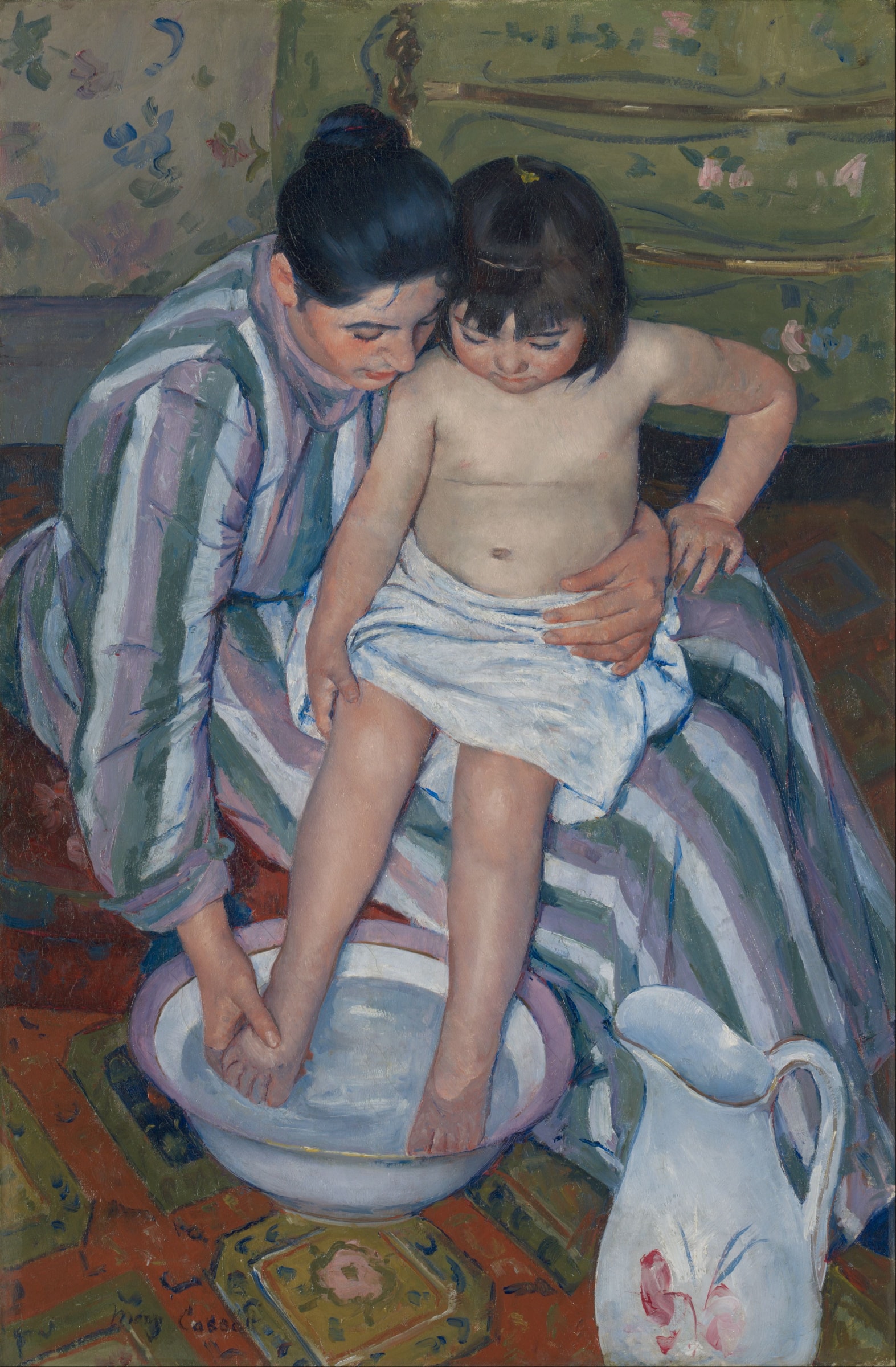
Attribution can draw on any region or period. Here are varied examples that show how the skill travels across the course.
- Ancient Mediterranean (Unit 2): A statue with idealized but naturalistic proportions and weight shift can be attributed to the Classical Greek style rather than the stiffer Archaic style. The shared traits are anatomical naturalism and balanced stance.
- Later Europe and Americas (Unit 4): A print or painting of intimate domestic life by a woman artist of the late 1800s, with soft modeling and tender mother-and-child subject matter, points toward Mary Cassatt. The justification rests on subject matter and handling that match her known works.
- Indigenous Americas (Unit 5): A blackware ceramic vessel with a matte-on-polished surface and a signed name can be tied to Pueblo pottery traditions associated with potters like Maria Martínez. Object type and surface technique anchor the attribution.
- The Pacific (Unit 9): A garment made of dense red feathers worn by elite men signals Hawaiian feather work such as the 'ahu 'ula. Materials and cultural function support placing it in the Pacific tradition.
- South, East, and Southeast Asia (Unit 8): A monumental seated Buddha with crossed legs in meditation links to Buddhist sculptural traditions across Asia. Pose, scale, and iconography justify the cultural and object-type attribution.
Notice that each example pairs a feature you can see with a known reference point. That pairing is the heart of attribution.
How to Practice Attribution of Unknown Works
- Build trait lists for major styles and cultures. For each style, jot two or three signature features. Archaic versus Classical Greek, for instance, can be sorted by stance, facial expression, and proportion.
- Quiz yourself with unfamiliar images. Pull up a work you have not studied, attribute it, then write one sentence of justification using visual evidence.
- Practice the claim-plus-evidence sentence. Write attributions in the form "This work is likely [attribution] because it shows [specific visual feature], which is also seen in [known work or tradition]."
- Compare near neighbors. Styles that look similar are the hardest. Drill the differences between styles, regions, or object types that are easy to confuse.
- Time the short essay. Practice making and justifying an attribution in about 15 minutes so the pace feels routine.
Common Mistakes
- Naming a style without evidence. A correct attribution with no justification leaves points on the table. Always explain the shared traits.
- Citing vague evidence. "It looks old" or "it has nice colors" does not support an attribution. Use specific features like proportion, technique, materials, composition, or iconography.
- Forcing a famous name. Attribute to the level the evidence supports. If you cannot defend a specific artist, attribute to a culture, style, or object type instead.
- Ignoring object type. Sometimes the strongest clue is the kind of object it is, such as a stele, reliquary, or feather cape. Do not overlook that path.
- Confusing similar styles. Mixing up neighbors like Archaic and Classical Greek is common. Anchor your choice in the trait that distinguishes them.
Quick Review
- Attribution means placing an unknown work with a known artist, culture, style, or object type from the image set.
- 6.A is the attribution claim. 6.B is the justification using shared visual evidence.
- The skill appears in multiple choice and in the Question 5 attribution short essay (5 points, about 15 minutes).
- A strong attribution pairs a specific visual feature with a known reference work or tradition.
- Attribute to the level the evidence supports, and always explain the similarities that back your claim.
See Fiveable more often in Google
Mark Fiveable as a preferred source and Google is more likely to show you our guides in Top Stories, with a "preferred" badge in AI Mode and AI Overviews.