9.3 Theories and Interpretations of Pacific Art

🖼AP Art History Unit 9 Review
9.3 Theories and Interpretations of Pacific Art
🖼 AP Art History
Scholars build interpretations of Pacific art using visual analysis, evidence, and outside fields like archaeology and oral history. Interpretations are arguments based on evidence, not fixed facts, and they can change as new evidence appears.
How Do Scholars Interpret Pacific Art?
Scholars interpret Pacific art by combining visual analysis with archaeology, oral history, performance context, memory, and evidence about who had access to the work. Many Pacific works express beliefs, social relations, core truths, and knowledge held by designated members of society, so meaning may depend on an event rather than a permanent object.
For AP Art History, frame interpretations as claims supported by evidence. Nan Madol can be studied through archaeology and Saudeleur power, moai through placement and ancestral authority, and Malagan through performance, memory, and the temporary life of ceremonial objects.
Why This Matters for the AP Art History Exam
This topic builds the skill of art historical interpretation, which shows up in the multiple-choice section and in free-response question 4. You are expected to explain how someone reached an interpretation, judge whether it holds up based on a work's form, materials, content, function, and context, and then build and defend your own evidence-based reading.
Pacific works are a strong place to practice this because their meaning often lives in performance and memory rather than in a permanent object. That pushes you to think about who made a work, who it was for, and how its meaning changes over time. The suggested works here are Nan Madol (213), Moai on platform (ahu) (214), and Malagan display and mask (222).
Key Takeaways
- Interpretations of art are evidence-based arguments that change over time and come from both visual analysis and scholarship.
- An interpretation is not automatic fact. You should weigh it against what you actually see and know about a work.
- For many Pacific works, meaning is carried by the acts of creation, performance, and sometimes dismantling, not only by the physical object.
- Memory is central. Presenting cultural heroes, founding ancestors, or totemic animals reaffirms shared values and important truths.
- Pacific arts express beliefs, social relations, and knowledge held by designated members of society.
- Outside fields and tools, such as archaeology, oral histories, and dating methods, help scholars interpret these works.
The Core Idea: Interpretation as Argument
Art historical interpretation means explaining what a work means and why, using evidence. Scholars draw that evidence from a work's form, style, materials, content, function, context, reception, and meaning. Because interpretations rely on available evidence, they shift as new evidence appears or as scholars ask new questions.
That is why you should treat any interpretation, including ones in textbooks or museum labels, as a claim to evaluate, not a fact to memorize. The exam wants you to recognize the difference between an interpretation and established fact, then defend your own reading with specific visual and contextual evidence.
A key feature of Pacific art is that the work often is not the permanent object. The creation, performance, and even planned dismantling of a mask, costume, or installation can carry the meaning. Meaning is communicated when the work appears and again later when the work or its occasion is recalled. This kind of memory is evoked through primordial forms such as cultural heroes, founding ancestors, or totemic animals to reaffirm shared values. In some cases the memory is created and performed, and then the objects are dismantled or set aside, leaving a new version of the memory behind.
Required Works for This Topic
Nan Madol (213)
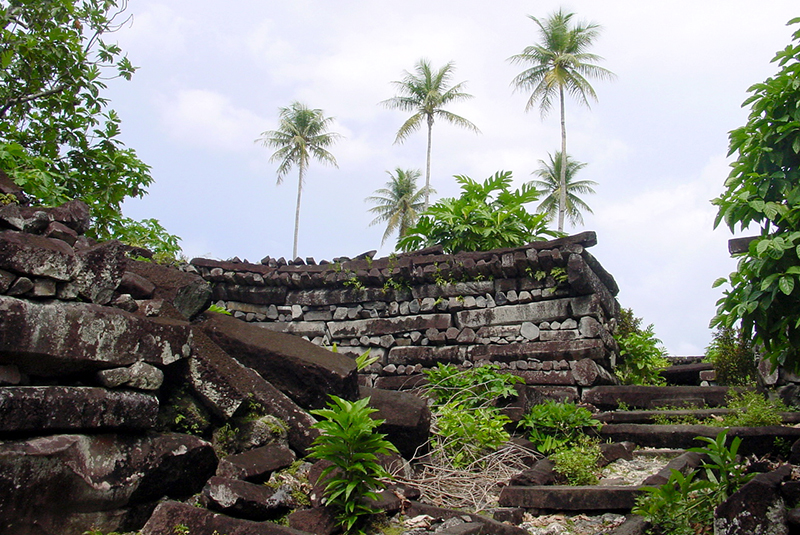
- Location and culture: Pohnpei, Micronesia, Saudeleur Dynasty
- Date: c. 700-1600 ce
- Medium: Basalt boulders and prismatic columns
- Why it fits interpretation: Nan Madol is a complex of human-made islets built with stacked basalt. Scholars interpret it using archaeological evidence and what is known about Saudeleur rulers, who commanded its construction as a residential and ceremonial center. Dating and survey methods help build arguments about how and when it was made.
Moai on platform (ahu) (214)
- Location: Rapa Nui (Easter Island)
- Date: c. 1100-1600 ce
- Medium: Volcanic tuff figures on basalt base
- Why it fits interpretation: The moai were carved and set on ahu platforms. Polynesian societies in places like Rapa Nui created sacred ceremonial spaces that both announce and contain power and life force. Interpretations here often combine visual analysis of the carved figures with archaeological evidence about quarrying, transport, and placement.
Malagan display and mask (222)

- Location: New Ireland Province, Papua New Guinea
- Date: c. 20th century ce
- Medium: Wood, pigment, fiber, and shell
- Why it fits interpretation: Malagan works are tied to mortuary ceremonies. The masks and displays are created and performed to commemorate ancestors and shared bonds, and some are intended to be harmed once the memory is created. This makes Malagan a clear example of meaning living in performance and memory rather than in a lasting object.
How to Use This on the AP Art History Exam
Multiple Choice
- Expect questions that ask you to identify a valid interpretation or judge how scholars reached one.
- Watch for answer choices that present an interpretation as if it were a fixed fact. The better answer usually ties a claim to specific evidence.
- Connect the tools and disciplines, such as archaeology and oral history, to the interpretations they support.
Free Response
- Interpretation shows up in free-response question 4. Make a clear claim about meaning, then justify it with specific visual and contextual evidence.
- Use evidence from form, materials, content, function, and context. For Pacific works, include performance and memory when they apply.
- If you discuss an existing interpretation, evaluate it. Explain what evidence supports it and whether your own analysis agrees.
Common Trap
- Do not just describe a work. The skill is interpretation, so you need a claim plus evidence, not a list of features.
- Do not treat performance-based works as if the object is the whole point. For Malagan and similar works, the act and the memory can carry the meaning.
Common Misconceptions
- Misconception: Interpretations are facts to memorize.Actually: They are evidence-based arguments that can change. Your job is to evaluate them and build your own.
- Misconception: The object is always the artwork.Actually: For many Pacific works, the creation, performance, or dismantling is where meaning lives, and the memory created can outlast the object.
- Misconception: Dismantling an object means the meaning is gone.Actually: Planned dismantling can be part of the work, leaving a renewed memory rather than erasing meaning.
- Misconception: Only visual analysis matters.Actually: Interpretations also draw on scholarship and other fields, such as archaeology, dating methods, and oral histories.
- Misconception: Pacific art is just decorative.Actually: These works express beliefs, social relations, and knowledge held by designated members of society, and they often play active roles in social life.
Related AP Art History Guides
Practice Questions for 9.3
1 of 10
Baining artists of New Britain construct large kavat masks using bamboo frames covered in barkcloth, which they paint with bold, graphic patterns. Art historians analyzing the performance context of these masks argue that the artists' decision to use these specific materials and high-contrast designs primarily serves to...
A.
Create striking visual effects in flickering firelight while allowing for the masks' rapid destruction after the ritual.
B.
Establish strict social hierarchies by restricting the use of heavy, durable materials to the highest-ranking chiefs.
C.
Demonstrate the artists' wealth by utilizing rare, imported trade goods that require extensive labor to acquire and use.
D.
Ensure the masks can be preserved in community storehouses as permanent records of ancestral lineage and local history.
Vocabulary
The following words are mentioned explicitly in the AP® course framework for this topic.Term | Definition |
|---|---|
art history | The academic discipline that studies works of art, their creation, context, and significance across time and cultures. |
costume | Clothing or garments worn during performance or ritual, often carrying symbolic meaning through their creation, use, and performance in Pacific art traditions. |
cultural heroes | Legendary or mythological figures central to a culture's identity and values, often represented in Pacific art to evoke and reaffirm shared cultural memory. |
founding ancestors | Revered ancestral figures believed to have established a culture or community, often depicted in Pacific art to maintain cultural continuity and shared values. |
installation | A large-scale, site-specific work of art that may involve performance or ritual acts where meaning is created through the act of creation or performance rather than the physical object alone. |
mask | A covering worn on the face, often used in Pacific art as a ritual or performance object whose meaning is created through its use and performance rather than the object itself. |
primordial forms | Ancient or archetypal representations such as cultural heroes, founding ancestors, or totemic animals that evoke shared cultural memory and reaffirm important truths. |
scholarship | Academic research and study that informs and shapes the understanding and interpretation of art and art history. |
theory and interpretation | Different frameworks and perspectives used to understand and explain the meaning, context, and significance of works of art that may change over time. |
totemic animals | Animals that hold spiritual or symbolic significance for a culture and serve as emblems of identity, kinship, or spiritual connection in Pacific art traditions. |
visual analysis | The systematic examination and interpretation of a work of art's formal elements, such as color, composition, form, and technique, to understand its meaning and significance. |
Frequently Asked Questions
How do scholars interpret Pacific art?
Scholars interpret Pacific art by combining visual analysis with archaeology, oral history, performance context, memory, and evidence about who had access to the work. Many meanings depend on events, social relations, and designated knowledge rather than only permanent objects.
Why is performance important for interpreting Pacific art?
For many Pacific works, the act of creation, presentation, dance, song, recitation, or dismantling carries the meaning. The memory created by the event can matter as much as, or more than, the physical object that remains.
How is Nan Madol interpreted in AP Art History?
Nan Madol is interpreted through archaeology, survey evidence, and context about Saudeleur rulers who commanded its construction. Its human-made islets and basalt construction support claims about residential, ceremonial, and political power.
How are moai on ahu interpreted?
Moai on ahu are interpreted through visual analysis, placement, archaeology, and evidence about ancestral authority and sacred ceremonial space on Rapa Nui. Their platform setting helps explain power, memory, and community legitimacy.
Why is Malagan important for interpretation?
Malagan displays and masks are tied to mortuary ceremonies, ancestor commemoration, performance, and memory. Their meaning is not limited to the object, because the event and later remembrance are central to the work.
How is interpretation tested for Pacific art on AP Art History?
The exam may ask you to evaluate an interpretation or build your own claim. Use evidence from form, material, content, function, context, performance, and memory, and avoid presenting debated meanings as fixed facts.
See Fiveable more often in Google
Mark Fiveable as a preferred source and Google is more likely to show you our guides in Top Stories, with a "preferred" badge in AI Mode and AI Overviews.