9.2 Interactions Within and Across Cultures in Pacific Art

🖼AP Art History Unit 9 Review
9.2 Interactions Within and Across Cultures in Pacific Art
🖼 AP Art History
Pacific art shows how migration, navigation, belief systems, and outside contact shaped what artists made and why. Focus on how the sea, mana and tapu, ceremonial exchange, and European or missionary contact appear in works like the Staff god, Buk mask, Tamati Waka Nene, the Navigation chart, and the Presentation of Fijian mats and tapa cloths to Queen Elizabeth II.
How Did Interactions Shape Pacific Art?
Interactions shaped Pacific art through ocean migration, navigation, exchange, ritual performance, ecology, and outside contact. The sea both connected and separated Pacific peoples, so voyaging knowledge, local materials, and social systems traveled across islands while still producing distinct regional traditions.
For AP Art History, connect the interaction to evidence in the work. A navigation chart records sea knowledge, the Staff god uses wrapping tied to mana and tapu, Tamati Waka Nene uses European oil portraiture to preserve Maori leadership, and Fijian mats and tapa show exchange as a performed social event.
Why This Matters for the AP Art History Exam
This topic builds the kind of contextual analysis the AP Art History exam rewards. You connect a work's form and materials to bigger ideas: how physical setting (an ocean of more than 25,000 islands) and cultural practices shaped art making, and how interactions like commerce, colonialism, and missionary activity changed it.
On the exam you will see Pacific works in multiple-choice questions and may use them in free-response questions that ask you to explain context, compare works, or evaluate an interpretation. Strong answers identify a work accurately, then use specific evidence from form, function, content, and context to support a clear claim. That last skill, building and defending an evidence-based interpretation, is central in this part of the course.
Key Takeaways
- The Pacific covers a huge ocean region; physical setting, available materials, and migration patterns shape Pacific art, and the sea is a constant theme because it both connects and separates islands.
- Navigation expertise mattered: voyagers built ships and tools and made personal charts that recorded their experience of the sea and helped ensure safe sailing.
- Mana (life force or status) and tapu (rules that restrict access) explain why objects of power are wrapped, sheathed, or shielded from contact.
- Many Pacific arts are performed (danced, sung, recited, displayed) using color, scent, texture, and movement, and the act itself can carry the meaning.
- Outside contact mattered: Europeans explored from the 16th century and most extensively from the later 18th century, and colonialism, commerce, and missionary activity affected art making.
- Dumont d'Urville divided the region into Melanesia, Micronesia, and Polynesia, a classification that comes from an outside European viewpoint.
Required Works in This Topic
These are the suggested works tied to Topic 9.2. Keep the identifying details precise.
Staff god
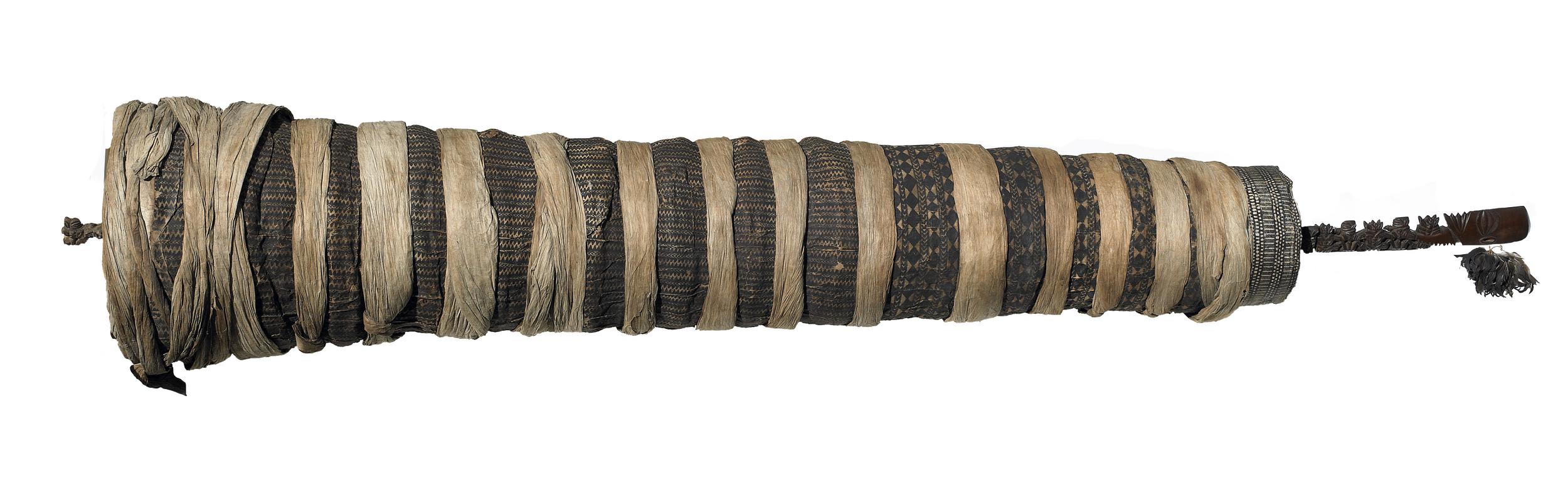
Staff god, late 18th to early 19th century, wood, tapa, fiber, and feathers, Rarotonga, Cook Islands, central Polynesia (Trustees of the British Museum)
- Title: Staff god; from Rarotonga, Cook Islands, central Polynesia; late 18th to early 19th century; made of wood, tapa, fiber, and feathers.
- Pacific arts often involve the power of deities, ancestors, and founders. Objects connected to that power are commonly protected by wrapping, sheathing, or covering to limit human access.
- The barkcloth wrapping connects to ideas of mana and tapu: covering an object can shield its power and mark it as restricted.
- One interpretation: figures along the staff have been read as connected to a deity or ancestral power, though the exact meaning has been debated.
Buk (mask)

Buk (mask), Torres Strait, mid- to late 19th century, turtle shell, wood, fiber, feathers, and shell (The Metropolitan Museum of Art)
- Title: Buk (mask); from the Torres Strait; mid- to late 19th century; made of turtle shell, wood, fiber, feathers, and shell.
- The Torres Strait sits between Australia and Papua New Guinea, a contact zone between cultural groups.
- Masks and the performance of masks can serve as a recital and commemoration of ancestors' histories and wisdom, so meaning often comes from the performance, not just the object.
- The turtle shell construction reflects local materials and a high level of skill with those materials.
Tamati Waka Nene
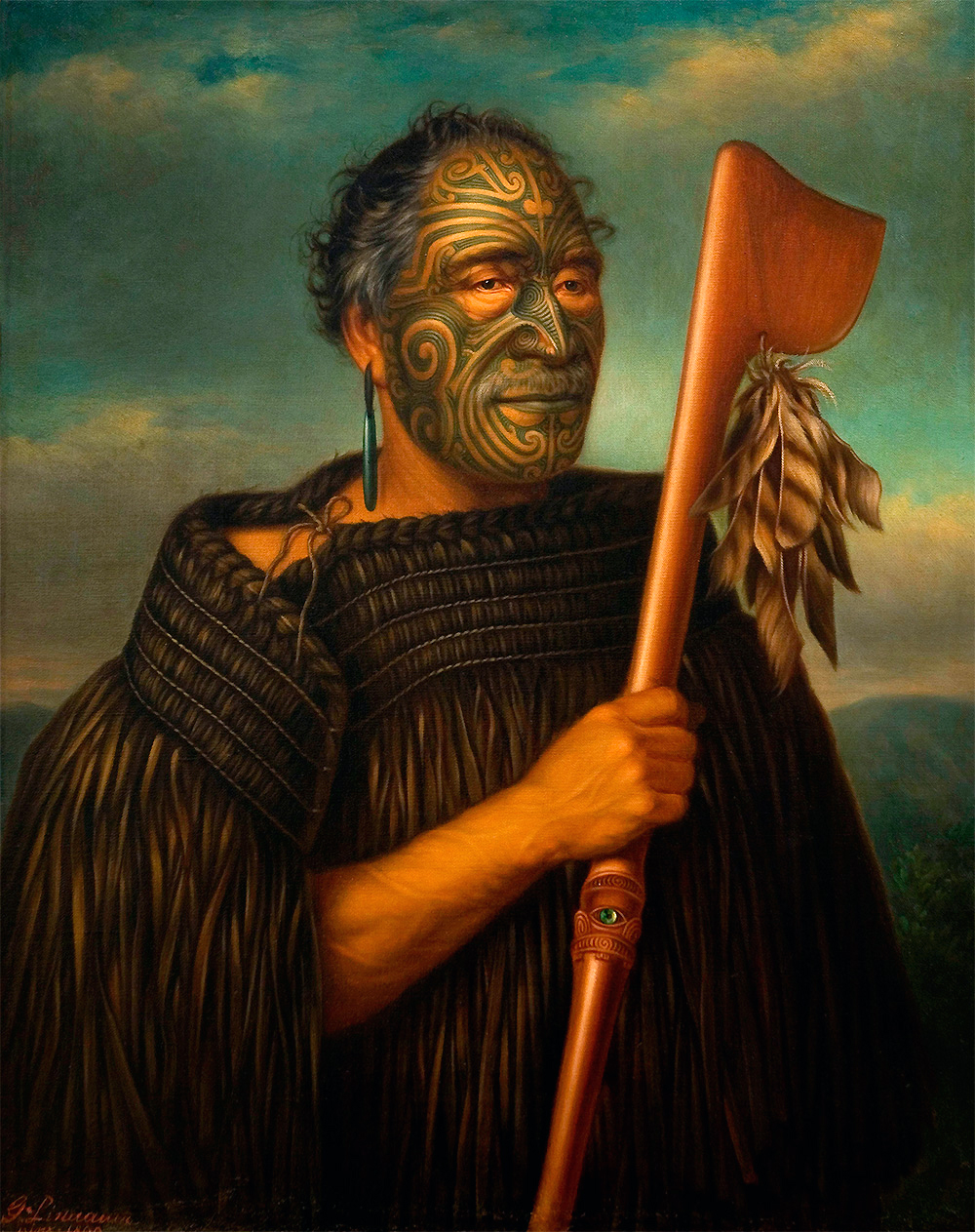
Gottfried Lindauer, Tamati Waka Nene, 1890, oil on canvas (Auckland Art Gallery)
- Title: Tamati Waka Nene; by Gottfried Lindauer; 1890; oil on canvas.
- This is a clear example of cross-cultural interaction: a European medium and portrait tradition (oil on canvas) used to depict a Maori leader.
- The portrait records a specific individual and his status. Pacific art often gives form to and preserves human history, social continuity, and the importance of a leader or ancestor.
- Compare it to carved or performed Pacific works to highlight how European contact introduced new materials and image-making methods.
Navigation chart

Navigation chart, Marshall Islands, Micronesia, 19th to early 20th century, wood and fiber (Trustees of the British Museum)
- Title: Navigation chart; from the Marshall Islands, Micronesia; 19th to early 20th century; made of wood and fiber.
- Navigators built tools like this to support exploration, migration, and exchange across the Pacific.
- These charts were personal expressions of a navigator's experience of the sea, recording patterns such as swells and the locations of islands rather than working like a Western map.
- It connects directly to the theme that the sea both connects and separates Pacific peoples.
Presentation of Fijian mats and tapa cloths to Queen Elizabeth II
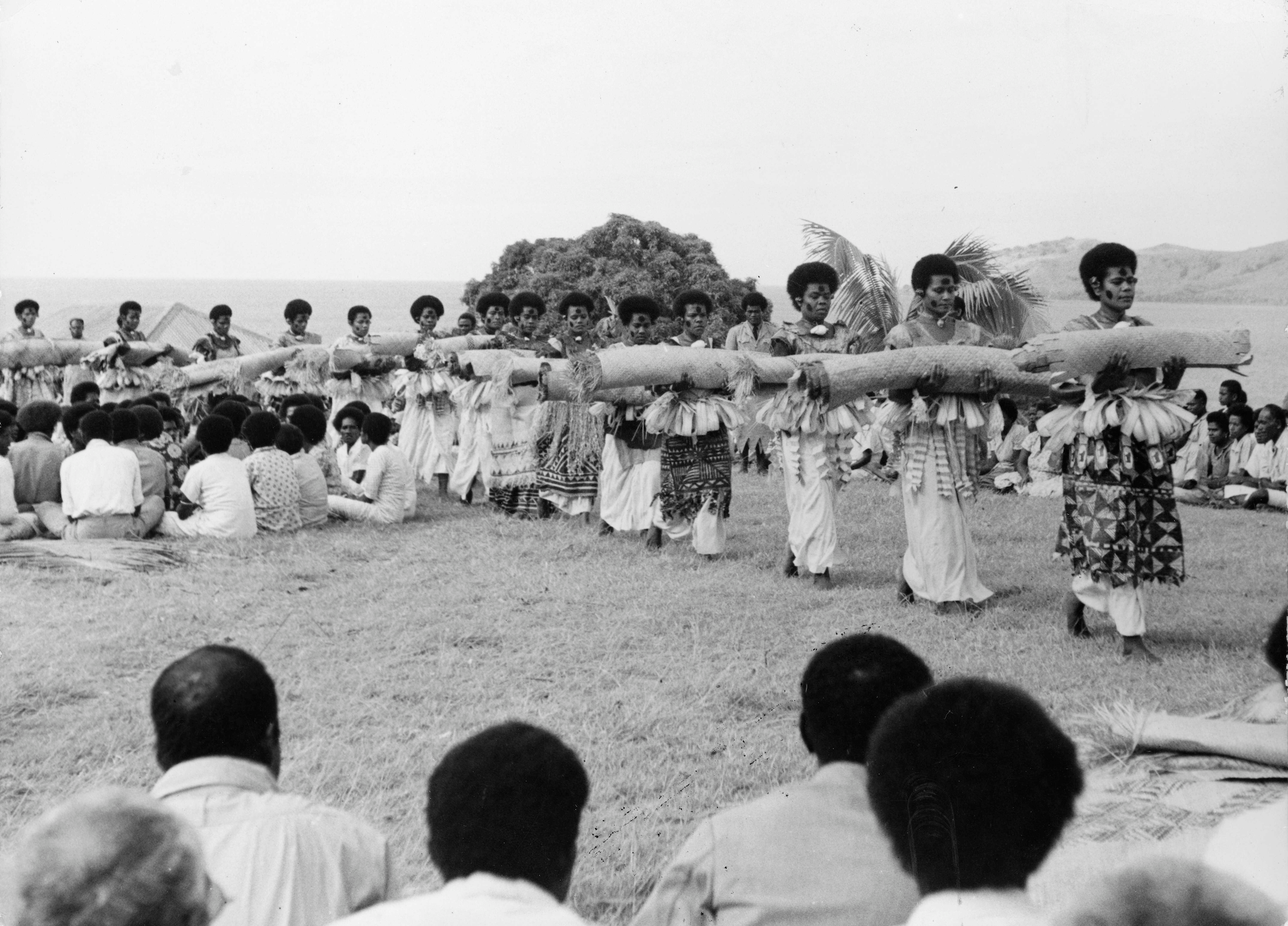
Presentation of Fijian mats and tapa cloths to Queen Elizabeth II during the 1953-54 royal tour, photographic documentation (Alexander Turnbull Library, Wellington, New Zealand)
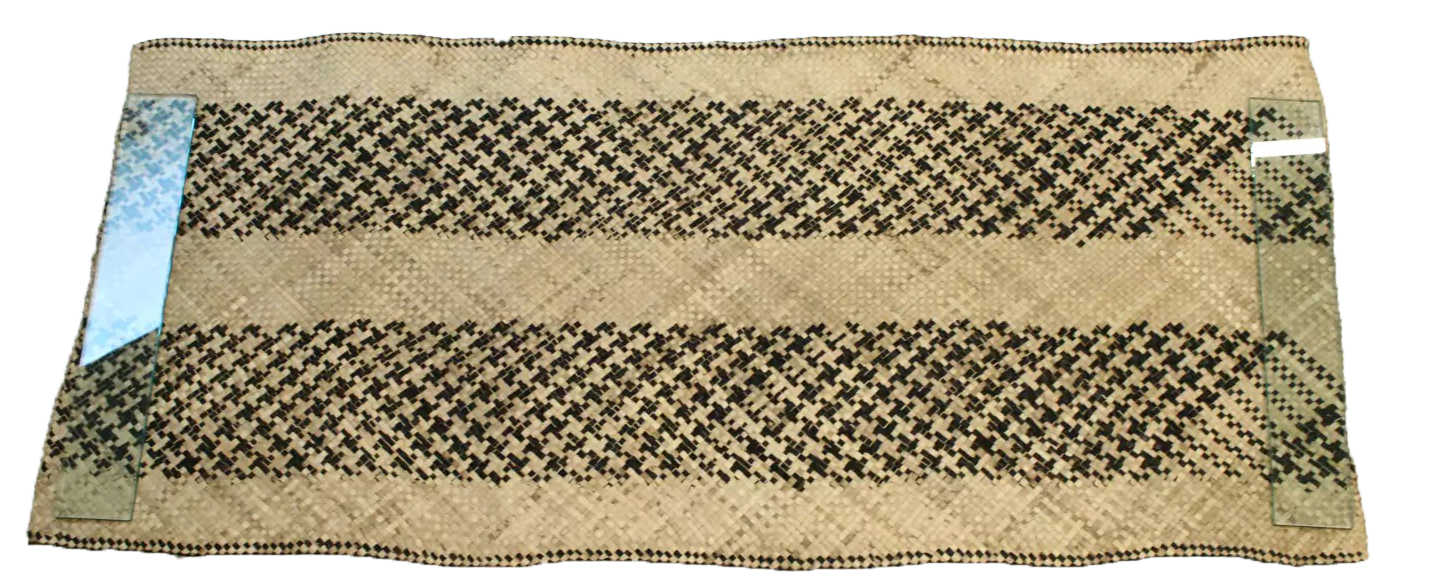
Mat, Fiji, pandanus leaf (Auckland War Memorial Museum)
- Title: Presentation of Fijian mats and tapa cloths to Queen Elizabeth II; Fiji, Polynesia; 1953; a multimedia performance (costume, cosmetics including scent, chant, movement, and pandanus fiber/hibiscus fiber mats), with photographic documentation.
- This is a performed work, not a single object. It uses an array of colors, scents, textures, and movement, which fits how many Pacific arts are danced, sung, recited, and displayed.
- It shows reciprocity and ceremonial exchange: designated people provide specific items in a complex, prescribed process that engages the senses.
- It also reflects interaction with an outside culture, here a British colonial relationship, presented through Fijian protocol and materials.
How to Use This on the AP Art History Exam
Multiple Choice
- Practice quick, accurate identification (title, culture or location, date, medium) so you can recognize these works fast.
- Match each work to a big idea from this topic: the sea, mana and tapu, performance, exchange, or outside contact.
- Watch for questions that test materials, since several works are defined by turtle shell, feathers, wood, tapa, and fiber.
Free Response
- Lead with a clear claim, then support it with specific visual and contextual evidence from form, function, content, and context.
- For comparison prompts, pair a carved or wrapped object (like the Staff god) with a European-influenced work (like Tamati Waka Nene) to show how interaction changed materials and methods.
- When a prompt asks about an interpretation, treat it as a claim to evaluate, not a fact. Use evidence from the work to decide if it holds up.
Common Trap
- Do not treat performed works like the Presentation of Fijian mats and tapa cloths as just objects. The performance and exchange carry much of the meaning.
- Do not assume a navigation chart works like a Western map. It records the navigator's experience of the sea, including swell patterns.
Common Misconceptions
- Misconception: Melanesia, Micronesia, and Polynesia are native Pacific labels.Actually: These categories come from Dumont d'Urville, a European geographer, so they reflect an outside viewpoint, not a single Pacific self-definition.
- Misconception: The Staff god's wrapping is just decoration.Actually: Covering and wrapping connect to mana and tapu, shielding power and limiting human access, so the wrapping is meaningful, not just ornamental.
- Misconception: Tamati Waka Nene is a traditional Maori carving.Actually: It is an 1890 oil on canvas by Gottfried Lindauer, a clear case of cross-cultural exchange in materials and image-making.
- Misconception: Pacific art is mainly permanent objects.Actually: Many works are performed or even meant to be dismantled once the memory is created, so meaning can live in the act rather than the object.
- Misconception: A navigation chart is decorative.Actually: It is a functional tool tied to real voyaging knowledge and the central theme of the sea.
- Misconception: European contact began only in the 1800s.Actually: Europeans explored the region as early as the 16th century, with the most extensive contact from the second half of the 18th century.
Related AP Art History Guides
Practice Questions for 9.2
1 of 10
What is the primary purpose of wrapping a Polynesian staff god in barkcloth and feathers instead of leaving it exposed?
A.
Protect the deity's mana and mark the staff as tapu and restricted
B.
Display textile skill but remain secondary to the object's spiritual purpose
C.
Conceal carved details to signal sacred restriction rather than mere decoration
D.
Preserve the wood from tropical weather as only a practical secondary benefit
Vocabulary
The following words are mentioned explicitly in the AP® course framework for this topic.Term | Definition |
|---|---|
ancestral representations | Art objects constructed to give form to and preserve human history and commemorate ancestors' histories and wisdom. |
belief systems | Organized sets of religious, spiritual, or philosophical ideas that guide how a culture understands the world and conducts itself. |
colonialism | The historical practice of establishing political and economic control over other territories and peoples, whose waning through independence movements has influenced global art production and representation. |
commerce | Trade and economic exchange between different regions and cultures. |
complementarity | In Pacific societies, the understanding that seemingly divergent forces or roles work together to maintain social balance and order. |
cultural patterns | Recurring themes, practices, and characteristics that are shared and transmitted across societies and regions. |
cultural practices | The customs, rituals, and traditional activities of a society that are reflected in and inform artistic and architectural creation. |
duality | In Pacific social relations, the expression of balance between opposing forces or circumstances necessary for social harmony. |
exchange of objects | The trade and sharing of material goods and cultural items between different peoples and regions. |
external influences | Cultural, economic, and social forces from outside a region that affect local art and society. |
feather capes | Garments worn by Hawaiian rulers that announce their status and shield them from contact. |
intended audience | The specific group of people for whom an artwork is created, which influences the artist's choices in form, content, and presentation. |
Lapita culture | An ancient Pacific culture whose people migrated eastward across the region beginning 4,000 years ago, characterized by distinctive pottery and patterns of settlement and exchange. |
mana | In Pacific cultures, one's vital force, identity, or strength that is expressed and protected through rules, prohibitions, wrapping, or shielding practices; also associated with communities and leaders who represent their peoples. |
masks | Carved or constructed face coverings worn in African performances and rituals to embody spirits, ancestors, or characters. |
migration | The movement of peoples across geographical regions, often involving the transport of plants, animals, cultural practices, and objects. |
missionary activity | Religious outreach and conversion efforts by missionaries that introduce new beliefs and cultural practices to indigenous populations. |
Nan Madol | A residential and ceremonial complex of human-made islets in Micronesia constructed under the command of Saudeleur Dynasty rulers. |
navigation | The practice and expertise of directing ocean-going vessels across the sea, including the creation of charts and devices to guide exploration and sailing. |
ocean-going vessels | Ships and boats designed and built to travel across vast ocean distances, capable of carrying families and communities across the Pacific. |
Papuan-speaking peoples | Indigenous populations of Papua New Guinea and surrounding regions who speak Papuan languages and migrated across a land bridge connecting Asia and Australia approximately 30,000 years ago. |
patron | A person or institution that commissions, funds, or supports the creation of an artwork, thereby influencing its purpose and content. |
physical setting | The geographic location, environment, and landscape that influences the creation and function of art. |
reciprocity | A cultural value in Andean societies emphasizing mutual exchange and interdependence between individuals and communities. |
ritual dress | Clothing worn in ceremonial contexts that encase and shield the focus of power from human interaction. |
sacred ceremonial spaces | Designated spaces created by Pacific societies that announce and contain their legitimacy, power, and life force. |
sheathing | A protective covering practice in Pacific arts used to prevent human access to sacred objects and shield the focus of power. |
tapu | Rules and prohibitions in Pacific cultures that protect mana and limit access to sacred objects and spaces. |
wrapping | A protective practice in Pacific arts used to prevent human access to sacred objects and shield the focus of power. |
Frequently Asked Questions
How did interactions shape Pacific art?
Interactions shaped Pacific art through ocean migration, navigation, exchange, ritual performance, ecology, and outside contact. The sea connected and separated Pacific peoples, so voyaging knowledge, local materials, and social systems traveled across islands while still producing distinct regional traditions.
Why is the sea important in Pacific art?
The sea is central because it connects and separates Pacific islands and peoples. Navigation, sailing expertise, migration, exchange, and works such as Marshall Islands navigation charts all show how ocean knowledge shaped Pacific art and culture.
What are mana and tapu in Pacific art?
Mana is vital force, status, or power associated with leaders, communities, and objects. Tapu refers to rules or restrictions that protect that power, often through covering, wrapping, shielding, or limiting access to important objects.
How does Tamati Waka Nene show cross-cultural interaction?
Tamati Waka Nene uses the European medium and portrait tradition of oil on canvas to depict a Maori leader. It preserves individual status and history while showing how European contact introduced new materials and image-making methods.
Why is the Presentation of Fijian mats and tapa cloths important?
The Presentation of Fijian mats and tapa cloths is a performed exchange involving materials, movement, protocol, scent, costume, and social status. It shows reciprocity and ceremonial exchange rather than a single isolated object.
How is Pacific cultural interaction tested on AP Art History?
AP Art History may ask you to connect a Pacific work to migration, navigation, mana, tapu, exchange, colonial contact, or performance. Strong answers name the interaction and support it with evidence from form, material, function, and context.
See Fiveable more often in Google
Mark Fiveable as a preferred source and Google is more likely to show you our guides in Top Stories, with a "preferred" badge in AI Mode and AI Overviews.