4.3 Materials, Processes, and Techniques in Later European and American Art

🖼AP Art History Unit 4 Review
4.3 Materials, Processes, and Techniques in Later European and American Art
🖼 AP Art History
TLDR
Topic 4.3 in AP Art History is about how new materials, processes, and techniques shaped art and architecture from 1750 to 1980. Technology like steel framing, ferroconcrete, and cantilevering changed building construction, while artists used new media such as lithography, photography, film, and serigraphy, plus industrial materials and mass-produced imagery that grew into massive earthworks and recorded performance.
What New Materials and Techniques Changed Unit 4 Art?
Unit 4 art changed through new building technologies like steel framing, ferroconcrete, and cantilevering, plus new media such as lithography, photography, film, and serigraphy. Artists also used industrial materials, prefabrication, mass-produced images, readymades, recorded performance, and earthworks to expand what art could be.
On the AP Art History exam, name the material or process and explain what it makes possible: taller buildings, reproducible images, appropriation, documentation, monumentality, or site-specific meaning.
This topic gives you the vocabulary to explain how a work was made and why the method matters. On the exam you are often asked to use visual and contextual analysis, and material choices are strong evidence for both. When you can connect a technique like the soak-stain method or steel-frame construction to the look and meaning of a work, you can support claims instead of making vague statements.
Free-response questions also ask you to compare works and to analyze a work that is not in the required image set by linking it to one you know. Knowing materials and processes helps you spot similarities in how works were made, which is the kind of attribution skill these questions reward.
What to Know About Materials, Processes, and Techniques in Later European and American Art
- Advances like the steel frame, ferroconcrete (reinforced concrete), and cantilevering sped up building construction and made skyscrapers possible, leading to an international style later challenged by postmodernism.
- Artists used new media including lithography, photography, film, and serigraphy (screen printing).
- Industrial technology, prefabrication, and new materials let artists make innovative and monumental works, building toward massive earthworks.
- Mass production gave artists ready-made images that they appropriated.
- Performance was carried out in new ways and recorded on film and video.
- Use specific material evidence, not generic statements, to support claims about how a work was made and what it means.
Materials and New Media in This Period


Industrialization and new technology gave artists fresh tools and surfaces. These are some of the materials and media you will see across Unit 4.
- Oil paint: pigments mixed with oil, valued for its range of effects and textures.
- Canvas: stretched fabric used widely in Europe and America as a painting surface.
- Watercolor: pigments mixed with water and a binder, often used for landscapes and outdoor scenes.
- Pastels: sticks of pigment and binder used for soft, delicate effects, popular in the 18th and 19th centuries.
- Charcoal: used for quick, loose drawings, popular in the 19th century.
- Photography, lithography, and film: new media that use light-sensitive or print processes to create images, emerging and spreading in the 19th century.
- Serigraphy (screen printing) and acrylic paint: later additions that let artists work with bold, flat color and mass-produced imagery.
Architecture and Construction Technology
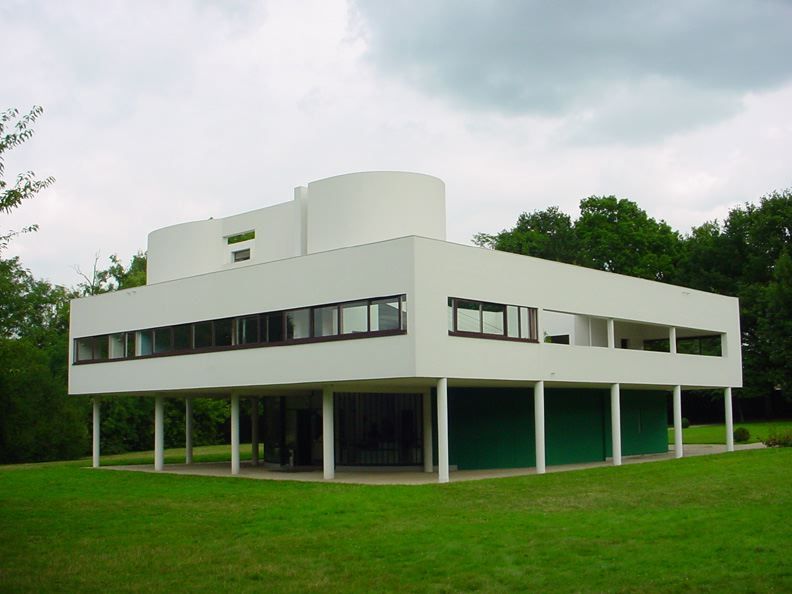

New building methods changed what architecture could do.
- Steel-frame construction and the structural steel skeleton allowed taller, lighter buildings. This is central to early skyscrapers like the Carson, Pirie, Scott and Company Building (Chicago, Louis Sullivan, 1899-1903, iron, steel, glass, and terra cotta).
- Ferroconcrete (reinforced concrete) combines concrete with steel for strength. Villa Savoye (Le Corbusier, 1929, steel and reinforced concrete) shows the clean, geometric look this made possible.
- Cantilevering lets sections of a building extend past their supports. Fallingwater (Frank Lloyd Wright, Pennsylvania, 1936-1939, reinforced concrete, sandstone, steel, and glass) uses cantilevered terraces over a waterfall.
- The glass curtain wall hangs a glass skin on a steel frame. The Seagram Building (Mies van der Rohe and Philip Johnson, New York City, 1954-1958, steel frame with glass curtain wall and bronze) is a key International Style example.
- This international style was later challenged by postmodernism, which brought back ornament, history, and variety.
Print, Photo, and Motion Media

Many required works in this topic show how new image-making processes expanded what art could be.
- Daguerreotype: an early photographic process. Still Life in Studio (Louis-Jacques-Mandé Daguerre, 1837, daguerreotype) is an early example of photography as art.
- Lithography: a printing process using a flat stone or plate. Nadar Raising Photography to the Height of Art (Honoré Daumier, 1862, lithograph) uses this medium for satire.
- Chronophotography: motion studies captured in sequence. The Horse in Motion (Eadweard Muybridge, 1878, albumen print) froze movement that the eye could not catch.
- Photogravure: a photo-based printing process. The Steerage (Alfred Stieglitz, 1907, photogravure) treats photography as fine art.
- Serigraphy (silkscreen) with mass-produced imagery: Marilyn Diptych (Andy Warhol, 1962, oil, acrylic, and silkscreen enamel on canvas) appropriates a publicity image and repeats it.
Sculpture, Paint Innovation, and Earthworks


- Direct carving and block-like form: Brancusi's The Kiss (original 1907-1908, stone) reads as a simplified, blocky pair of figures. Treat the carving approach and compact form as visual and material analysis you can describe, not a fixed required process.
- Soak-stain technique with acrylic paint: The Bay (Helen Frankenthaler, 1963, acrylic on canvas) pours thinned paint so color soaks into unprimed canvas, creating soft, flat fields.
- Earthworks: Spiral Jetty (Robert Smithson, Great Salt Lake, Utah, 1970, earthwork of mud, salt crystals, rocks, and water) is a massive, site-specific work made from natural materials on location.
- As a broader Unit 4 example of new media and audience interaction, Narcissus Garden (Yayoi Kusama, original installation and performance 1966, mirror balls) shows performance and installation recorded and staged in new ways.
Materials, Processes, and Techniques in Later European and American Art on the AP Art History Exam
Visual and Contextual Analysis: Name the material or process, then explain its effect. For example, say that the glass curtain wall on the Seagram Building creates a sleek, transparent surface that fits the International Style, rather than just saying it looks modern.
Comparison: When a question asks you to compare two works, material and technique are reliable points of comparison. You might compare how steel-frame construction and ferroconcrete each allowed new forms, or how silkscreen and lithography both spread images widely.
Attribution: For the question that gives you a work outside the required image set, link it to a work you know by describing shared materials, processes, or techniques. If an unknown building uses a steel skeleton and glass walls, connect it to the Seagram Building and explain the shared method.
Common Trap: Avoid generic claims like "technology changed art." Instead, point to a specific process and a specific effect, such as cantilevering allowing Fallingwater's terraces to project over the water.
Common Misconceptions
- Misconception: Reinforced concrete and regular concrete are the same.Actually: Reinforced concrete and regular concrete are not the same. Ferroconcrete adds steel inside the concrete for strength, which is what makes thin slabs and cantilevers possible.
- Misconception: Photography instantly counted as "art" to everyone.Actually: Photography did not instantly count as "art" to everyone. Works like The Steerage and the Daumier lithograph reflect an ongoing debate about whether photography belonged in the art world.
- Misconception: Pop artists always invented their images.Actually: Pop artists did not always invent their images. Warhol appropriated an existing publicity photo of Marilyn Monroe; the art is in the selection, process, and repetition.
- Misconception: Earthworks are just big sculptures placed outside.Actually: Earthworks are not just big sculptures placed outside. Spiral Jetty is made from the site's own materials and is meant to exist in that specific place.
- Misconception: The International Style was the final word in architecture.Actually: The International Style was not the final word in architecture. Postmodernism pushed back by bringing ornament and historical references back into design.
- Misconception: Brancusi's block-like form is a required technical label.Actually: Brancusi's block-like form is something you describe, not a required technical label. Focus on what the compact, carved form communicates rather than memorizing a fixed process term.
Related AP Art History Guides
Practice Questions for 4.3
1 of 10
Which capability did 20th-century serigraphy (silkscreen) most directly give Pop artists?
A.
Creation of subtle tonal gradations and atmospheric effects like oil painting
B.
Rapid reproduction of bold flat colors and repeated commercial imagery
C.
Handmade unique works that cannot be duplicated or mass produced
D.
Use of black and white compositions emphasizing line over color
Vocabulary
The following words are mentioned explicitly in the AP® course framework for this topic.Term | Definition |
|---|---|
appropriation | An artistic technique in which artists incorporate existing objects, images, or cultural materials into new works to recontextualize or revalue them. |
cantilevering | An architectural technique where a horizontal structural element extends beyond its support, creating an overhanging form. |
earthwork | Large-scale artworks created by manipulating natural landscapes and earth materials, often monumental in scale. |
ferroconcrete construction | A building technique combining reinforced concrete with steel reinforcement to create strong, durable structures. |
film | A time-based medium using moving images and sound, employed by artists to create narrative and experimental works. |
international style | A modernist architectural movement characterized by clean lines, geometric forms, and the use of new materials like steel and glass. |
lithography | A printmaking technique based on the principle that oil and water do not mix, allowing artists to create multiple copies of an image. |
mass production | The industrial manufacture of goods in large quantities, which supplied artists with ready-made images and objects to appropriate. |
performance art | An artistic practice in which the artist's actions, presence, and body become the primary medium of artistic expression. |
photography | A medium that captures images using light and chemical or digital processes, adopted by artists as a new form of artistic expression. |
postmodernism | An artistic and architectural movement that challenged modernist principles by incorporating historical references, ornamentation, and diverse styles. |
prefabrication | The manufacturing of components or structures in advance, away from the final site, then assembled on location. |
serigraphy | A printmaking technique using a mesh screen and stencil to push ink through onto a surface, allowing for bold colors and multiple layers. |
skyscrapers | Tall multistory buildings made possible by advances in steel frame and concrete construction technology. |
steel frame | A structural system using steel beams and columns to support buildings, enabling taller and more flexible architectural designs. |
video | A time-based medium using electronic recording and playback technology, used by artists to document and create works. |
See Fiveable more often in Google
Mark Fiveable as a preferred source and Google is more likely to show you our guides in Top Stories, with a "preferred" badge in AI Mode and AI Overviews.