9.4 Unit 9 Required Works

🖼AP Art History Unit 9 Review
9.4 Unit 9 Required Works
🖼 AP Art History
Unit 9 covers 11 required works from the Pacific (700-1980 CE), spread across Melanesia, Micronesia, and Polynesia. These works show how materials, performance, status, navigation, and cross-cultural contact shape Pacific art.
Why This Matters for the AP Art History Exam
The Pacific is about 4% of the exam, so you will likely see these works in the multiple-choice section and possibly in free-response questions. This unit is a strong place to practice art historical interpretation, which means building an evidence-based reading of a work using its form, materials, function, and context. The free-response question that focuses on attribution and interpretation rewards students who can connect what they see to a culture, time, and purpose.
Pacific works also work well for comparison questions because many of them share themes like the sea, ancestry, status, performance, and the protection of spiritual power. Knowing precise identifying details helps you avoid weak guesses and lets you support claims with specific visual and contextual evidence.
Key Takeaways
- Pacific arts are often performed events, not just objects. Costume, scent, chant, and movement can carry the meaning, and some works are meant to be dismantled, consumed, or destroyed after their purpose is fulfilled.
- Materials matter. Artists used fibers, feathers, wood, shell, turtle shell, sea ivory, coral, and stone, often valued for rarity and skill of use.
- Rare and precious materials signal wealth, status, and circumstance, as with the Hawaiian feather cape.
- Many works connect to mana (life force or power) and tapu (protective rules and restrictions), shown through wrapping, sheathing, and covering to limit human access.
- Navigation and the sea are central themes, reflected in the Marshall Islands navigation chart and the migration history of the region.
- European contact, colonialism, and missionary activity influenced later works, like Lindauer's portrait of Tamati Waka Nene.
The 11 Required Works
Nan Madol
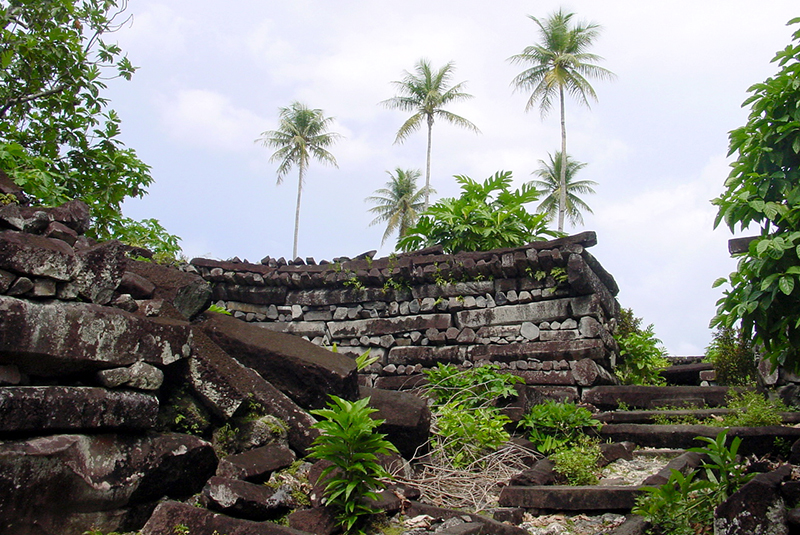
Nan Madol, Pohnpei, Micronesia (photo: CT Snow, CC BY 2.0)

- Location/culture: Pohnpei, Micronesia, Saudeleur Dynasty
- Date: c. 700-1600 ce
- Medium: Basalt boulders and prismatic columns
- A residential and ceremonial complex built on numerous human-made islets. Rulers of the Saudeleur Dynasty commanded its construction, making it a statement of power and order.
- Use it as an architecture example of how spatial organization and shared or restricted spaces reinforce social order.
Moai on platform (ahu)
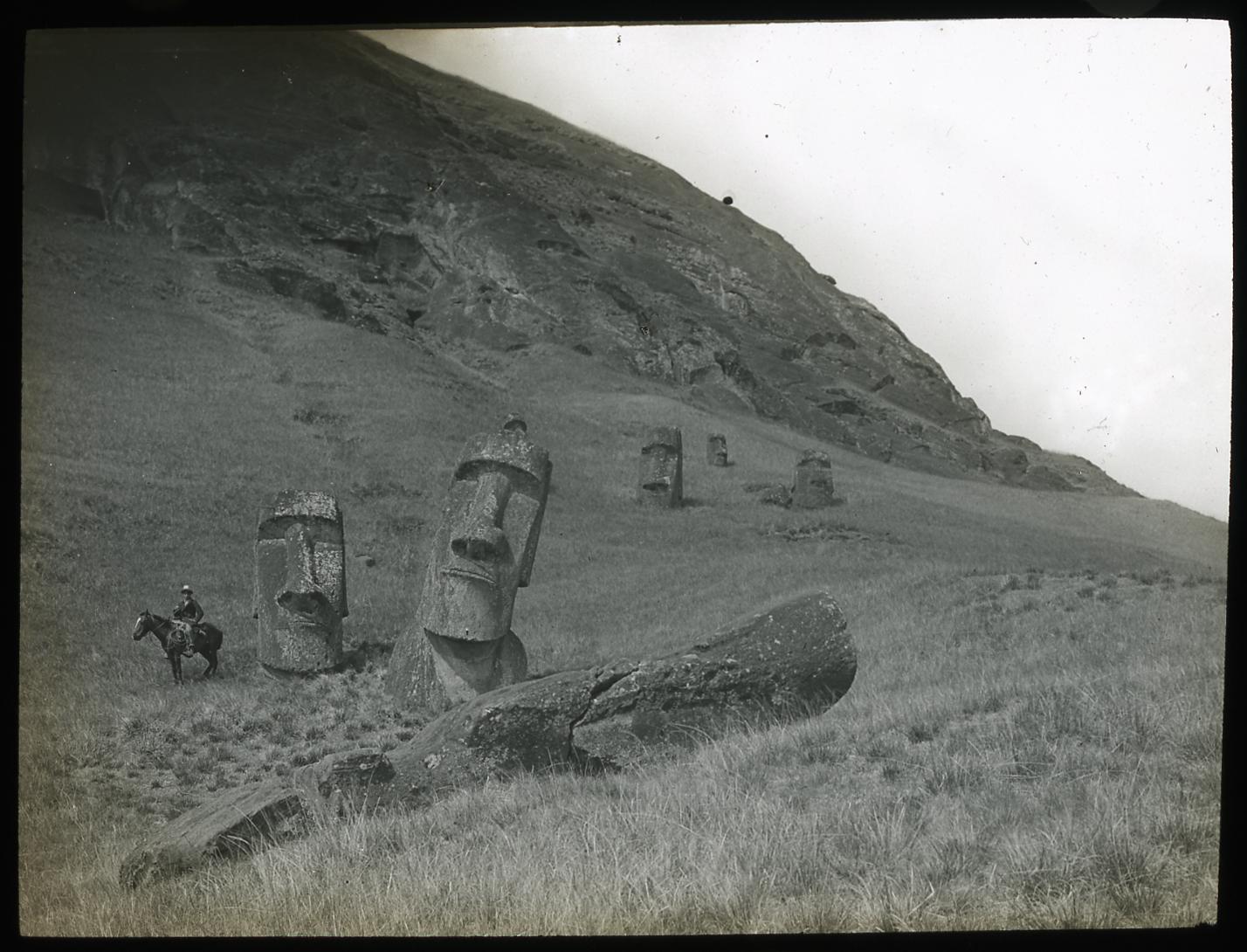
Moai on the slopes near the quarry, Rapa Nui (Easter Island), photo by Katherine Maria Routledge, c. 1914-15 (© Trustees of the British Museum)
- Location: Rapa Nui (Easter Island)
- Date: c. 1100-1600 ce
- Medium: Volcanic tuff figures on basalt base
- Large stone figures set on platforms (ahu). These sacred ceremonial spaces both announce and contain the legitimacy, power, and life force of the community.
- One interpretation connects the moai to ancestors and to the spiritual continuity of the Rapa Nui people.
'Ahu 'ula (feather cape)

Feather cape, olona fibre and feather, Hawaii © Trustees of the British Museum
- Culture: Hawaiian
- Date: Late 18th century ce
- Medium: Feathers and fiber
- Worn by Hawaiian rulers to announce status and to shield them from contact. The rare, precious feathers display wealth and rank.
- A clear example of how materials and their virtuosic use demonstrate status and protect a leader's mana.
Staff god
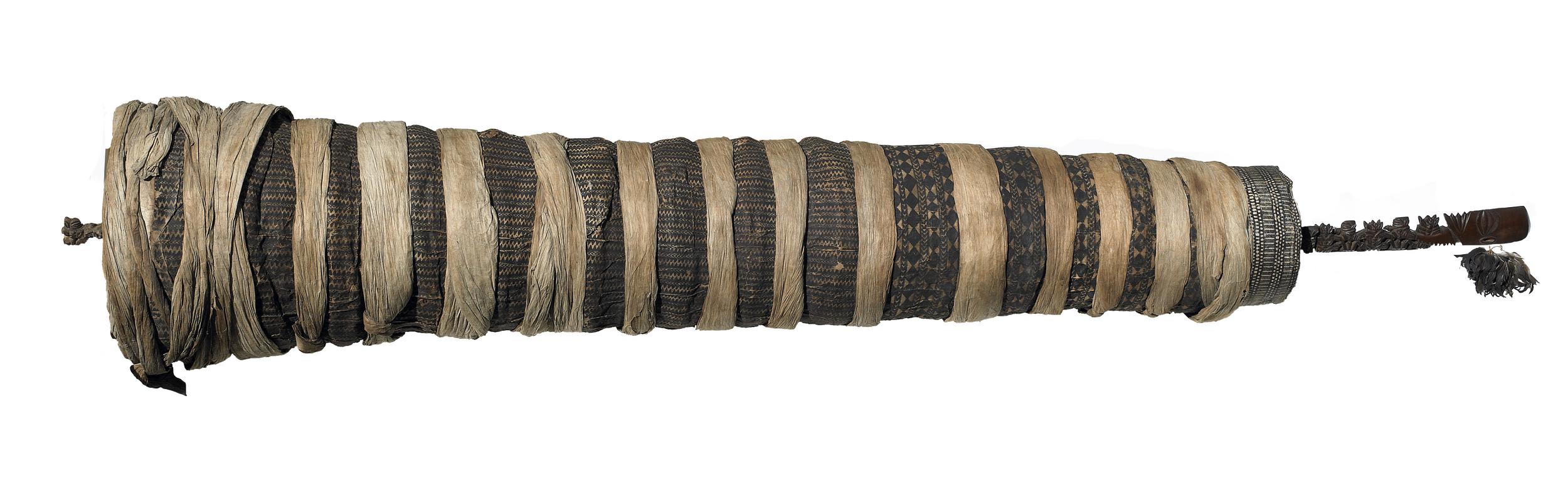
Staff-god in its barkcloth wrapping, Rarotonga, Cook Islands (© Trustees of the British Museum)
- Location: Rarotonga, Cook Islands, central Polynesia
- Date: Late 18th to early 19th century ce
- Medium: Wood, tapa, fiber, and feathers
- Represents a deity, with wrapping and covering used to protect the focus of spiritual power from human access.
- Connect it to ideas of mana and tapu and to how covering keeps powerful forms secure.
Female deity
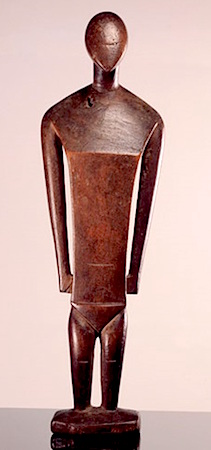
Female figure, Nukuoro, Caroline Islands, Micronesia, wood (Barbier-Mueller Museum)
- Location: Nukuoro, Micronesia
- Date: c. 18th to 19th century ce
- Medium: Wood
- A carved wood figure of a deity. Its simplified, smooth forms make it useful for visual analysis of abstraction in Pacific sculpture.
- Keep claims focused on its identity as a deity figure and its medium rather than inventing specific functions.
Buk (mask)

Mask (Buk), Torres Strait, mid to late 19th century, turtle shell, wood, cassowary feathers, fiber, shell, paint (The Metropolitan Museum of Art)
- Location: Torres Strait
- Date: Mid- to late 19th century ce
- Medium: Turtle shell, wood, fiber, feathers, and shell
- A mask combining many natural and rare materials. Masks and their performance recite and commemorate ancestors' histories and wisdom.
- Strong example of how performance gives a work its meaning, not just the object alone.
Hiapo (tapa)
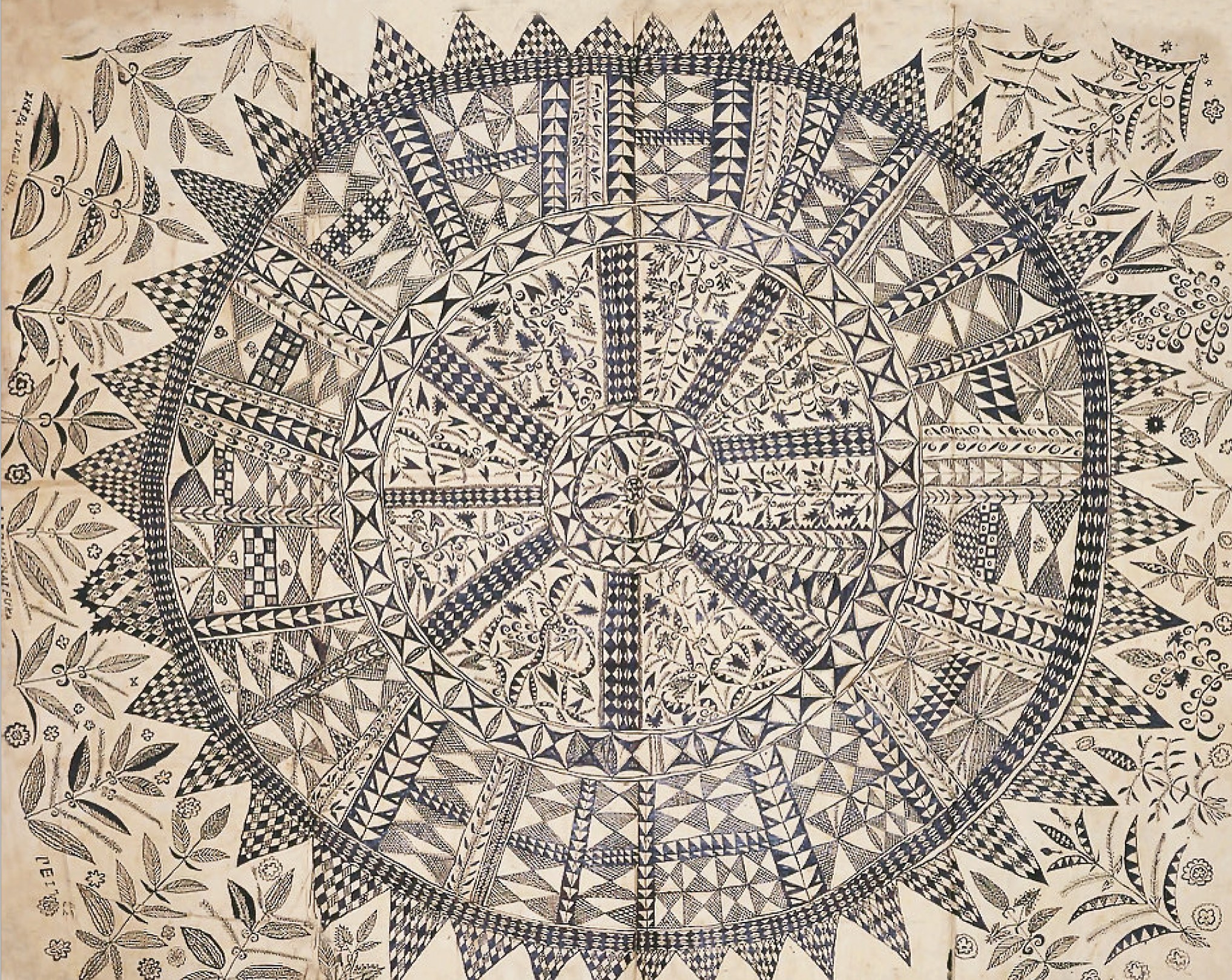
Hiapo (tapa), Niue, c. 1850-1900, tapa or bark cloth, freehand painting (Auckland War Memorial Museum)
- Location: Niue
- Date: c. 1850-1900 ce
- Medium: Tapa or bark cloth, freehand painting
- Bark cloth decorated with freehand painted patterns. Good example for analyzing surface design and the skilled use of fiber-based materials.
- Focus on its medium and decoration rather than adding unsupported ritual claims.
Tamati Waka Nene
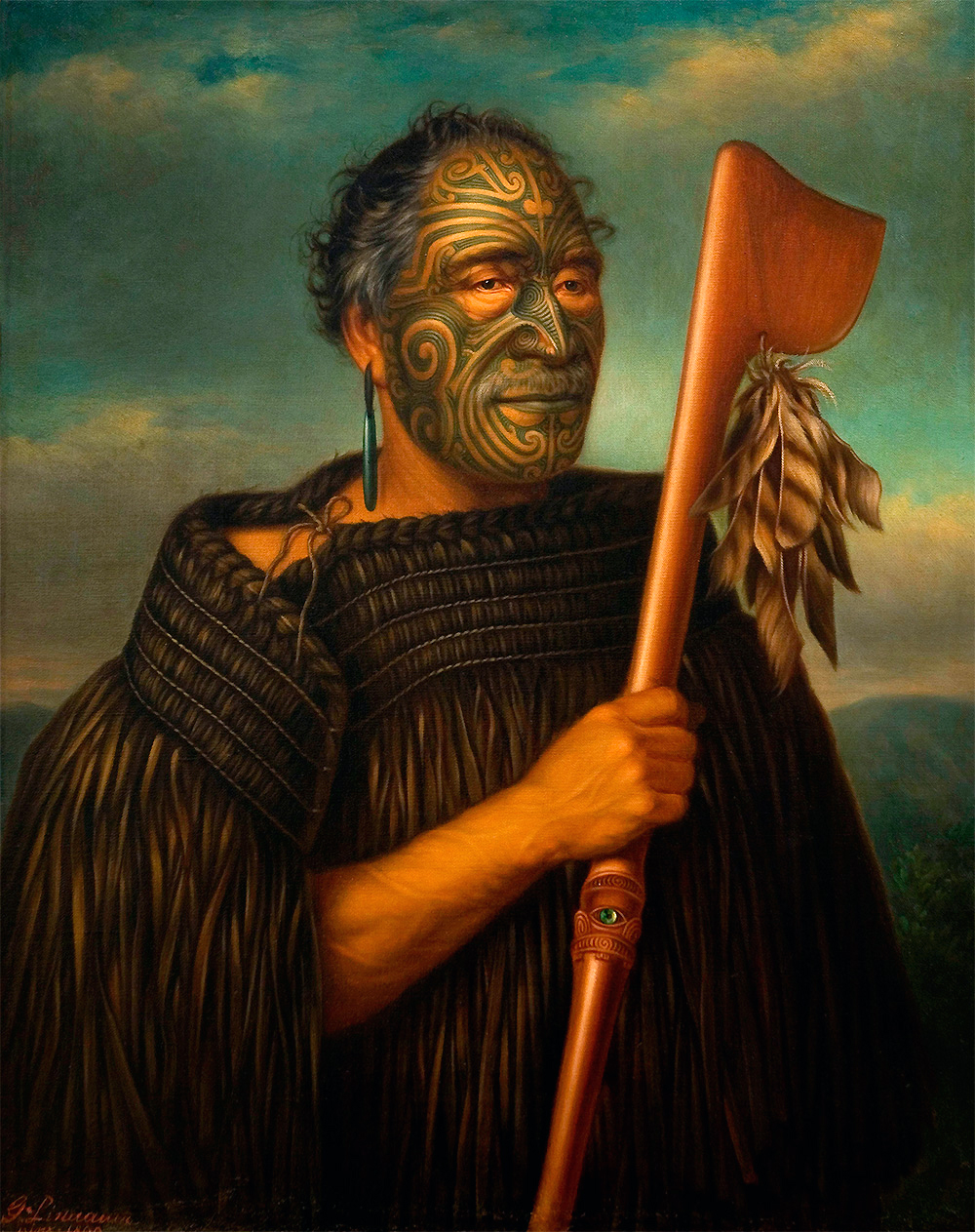
Gottfried Lindauer, Tamati Waka Nene, 1890, oil on canvas (Auckland Art Gallery)
- Artist: Gottfried Lindauer
- Date: 1890 ce
- Medium: Oil on canvas
- A portrait of a Maori leader painted in a European oil-on-canvas style. It shows the impact of external influences like commerce, colonialism, and contact with Europeans.
- Use it as an example of cross-cultural interaction, blending Maori subject and identity with European painting technique.
Navigation chart

Navigation chart (rebbelib), wood and shell, Marshall Islands, Micronesia © Trustees of the British Museum
- Location: Marshall Islands, Micronesia
- Date: 19th to early 20th century ce
- Medium: Wood and fiber
- A personal chart expressing a navigator's knowledge of the sea, used to support exploration, migration, and safe sailing.
- Tie it directly to the theme of the sea and to the navigation expertise that connected Pacific peoples across vast distances.
Malagan display and mask

Malagan figure (detail), wood, vegetable fiber, pigment and shell, north coast of New Ireland, Papua New Guinea © Trustees of the British Museum
- Location: New Ireland Province, Papua New Guinea
- Date: c. 20th century ce
- Medium: Wood, pigment, fiber, and shell
- Elaborate carved masks and displays used to honor the deceased and their ancestors. In Melanesia, status and social balance are tied to relationships and exchange.
- A key example of works created for a performance or memory and then sometimes harmed once their purpose is complete.
Presentation of Fijian mats and tapa cloths to Queen Elizabeth II
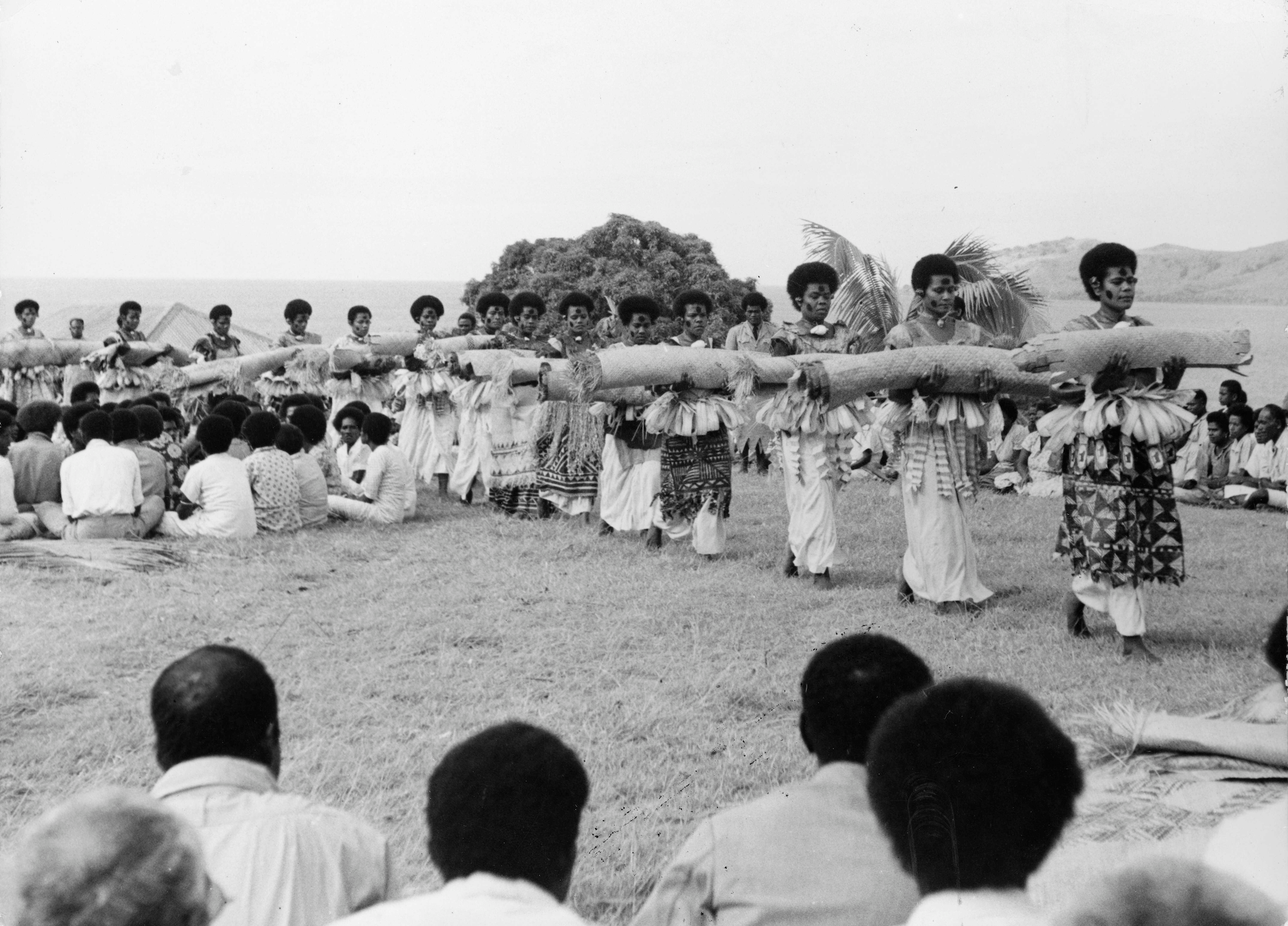
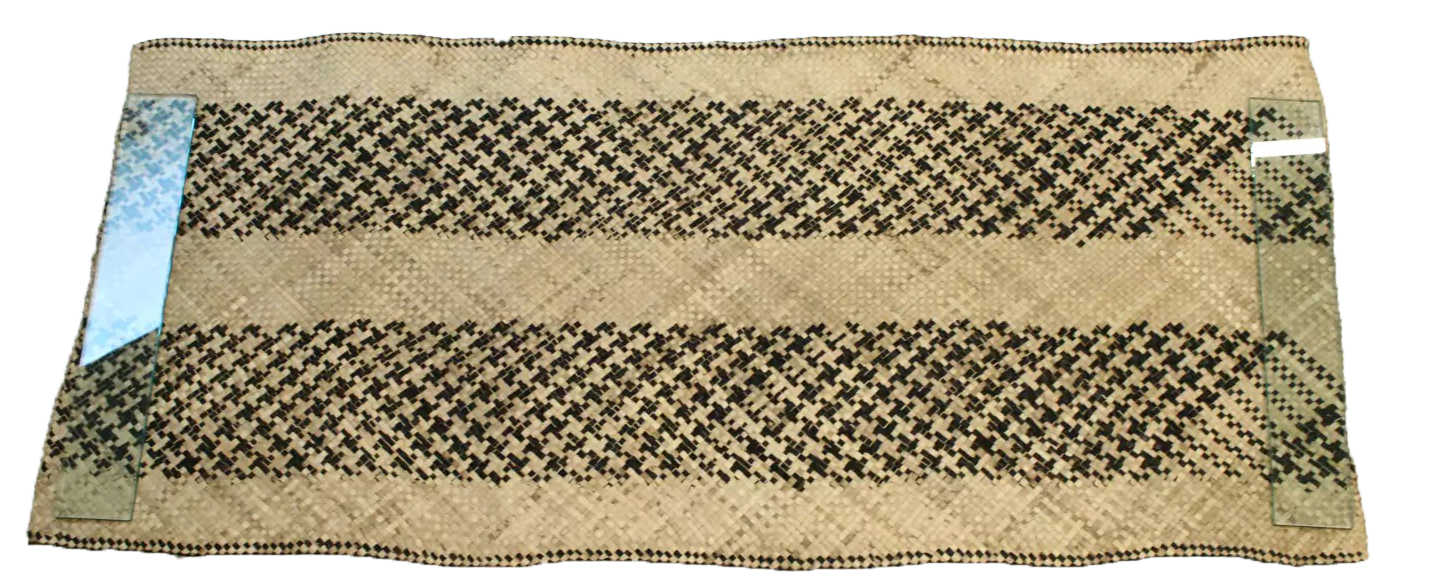
Presentation of Fijian mats and tapa cloths to Queen Elizabeth II during the 1953-54 royal tour, silver gelatin print (Alexander Turnbull Library, Wellington, New Zealand). Mat, Fiji, pandanus leaf (Auckland War Memorial Museum)
- Location: Fiji, Polynesia
- Date: 1953 ce
- Medium: Multimedia performance (costume; cosmetics, including scent; chant; movement; and pandanus fiber/hibiscus fiber mats), with photographic documentation
- A reciprocal exchange in which designated people and communities present specific items in a structured ceremony that engages all the senses.
- Strong example of reciprocity, performance, and how exchange expands the significance of objects.
How to Use This on the AP Art History Exam
MCQ
- Practice quick identification: link each work to its location/culture, date range, and medium. Many multiple-choice questions test whether you can attribute an unfamiliar image to the right culture and period.
- Watch for material clues. Feathers and fiber point to the Hawaiian feather cape, basalt islets point to Nan Madol, and turtle shell points to the Buk mask.
Free Response
- For interpretation questions, make a claim and back it with specific visual and contextual evidence. For example, explain how the feather cape's rare materials show status, or how a navigation chart reflects the importance of the sea.
- Treat experts' interpretations as arguments to evaluate, not fixed facts. Show how the interpretation is supported by the work's form, function, and context.
Comparison
- Group works by shared themes to compare quickly: status and power (feather cape, Nan Madol), ancestors and memory (moai, Malagan, Buk mask), the sea and navigation (navigation chart), and cross-cultural contact (Tamati Waka Nene, the Fijian presentation).
Common Trap
- Do not assume every Pacific work is purely "ancestral" or "ritual." Use precise functions supported by the work, and use "may" or "one interpretation" when a function is debated.
Common Misconceptions
- Misconception: The feather cape and the female deity are from the same culture.Actually: The feather cape is not the same as the female deity's culture. The cape is Hawaiian, while the Nukuoro female deity is from Micronesia. Keep cultures and locations straight.
- Misconception: Pacific art is only carved objects.Actually: Pacific art is not only carved objects. Several required works are performances or events, and the experience can carry the meaning more than the object.
- Misconception: All works are meant to be permanent.Actually: Some works are meant to be temporary. With Malagan, the creation, use, and later dismantling of the object can matter more than preserving it, which can feel surprising compared to museum-based ideas of art.
- Misconception: Tapa is a single fixed design.Actually: "Tapa" is a material and technique, not a single fixed design. Hiapo refers to tapa from Niue with freehand painting.
- Misconception: The moai have one certain purpose.Actually: The moai's exact purpose is debated. Connect them to ancestors and sacred space, but avoid stating a single certain function as fact.
- Misconception: Lindauer's portrait is a traditional Maori carving.Actually: Lindauer's portrait is European oil on canvas, not a traditional Maori carving. It shows cross-cultural interaction, so do not treat it as an Indigenous medium.
Related AP Art History Guides
Frequently Asked Questions
How many AP Art History Unit 9 required works are there?
There are 11 required works in AP Art History Unit 9: The Pacific. You should know each work's title, location or culture, date, medium, and how form connects to function and context.
What are the AP Art History Pacific required works?
The Unit 9 works include Nan Madol, moai on ahu, Ahu ula feather cape, staff god, female deity, Buk mask, Hiapo tapa, Tamati Waka Nene, navigation chart, Malagan display and mask, and Fijian mats and tapa cloths.
Why are materials important in Pacific art?
Materials such as feathers, fiber, turtle shell, wood, basalt, shell, and tapa often signal rarity, status, spiritual power, or skilled making. Material evidence helps you support interpretation claims on the exam.
How does performance matter in AP Art History Unit 9?
Many Pacific works gain meaning through performance, ceremony, movement, scent, chant, exchange, or temporary use. The object alone may not carry the full meaning.
What themes connect Unit 9 required works?
Major themes include ancestry, status, mana, tapu, navigation, the sea, reciprocity, cross-cultural contact, and the relationship between objects and performance.
How should I study AP Art History Unit 9?
Study by grouping works by theme and by drilling identifying details. Practice connecting visual evidence to context, such as feathers to status, basalt islets to Nan Madol, or turtle shell to the Buk mask.
See Fiveable more often in Google
Mark Fiveable as a preferred source and Google is more likely to show you our guides in Top Stories, with a "preferred" badge in AI Mode and AI Overviews.