Multiple-Choice Questions (MCQ)

🖼AP Art History Review
Multiple-Choice Questions (MCQ)
🖼 AP Art History
Overview
The AP Art History MCQ section gives you 80 multiple-choice questions in 60 minutes, and it counts for 50% of your total exam score. Questions appear both individually and in sets of 3 to 6 questions tied to one or more images, drawing on works from the 250-piece required image set as well as unfamiliar works you've never seen. The exam has been fully digital since May 2025, so the images appear on screen instead of in a booklet.
That last part is what makes this section unique among AP exams. You can't reason your way through from a passage like in AP Lang. The exam assumes you carry a mental library of those 250 works, not just titles and dates, but visual characteristics, cultural context, and function. Unknown works are chosen specifically because they connect to traditions you've studied, so your job is to use what you know as a compass.
AP Art History MCQ Format and Weighting
The multiple-choice section is Section I of the exam, worth half your score, and it averages out to 45 seconds per question.
| Fact | Detail |
|---|---|
| Number of questions | 80 |
| Time | 60 minutes |
| Exam weighting | 50% of total score |
| Question styles | Individual questions and image-based sets of 3-6 questions |
| Images | Works from the required image set AND works beyond it |
| Format | Fully digital (since May 2025) |
The questions are built around art historical thinking skills, and the weighting tells you exactly where to invest your study time:
| Skill | Share of MCQs | What it asks |
|---|---|---|
| Contextual Analysis | 28-32% | Why a work was made, for whom, and how context shapes meaning |
| Artistic Traditions | 20-25% | How a work relates to a style, movement, or practice |
| Visual Analysis | 15-19% | Identifying works and explaining how visual choices create meaning |
| Comparison | 11-13% | How two or more works relate |
| Visual Analysis of Unknown Works | 6-8% | Analyzing a work beyond the image set |
| Attribution of Unknown Works | 6-8% | Attributing a work beyond the image set to a culture, period, or artist |
| Art Historical Interpretations | 6-8% | How scholars have interpreted works |
Notice that contextual analysis is the single biggest category. Almost a third of the section asks "why" rather than "what does it look like." Also notice that 12-16% of questions use works beyond the image set; questions testing unknown-work skills always show works outside the 250.
Content coverage follows the course units. Early Europe and Colonial Americas (~21%) and Later Europe and Americas (~21%) together make up about 42% of the section. Ancient Mediterranean is ~15% and Global Contemporary is ~11%. The remaining units (Indigenous Americas, Africa, West and Central Asia, South/East/Southeast Asia, the Pacific) each carry roughly 4-8%, which means a small number of questions can hinge on deep knowledge of those visual traditions. Don't skip them; a handful of guaranteed points lives there.
For the other half of the exam, the six free-response essays, see the guides on the long essay FRQs 1-2 and the short essay FRQs 3-6.
How to Approach the AP Art History MCQ Section
The core strategy is steady momentum plus instant pattern recognition. You answer easy recognition questions in 20 seconds so you can spend a full minute on tricky attributions.
Pace yourself by checkpoint, not by question
Sixty minutes for 80 questions sounds brutal, but set-based questions share analysis time, and many questions are quick recognition checks. Use checkpoints instead of a per-question stopwatch. As a rough target, be through question 20 in about 12-13 minutes and have 32-35 minutes left at question 40. That cushion matters because the hardest attributions and unknown-work analysis often cluster later, and image fatigue is real around question 60. When Byzantine and Romanesque start looking identical, close your eyes for three seconds, breathe, and reset.
For set-based questions, read every question in the set before you study the image closely. This primes your eye for what to notice and saves you from re-analyzing the same image three times.
Scan images systematically
When an image appears, give yourself about 10 seconds of structured looking before touching the answers. Go in this order: medium first (painting, sculpture, architecture), then immediate visual qualities (color, composition, scale clues), then style markers (perspective system, brushwork, carving technique). This isn't casual looking. It's close visual examination under time pressure, and the order keeps you from fixating on one detail.
The goal is recognition that feels as automatic as reading letters. Archaic Greek sculpture has that distinctive smile and frontal rigidity. Northern Renaissance painting shows obsessive detail. Baroque works create drama through extreme light-dark contrast. When you see an unknown work, your brain should start sorting immediately: "Red-figure pottery technique, but the musculature is too naturalistic for Archaic, so this is Classical."
Answer context questions historically, not personally
Contextual analysis questions want the original historical function, not a modern reading. When a question asks about the function of a cathedral tympanum, the answer they want is "taught biblical stories to a largely illiterate population," not "expressed the church's power" (even if both are arguably true). A question about Aztec art wants Mexica religious beliefs and political structures, not post-colonial interpretation. Think like an art historian working in the work's own time and place.
Treat attribution questions as elimination puzzles
Unknown-work attribution questions are detective problems with multiple solution paths. Start with the most distinctive feature and work backward. Elongated proportions and a sinuous S-curve put you in Gothic territory. Add pointed arches and you're likely looking at French Gothic. Same elongation but a gold background? Now you're thinking Byzantine or medieval Italian.
Use the answer choices as evidence too. If three options are Renaissance artists and one is Baroque, and the painting shows dramatic tenebrism, you've found your answer. The exam picks unknowns that clearly belong to a tradition but aren't famous enough to recognize on sight, so material and technique clues (specific woods, glazing methods, binding techniques) often give a surer attribution than style alone.
Recurring Question Patterns and Distractor Traps
Wrong answers on this exam are built in predictable ways, and recognizing the construction helps you eliminate fast.
Chronological neighbors. If the correct answer is "Classical Greek," expect "Archaic Greek" and "Hellenistic Greek" as distractors. This tests whether you actually understand stylistic evolution or just memorized period names. (Sample exam questions do exactly this: one released item offers Archaic Greek, Classical Greek, Ancient Etruscan, and Early Byzantine as the four choices.)
Geographic confusion within a shared tradition. For Buddhist art, if the answer is Gupta India, expect Tang China or Heian Japan as options. Same iconography, different regional expression. Know the regional tells.
Function vs. form traps. A question about purpose may include an option that accurately describes appearance but misses function. For Egyptian tomb painting, "displayed naturalistic portraiture" might be partially true, but "ensured the deceased's successful afterlife journey" is the functional answer being tested. Match your answer to the verb in the question.
Vocabulary precision checks. Tenebrism vs. chiaroscuro, fresco vs. tempera, icon vs. idol. When technical terms appear in the choices, the question is testing vocabulary as much as vision. Wrong answers use terms that sound plausible but are wrong for that culture, medium, or period. The key terms glossary is a good place to drill these distinctions.
Continuity-and-change balance. When a question asks how a work relates to earlier traditions, the correct answer usually captures both what continued and what changed. For a Neoclassical painting, the right answer mentions the revival of Classical ideals AND the Enlightenment context. Choices that are all similarity or all difference are usually wrong.
Worked Example: Reading a Released Question
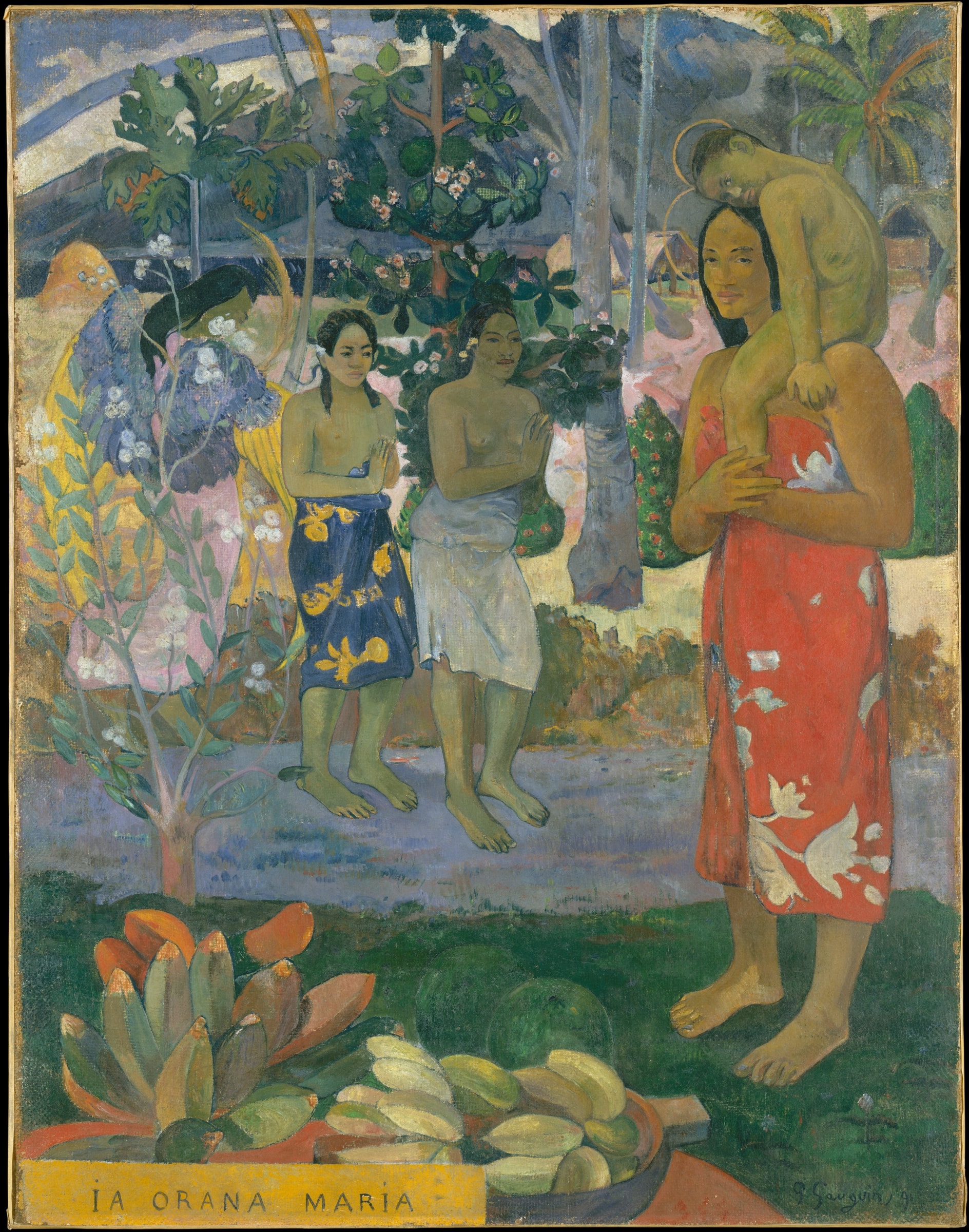
Here's a released question and how a prepared student moves through it. The exam shows an unfamiliar print and asks:
The work shown demonstrates the influence of Japanese ukiyo-e prints through its depiction of (A) an allegory of vanity heightened by strident colors (B) daily life using flattened shapes and patterns (C) a satire of aristocratic life presented with minute detail (D) a genre scene using objects with symbolic meaning
The question itself hands you the framework: ukiyo-e influence. So ask yourself what ukiyo-e prints are actually known for. The answer is everyday subject matter, flattened space, bold outlines, and decorative pattern. That maps directly onto (B). Choices (A), (C), and (D) each describe real things European art does (vanitas allegory, social satire, symbolic genre scenes), but none of them is the signature of Japanese print influence. The correct answer is (B).
That's the pattern for most contextual and tradition questions. Define the key term in the stem first, then find the choice that matches the definition. Don't start by debating the choices.
A second example tests interpretation. A question about the colossal Longmen Buddha says art historians theorize it was created to popularize Buddhist teachings "as well as to" do what? The answer is "reinforce the political power of imperial rule." Monumental scale plus imperial sponsorship is a recurring logic across cultures, from Egyptian pharaohs to Qin terracotta warriors to Napoleonic portraiture. When you recognize these cross-cultural strategies (monumental scale, frontality, symbolic attributes signal power), whole families of questions become predictable.
Common Mistakes
- Studying the 250 works as flashcard IDs only. Recognizing Las Meninas isn't enough; questions probe why Velázquez included himself or what the mirror signifies. For every work, know its innovation, its function, and the formal traits that mark its period.
- Neglecting the small-percentage units. The Pacific, Africa, and West and Central Asia each sit around 4-6%, so it's tempting to skip them. That's roughly 11 free-ish points combined, and these questions are often straightforward if you know the works at all.
- Burning a minute on one attribution. If you're stuck after two eliminations, pick the best remaining option, flag it, and move on. There's no guessing penalty, and an unanswered question is a guaranteed zero.
- Answering with modern interpretations. The exam rewards historical context. If a choice sounds like a contemporary critique and another sounds like the work's original audience and purpose, the original-context answer almost always wins.
- Confusing accurate description with the right answer. Distractors often describe something true about the image but irrelevant to the question. Re-read the stem's verb (function? technique? influence? attribution?) before committing.
- Ignoring set-based efficiency. Analyzing the same image fresh for each question in a 3-6 question set wastes minutes. Read the whole set first, do one thorough scan, then answer.
Practice and Next Steps
Timed repetition is what turns slow analysis into instant recognition. Start with the AP Art History exam prep hub to see how the MCQ section fits alongside the six FRQs, then drill questions in guided MCQ practice to build that 45-second rhythm with feedback on why each answer is right.
Once individual questions feel comfortable, take a full-length practice exam to test your pacing checkpoints (question 20 by minute 13, question 40 with 32-35 minutes left) and to experience the image fatigue that hits around question 60. Reviewing past exam questions helps you internalize the distractor patterns above, since the same construction tricks repeat year after year.
After each practice run, plug your raw scores into the AP score calculator to see how MCQ performance combines with the FRQ section. Since the MCQ is exactly half your score, every point of accuracy you add here moves your final score as much as an FRQ improvement does.
Frequently Asked Questions
How many multiple-choice questions are on the AP Art History exam?
The AP Art History MCQ section has 80 questions in 60 minutes, which averages to 45 seconds per question. Questions appear individually and in image-based sets of 3 to 6 questions, and the section counts for 50% of your total exam score.
What skills does the AP Art History multiple-choice section test most?
Contextual Analysis is the biggest category at 28-32% of questions, followed by Artistic Traditions (20-25%) and Visual Analysis (15-19%). Comparison makes up 11-13%, and unknown-work analysis, attribution, and art historical interpretations each cover 6-8%. Practice these question types in guided MCQ practice.
Are all AP Art History MCQ questions about the 250 required works?
No. About 12-16% of questions show works beyond the required image set, and questions testing visual analysis or attribution of unknown works always use unfamiliar pieces. Those unknowns are chosen because they clearly connect to styles and cultures from the 250 works, so you analyze them by comparison rather than recognition.
Which units are weighted most on the AP Art History MCQ?
Early Europe and Colonial Americas (~21%) and Later Europe and Americas (~21%) together make up about 42% of multiple-choice questions. Ancient Mediterranean is ~15% and Global Contemporary is ~11%, while the remaining units each carry roughly 4-8%. Don't skip the smaller units; they add up to about a fifth of the section.
Should you guess on AP Art History multiple-choice questions?
Yes, always answer every question. There is no penalty for wrong answers, so a blank is a guaranteed zero while an educated guess after eliminating one or two choices has solid odds. If an attribution question stalls you, pick the best remaining option, flag it, and keep your pacing on track.
See Fiveable more often in Google
Mark Fiveable as a preferred source and Google is more likely to show you our guides in Top Stories, with a "preferred" badge in AI Mode and AI Overviews.