9.1 Supply Chain Strategy and Design

🏭Intro to Industrial Engineering Unit 9 Review
9.1 Supply Chain Strategy and Design
🏭 Intro to Industrial Engineering
Supply chain management's strategic importance
Supply chain strategy and design determine how a company moves goods, services, and information from raw material suppliers all the way to end customers. Getting this right affects everything from cost structure to customer satisfaction, which is why it's a core topic in industrial engineering.

Top images from around the web for Integration and performance impact
Supply Chain Integration | Levels & Barriers to Supply Chain Integration View original
Is this image relevant?
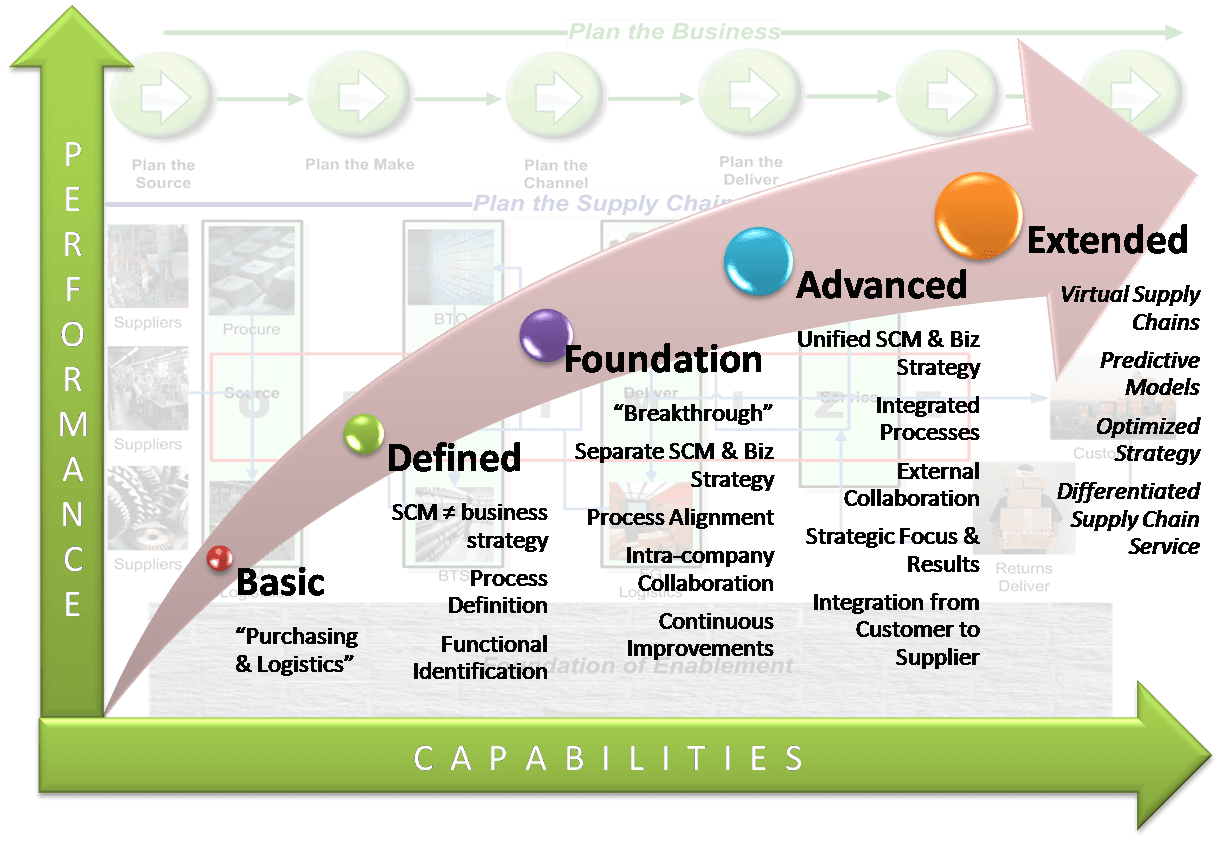
Levels & Barriers to Supply Chain Integration: a Conceptual Model of Supply Chain Performance ... View original
Is this image relevant?
Levels & Barriers to Supply Chain Integration: a Conceptual Model of Supply Chain Performance ... View original
Is this image relevant?
Supply Chain Integration | Levels & Barriers to Supply Chain Integration View original
Is this image relevant?
Levels & Barriers to Supply Chain Integration: a Conceptual Model of Supply Chain Performance ... View original
Is this image relevant?
Integration and performance impact
Supply chain management (SCM) is the coordination of the entire flow of goods, services, information, and finances across a network of suppliers, manufacturers, distributors, and customers. It's not just about logistics; it touches nearly every part of a business.
Effective SCM directly improves key performance indicators:
- Cost reduction through optimized inventory levels and fewer redundancies
- Revenue growth by getting the right products to market faster
- Customer satisfaction through shorter lead times and more reliable delivery
SCM also plays a critical role in risk management. By mapping out the full supply chain, companies can identify where disruptions are most likely (a single-source supplier, a bottleneck at a port) and build mitigation strategies before problems hit.
What makes SCM powerful is its integration with other business functions. Marketing needs accurate delivery promises. Finance needs cost visibility. Product development needs to know supplier capabilities. When SCM connects with these functions, the whole organization runs more smoothly.
Adapting to global trends
SCM has become more strategically important as supply chains have gone global and consumer expectations have shifted. Several trends are driving this:
- E-commerce growth and same-day delivery expectations require faster, more flexible distribution networks
- Ethical sourcing and transparency are increasingly demanded by consumers and regulators
- Sustainability goals push companies to reduce carbon footprints through optimized routing, sustainable packaging, and reverse logistics (recovering products for recycling or reuse)
- Technological advancements like IoT sensors, AI-driven demand forecasting, and blockchain for traceability are reshaping how supply chains operate
Companies that don't adapt their supply chain practices to these shifts risk losing competitiveness.
Supply chain strategies for business goals
Different business goals call for different supply chain strategies. The key is matching your strategy to your product type, demand patterns, and competitive environment.

Efficiency-focused strategies
A lean supply chain strategy minimizes waste and maximizes efficiency. It works best for products with stable, predictable demand, like household staples or commodity goods.
- Core techniques: just-in-time (JIT) inventory, value stream mapping, continuous improvement (kaizen)
- Goal: reduce costs by eliminating non-value-adding activities at every stage
- The tradeoff is that lean chains have very little buffer, so they're vulnerable when demand suddenly spikes or a supplier goes down
A risk-hedging strategy prioritizes business continuity by building in redundancy and diversification. This is especially relevant for companies exposed to supply disruptions from natural disasters, geopolitical instability, or sole-source dependencies.
- Methods: multi-sourcing (using multiple suppliers for the same component), maintaining safety stock, and developing flexible manufacturing capabilities
- Tradeoff: higher inventory and sourcing costs in exchange for greater resilience
A green supply chain strategy aligns operations with environmental sustainability goals and regulatory requirements.
- Practices: reverse logistics, sustainable packaging, use of renewable energy in operations
- This strategy is increasingly a competitive differentiator, not just a compliance exercise
Flexibility and collaboration strategies
An agile supply chain strategy prioritizes responsiveness to rapid market changes. It suits products with unpredictable demand or short lifecycles (think fashion or consumer electronics).
- Approaches: modular product design, postponement (delaying final customization until demand is known), and demand-driven production
- The focus is on speed and adaptability rather than cost minimization
A leagile (hybrid) strategy combines lean and agile elements. A company might use lean practices for its high-volume, stable products while applying agile practices for customized or seasonal items. The decoupling point is where the chain shifts from lean (push-based, driven by forecasts) to agile (pull-based, driven by actual customer orders). Choosing where to place this point is one of the most important design decisions in a leagile system.
A collaborative supply chain strategy emphasizes partnerships and information sharing across supply chain members.
- Tools include vendor-managed inventory (VMI), where the supplier monitors and replenishes stock, and CPFR (Collaborative Planning, Forecasting, and Replenishment), where partners jointly develop demand forecasts
- Better information sharing reduces the bullwhip effect, where small demand fluctuations at the retail level get amplified as you move upstream toward manufacturers and raw material suppliers. For example, a 5% increase in consumer purchases might look like a 20% spike to a tier-two supplier because each link in the chain overreacts.
Strategy selection considerations
Choosing the right strategy isn't one-and-done. You should evaluate:
- Product characteristics - Is demand stable or volatile? Is the product standardized or customized?
- Supply and demand uncertainty - High uncertainty favors agile or risk-hedging approaches; low uncertainty favors lean
- Competitive landscape - What do customers in your market value most: low price, fast delivery, customization?
- Organizational capabilities - Does the company have the technology, partnerships, and workforce to execute the strategy?
Strategies should be reviewed regularly as market conditions, technology, and customer expectations evolve. Many companies also use different strategies for different product lines within the same organization.

Designing effective supply chain networks
Network design is about making strategic, long-term decisions on the physical structure of your supply chain. These decisions are expensive to reverse, so getting them right matters.
Facility planning and analysis
Network design determines the number, location, and capacity of facilities (plants, warehouses, distribution centers). The goal is to balance cost, service level, and risk.
Facility location analysis weighs multiple factors:
- Proximity to suppliers and customers (affects transportation cost and lead time)
- Labor availability and wage rates
- Transportation infrastructure (highways, ports, rail access)
- Local regulations, tax incentives, and trade zones
- Political stability and economic conditions of the region
Capacity planning determines how much each facility should be able to produce or store. Common methods include:
- Linear programming to optimize resource allocation across facilities, for example minimizing total cost subject to constraints on demand fulfillment and production limits
- Simulation modeling to test performance under different demand scenarios without risking real resources
- Scenario analysis to plan for best-case, worst-case, and most-likely outcomes
Geographic Information Systems (GIS) and data visualization tools support these decisions by mapping spatial relationships. They're used for site selection, route optimization, and understanding how well a network covers its target markets.
Transportation and logistics considerations
The choice of transportation mode shapes the entire network design. Each mode involves tradeoffs:
| Factor | Truck | Rail | Ocean | Air |
|---|---|---|---|---|
| Cost per unit | Moderate | Low | Very low | Very high |
| Speed | Fast (short distance) | Moderate | Slow | Very fast |
| Flexibility | High | Low | Low | Moderate |
| Capacity | Moderate | High | Very high | Low |
Multimodal transportation combines modes to balance cost and speed. A common example: ocean freight for long-distance international shipping, then trucks for last-mile delivery to customers. The key is picking the combination that meets your service-level requirements at the lowest total cost.
Two distribution strategies that improve network efficiency:
- Cross-docking: Products arrive at a facility and are immediately sorted and shipped out without being stored. This cuts handling and storage costs but requires tight coordination of inbound and outbound schedules.
- Hub-and-spoke systems: Shipments are consolidated at a central hub, then distributed outward to destinations. This reduces the number of direct routes needed (compared to point-to-point shipping) while keeping delivery speed reasonable.
Optimization techniques and future planning
Quantitative methods are central to network design in industrial engineering:
- Mixed-integer linear programming (MILP) for facility location and capacity decisions. For instance, if you have 10 candidate warehouse sites, MILP can determine which combination to open to minimize total cost while meeting all regional demand.
- Network optimization models for analyzing product flow and minimizing total cost (transportation + inventory + facility operating costs) across the network
- Simulation models for evaluating how the network performs under various scenarios like demand spikes, supplier failures, or transportation delays
A well-designed network also accounts for the future. Techniques for building in adaptability:
- Sensitivity analysis: Testing how results change when key assumptions (demand growth, fuel costs) shift
- Scenario planning: Developing strategies for multiple possible futures rather than betting on a single forecast
- Real options analysis: Valuing the flexibility to expand, contract, or reconfigure facilities later, similar to how financial options give you the right but not the obligation to act
Practical ways to build flexibility into the physical network include modular facility designs (easy to expand), scalable automation systems, and adaptable transportation contracts that allow volume adjustments. The goal is a network that performs well today and can evolve as conditions change.
See Fiveable more often in Google
Mark Fiveable as a preferred source and Google is more likely to show you our guides in Top Stories, with a "preferred" badge in AI Mode and AI Overviews.