4.1 Inventory Models and Economic Order Quantity

🏭Intro to Industrial Engineering Unit 4 Review
4.1 Inventory Models and Economic Order Quantity
🏭 Intro to Industrial Engineering
Inventory Management in Industrial Engineering
Inventory models give you a structured way to decide how much to order and when to order it. The Economic Order Quantity (EOQ) model is the most foundational of these: it finds the order size that minimizes your total costs. Once you understand EOQ, more advanced inventory systems start to make a lot more sense.

Top images from around the web for Importance and Key Concepts
Application Economic Order Quantity (EOQ) for Control of Raw Material Inventory | Management ... View original
Is this image relevant?
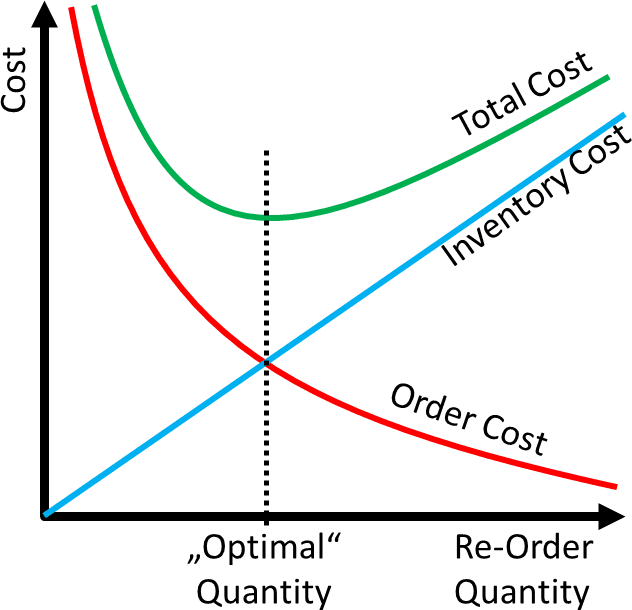
Economic Order Quantity Theory | AllAboutLean.com View original
Is this image relevant?
Controlling the Supply Chain | Boundless Business View original
Is this image relevant?
Application Economic Order Quantity (EOQ) for Control of Raw Material Inventory | Management ... View original
Is this image relevant?
Economic Order Quantity Theory | AllAboutLean.com View original
Is this image relevant?
Importance and Key Concepts
Inventory management is the process of controlling and overseeing the ordering, storage, and use of the materials a company needs. The central challenge is balancing two competing goals: keeping inventory costs low while still having enough stock on hand to meet customer demand.
There are several types of inventory, and each requires a different management approach:
- Raw materials are inputs waiting to be used in production
- Work-in-progress (WIP) refers to partially completed goods still on the production floor
- Finished goods are completed products ready for sale or shipment
To measure how well inventory is being managed, companies track key performance indicators like:
- Inventory turnover ratio (how many times inventory is sold and replaced per year)
- Days of inventory on hand (how long current stock would last at the current sales rate)
- Stock-out rate (how often demand can't be met because inventory ran out)
Effective inventory management directly affects production scheduling, supply chain efficiency, and customer satisfaction. Modern systems often rely on technology like Enterprise Resource Planning (ERP) software and Radio-Frequency Identification (RFID) tags for real-time tracking.
Strategies and Techniques
- Just-in-time (JIT) inventory systems aim to receive materials only as they're needed in production, reducing holding costs significantly.
- ABC analysis categorizes inventory items by value and importance. "A" items are the most valuable (often ~20% of items but ~80% of total value), while "C" items are the least valuable. You focus tighter controls on A items.
- Safety stock is extra inventory held as a buffer against unexpected demand spikes or supply delays. Calculating the right amount depends on demand variability and desired service level.
- Cycle counting is a technique where you physically count a small subset of inventory on a rotating schedule, rather than shutting down for a full annual count.
- Demand forecasting methods like moving averages and exponential smoothing help predict future demand so you can adjust order quantities proactively.
- Vendor-managed inventory (VMI) shifts the responsibility for monitoring and replenishing stock to the supplier, which can streamline the supply chain for both parties.
Economic Order Quantity Model
EOQ Formula and Applications
The EOQ model answers a simple question: what order quantity minimizes total inventory costs? It balances the cost of placing orders against the cost of holding inventory.
The formula is:
Where:
- D = annual demand (units per year)
- S = ordering cost per order (fixed cost each time you place an order)
- H = annual holding cost per unit (cost to store one unit for a year)
Example: Suppose annual demand is 10,000 units, it costs $50 to place each order, and holding one unit for a year costs $2.
So you'd order about 707 units each time to minimize total costs.
The EOQ model rests on several simplifying assumptions:
- Demand is constant and known
- Replenishment is instantaneous (the entire order arrives at once)
- No stockouts are allowed
- Ordering cost and holding cost per unit are constant
These assumptions rarely hold perfectly in practice, but EOQ still provides a strong baseline. The model can be extended to handle quantity discounts, planned backorders, and production settings. The Economic Production Quantity (EPQ) model, for instance, relaxes the instantaneous replenishment assumption for situations where items are produced internally over time.
Sensitivity Analysis and Model Limitations
One useful property of EOQ: the total cost curve is relatively flat near the optimum. This means that if your order quantity is somewhat off from the true EOQ, your total cost won't increase dramatically. That's good news, because real-world parameters are rarely known with precision.
Sensitivity analysis helps you understand how changes in D, S, or H affect the optimal order quantity. Because EOQ uses a square root, doubling demand doesn't double the order quantity; it increases it by a factor of about 1.41 ().
Real-world limitations to keep in mind:
- Demand is often variable or seasonal, not constant
- Lead times can fluctuate, making instantaneous replenishment unrealistic
- Perishable products or items at risk of obsolescence may incur holding costs that change over time
- Suppliers may impose minimum order quantities that override the EOQ calculation
- Different industries (retail, manufacturing, healthcare) may need modified versions of the model
Ordering vs. Holding Costs

Cost Components and Trade-offs
Understanding the trade-off between ordering costs and holding costs is the entire foundation of the EOQ model.
Ordering costs are the fixed expenses incurred every time you place an order. These include administrative processing, transportation and shipping fees, and any production setup costs. If you order more frequently (smaller batches), total ordering costs go up.
Holding costs are the variable expenses of keeping inventory in storage. These include warehouse space, insurance, taxes, spoilage or damage, and the opportunity cost of capital tied up in inventory. If you order less frequently (larger batches), average inventory rises and total holding costs go up.
The trade-off works like this: ordering in large quantities means fewer orders per year (lower ordering costs) but more inventory sitting in your warehouse (higher holding costs). Ordering in small quantities means the opposite. The EOQ is the point where these two cost curves intersect, and total cost is minimized.
At the optimal order quantity, annual ordering cost equals annual holding cost. This is a useful check: if you calculate EOQ and these two aren't equal, something went wrong.
Practical Applications and Considerations
- Bulk discounts complicate the trade-off. A supplier offering a lower unit price for larger orders might make it worthwhile to order more than the basic EOQ suggests.
- Seasonal demand means the "constant demand" assumption breaks down. You may need to adjust order sizes and timing throughout the year.
- Storage constraints can cap how much you're able to order at once, regardless of what EOQ recommends.
- Product shelf life directly affects holding costs. Perishable goods carry a higher effective holding cost because unsold units may expire.
- Supplier partnerships and electronic ordering systems can reduce the fixed cost per order (S), which shifts the EOQ downward toward smaller, more frequent orders.
- Financing arrangements like consignment inventory (where you don't pay until items sell) or favorable credit terms from suppliers can lower the effective holding cost.
Total Inventory Cost
Cost Calculation and Components
The total annual inventory cost combines three elements: ordering costs, holding costs, and the purchase cost of the items themselves.
Where:
- D = annual demand
- Q = order quantity
- S = ordering cost per order
- H = annual holding cost per unit
- C = unit cost of the item
Here's what each term represents:
- Annual ordering cost = . The term gives you the number of orders placed per year. Multiply by the cost per order.
- Annual holding cost = . The term represents the average inventory level (inventory cycles from Q down to 0, so the average is half). Multiply by the per-unit holding cost.
- Annual purchase cost = . Total units purchased times the unit price. This term doesn't depend on Q, so it doesn't affect the EOQ calculation unless quantity discounts are involved.
Quick check: At the EOQ, annual ordering cost and annual holding cost should be equal. If you plug your EOQ into both terms and they match, your calculation is correct.
The total cost function is convex, meaning it has a single minimum point. That minimum corresponds to the EOQ. Graphically, if you plot total cost against order quantity, you'll see a U-shaped curve with ordering costs decreasing and holding costs increasing as Q grows.
Analysis and Optimization Techniques
- Graphical analysis is a helpful study tool. Plot ordering cost, holding cost, and total cost on the same graph against Q. The point where the ordering and holding cost curves cross is the EOQ, and it sits at the bottom of the total cost curve.
- Quantity discounts shift the purchase cost term (DC) and can create multiple total cost curves, one for each price tier. You evaluate the EOQ at each price level and compare total costs to find the true optimum.
- Stockout costs aren't included in the basic model but matter in practice. If running out of stock carries a penalty (lost sales, expedited shipping, customer dissatisfaction), you may want to order more than the basic EOQ or maintain safety stock.
- Reducing total inventory cost often comes down to negotiating lower ordering costs with suppliers, improving warehouse efficiency to lower holding costs, or using better demand forecasts to avoid excess stock.
See Fiveable more often in Google
Mark Fiveable as a preferred source and Google is more likely to show you our guides in Top Stories, with a "preferred" badge in AI Mode and AI Overviews.