14.1 Fundamentals of Industrial Automation

🏭Intro to Industrial Engineering Unit 14 Review
14.1 Fundamentals of Industrial Automation
🏭 Intro to Industrial Engineering
Industrial automation replaces human operators with control systems and information technologies to run industrial processes and machinery. It relies on components like PLCs, HMIs, and SCADA systems working together across a layered architecture. This topic covers what makes up an automation system, the trade-offs of implementing it, the different levels of automation you'll encounter, and the sensors, actuators, and control systems that tie everything together.
Industrial Automation Defined

Top images from around the web for Core Concepts and Components
Industrial control system - Wikipedia View original
Is this image relevant?
Personal – Automation system of industrial control View original
Is this image relevant?
Personal – Automation system of industrial control View original
Is this image relevant?
Industrial control system - Wikipedia View original
Is this image relevant?
Personal – Automation system of industrial control View original
Is this image relevant?
Core Concepts and Components
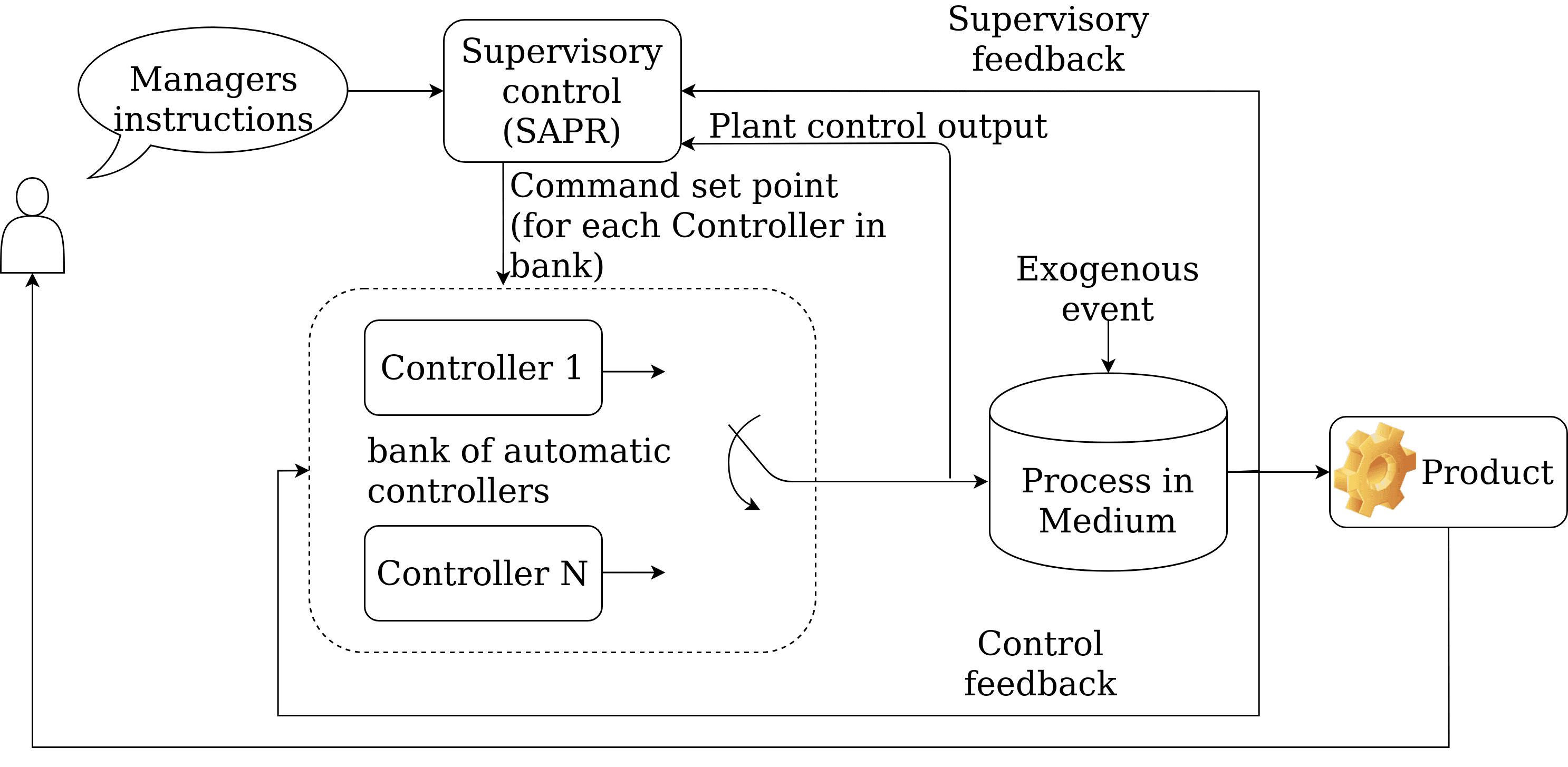
At its simplest, an industrial automation system has three elements working in a loop: sensors collect data from the physical environment, controllers process that data and make decisions, and actuators carry out those decisions as physical actions. Every automation setup, from a single machine to an entire factory, builds on this sense-decide-act cycle.
The major hardware and software components you need to know:
- Programmable Logic Controllers (PLCs) are ruggedized industrial computers that run the control logic. They're the workhorse of most automation systems.
- Human-Machine Interfaces (HMIs) give operators a visual dashboard to monitor and interact with the system.
- SCADA (Supervisory Control and Data Acquisition) systems provide high-level monitoring and control across an entire facility or process.
These components communicate over industrial network protocols like Modbus, Profibus, and EtherNet/IP. On the software side, two platforms come up frequently:
- Distributed Control Systems (DCS) coordinate multiple control loops across a process (common in chemical plants and refineries).
- Manufacturing Execution Systems (MES) track and document production from raw materials to finished goods.
System Architecture and Integration
Automation systems are organized in a layered architecture, where each level has a distinct role:
- Field level — Sensors and actuators interface directly with the physical process (measuring temperature, moving a robotic arm, etc.).
- Control level — PLCs and other controllers process incoming data and issue commands to the field devices.
- Supervisory level — SCADA systems provide operators with an overview of the entire process and allow high-level control.
- Enterprise level — MES and ERP (Enterprise Resource Planning) systems connect manufacturing data to business processes like scheduling, inventory, and finance.
This layered model is sometimes called the automation pyramid or referenced as the Purdue/ISA-95 model. Data flows upward for visibility and analytics, while commands flow downward to control the physical process.
A key trend in modern manufacturing is the convergence of IT and OT (Operational Technology). IT systems handle business data and analytics, while OT systems control the physical equipment. Merging them creates what's often called a "smart factory."
Two computing approaches support this integration:
- Cloud computing provides centralized storage and powerful analytics for large datasets.
- Edge computing processes data right at the device level, which is critical when you need real-time responses (millisecond latency matters on a production line).
Automation Benefits vs Challenges
Advantages of Industrial Automation
- Increased productivity — Automated systems can run continuously (24/7) without breaks, and they typically process faster than manual operations.
- Improved quality and consistency — Machines don't get tired or distracted, so they minimize the variability and errors that come with human operation.
- Enhanced safety — Automation removes workers from hazardous environments (extreme heat, toxic chemicals, heavy lifting).
- Reduced long-term labor costs — Although upfront investment is high, operating costs drop over time as fewer operators are needed.
- Better process control and data collection — Real-time monitoring allows immediate adjustments, and historical data analysis reveals trends and improvement opportunities.
- Production flexibility — Modern systems can handle quick changeovers between product variants and perform complex, precise tasks like microelectronics assembly.

Implementation Challenges and Concerns
- High initial investment — Equipment, software, system integration, and commissioning all carry significant costs. A single robotic work cell can cost hundreds of thousands of dollars before installation and programming.
- Specialized skill requirements — Operating and maintaining automated systems demands technical expertise. This often means retraining existing workers or hiring new ones with backgrounds in controls, programming, or mechatronics.
- Job displacement — Automation shifts labor demand from manual tasks to technical roles. This creates real socioeconomic impacts that require workforce transition planning.
- Cybersecurity risks — Interconnected systems are vulnerable to hacking, data breaches, and industrial espionage. Robust cybersecurity measures and regular updates are not optional.
- Scalability and flexibility trade-offs — Fixed automation systems are difficult to modify for new products. Designing a system that's both efficient and adaptable is one of the core engineering challenges in this field.
Levels of Automation and Applications
Fixed and Programmable Automation
Fixed automation (also called hard automation) is designed for high-volume production of a single standardized product. Think of a dedicated automotive transfer line or a bottling plant. The equipment is purpose-built, so it runs very efficiently but can't easily switch to a different product. If demand changes or the product design shifts, retooling is expensive and time-consuming.
Programmable automation adds flexibility by allowing the equipment to be reconfigured through software changes. CNC machines and robotic assembly cells are common examples. You can reprogram them to produce different product variations without replacing hardware. The trade-off is that changeover between programs takes time (loading new instructions, swapping tooling), so this approach suits batch production at moderate volumes where you need variety without sacrificing too much efficiency.
Advanced Automation Levels
- Flexible automation combines the strengths of fixed and programmable approaches. It enables quick changeovers between different products with minimal downtime, often switching automatically without stopping the line. Modern automotive plants that produce multiple vehicle models on the same line are a good example.
- Integrated automation connects multiple automated subsystems under a central control architecture. This is typical in large-scale continuous-process facilities like chemical plants and oil refineries, where dozens of processes must be coordinated simultaneously.
- Lights-out automation refers to fully automated facilities that operate without any human presence on the floor. Semiconductor fabs and automated warehouses use this approach. These systems require sophisticated self-diagnostic and monitoring capabilities since there's no one physically present to catch problems.
The choice between these levels comes down to volume, variety, and budget. Fixed automation wins on cost-per-unit at very high volumes. Flexible and programmable automation win when your product mix changes frequently.

Sensors, Actuators, and Control Systems in Automation
Sensor Technologies and Applications
Sensors are the input side of the automation loop. They detect physical properties or environmental changes and convert them into electrical signals that controllers can process.
Common industrial sensor types:
- Proximity sensors detect whether an object is present without physical contact (used for counting parts, detecting jams, verifying positioning).
- Temperature sensors (thermocouples, RTDs) monitor process temperatures in ovens, reactors, or cooling systems.
- Pressure sensors measure fluid or gas pressure in pipelines and vessels.
- Vision systems use cameras and image processing for quality inspection and object recognition on production lines.
More advanced sensing technologies include LIDAR (Light Detection and Ranging), which creates 3D maps for object detection and navigation, and force/torque sensors, which give robots the ability to "feel" how much pressure they're applying during assembly or material handling.
When selecting a sensor, you'll evaluate specifications like range, accuracy, resolution, and response time to match the application requirements.
Actuators and Motion Control
Actuators are the output side of the loop. They convert energy into mechanical motion to carry out the controller's commands. Different applications call for different actuator types:
- Electric motors provide precise speed and position control (dominant in robotics and CNC machines).
- Hydraulic cylinders generate very high forces (used in heavy presses, injection molding, and construction equipment).
- Pneumatic actuators offer fast, clean operation, making them common in food processing and packaging.
- Solenoids handle simple on-off switching in valves and latches.
Motion control systems coordinate multiple actuators to produce complex movements. A robotic arm, for instance, needs several motors working in sync across multiple joints. These systems incorporate feedback loops that continuously compare the actual position and speed to the desired values, making corrections in real time. This is called closed-loop control, and it's what allows precise, repeatable motion.
Control Systems and Process Management
Control systems tie sensors and actuators together. They process incoming sensor data, execute decision logic, and send output signals to actuators.
PLCs are the backbone of most industrial control systems. They're ruggedized to handle factory conditions (dust, vibration, temperature extremes) and are typically programmed using ladder logic or other languages defined in the IEC 61131-3 standard (structured text, function block diagrams, etc.).
Feedback control is central to how these systems maintain precision:
- PID (Proportional-Integral-Derivative) controllers are the most common type. They continuously calculate the error between a measured value and a desired setpoint, then adjust the output to minimize that error. For example, a PID controller might regulate the temperature of an industrial oven by adjusting the heater power: the proportional term reacts to the current error, the integral term accounts for accumulated past error, and the derivative term anticipates future error based on the rate of change.
- Adaptive control systems go a step further by automatically adjusting their own parameters as process conditions change, without requiring manual retuning.
Advanced control systems increasingly incorporate AI and machine learning:
- Predictive maintenance algorithms analyze equipment data (vibration patterns, temperature trends) to anticipate failures before they happen, reducing unplanned downtime.
- Optimization algorithms fine-tune process parameters in real time for better efficiency.
- Computer vision systems enhance quality control by detecting defects that traditional sensors might miss.
See Fiveable more often in Google
Mark Fiveable as a preferred source and Google is more likely to show you our guides in Top Stories, with a "preferred" badge in AI Mode and AI Overviews.