14.4 Computer Integrated Manufacturing (CIM)

🏭Intro to Industrial Engineering Unit 14 Review
14.4 Computer Integrated Manufacturing (CIM)
🏭 Intro to Industrial Engineering
CIM in Manufacturing
Computer Integrated Manufacturing (CIM) connects every stage of a factory's operations through computer technology and automation. Rather than having design, production, quality control, and distribution operate as separate islands, CIM links them into a single coordinated system. Think of it as the nervous system of a modern factory: it makes sure information flows between all the parts so they can work together.
This matters for automation and industrial robotics because CIM is the framework that ties individual automated systems (robots, CNC machines, sensors) into a coherent whole. Without CIM, you might have a great robotic welding cell and a great quality inspection station, but they can't talk to each other. CIM solves that.

Top images from around the web for Definition and Purpose of CIM
Industrial engineering - Wikipedia View original
Is this image relevant?
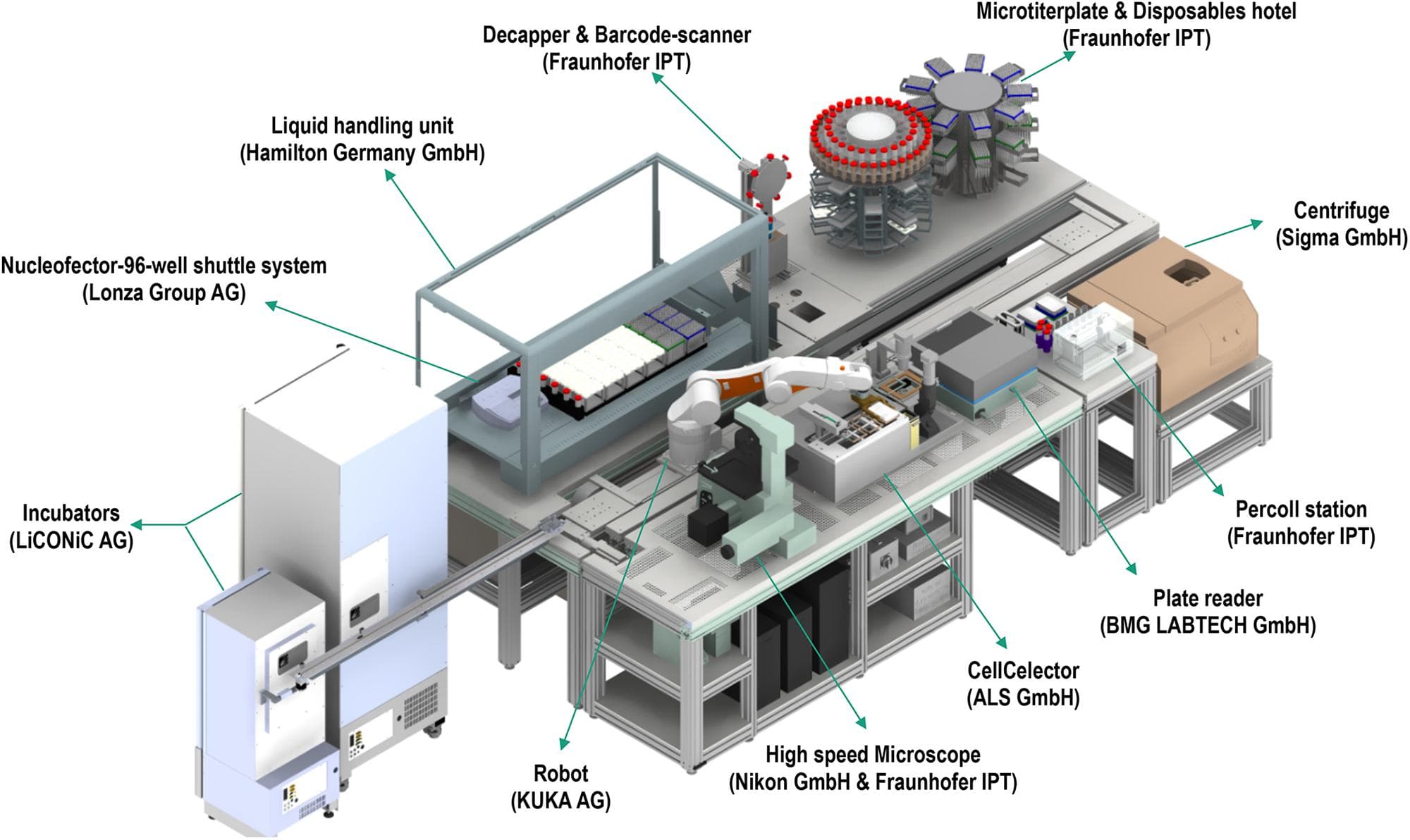
Frontiers | Automation, Monitoring, and Standardization of Cell Product Manufacturing View original
Is this image relevant?
A hybrid reconfigurable computer-integrated manufacturing cell for the production of mass ... View original
Is this image relevant?
Industrial engineering - Wikipedia View original
Is this image relevant?
Frontiers | Automation, Monitoring, and Standardization of Cell Product Manufacturing View original
Is this image relevant?
Definition and Purpose of CIM
Computer Integrated Manufacturing (CIM) is the use of computer systems and automation to integrate all manufacturing processes, from initial product design through production, quality control, and distribution.
Its core purposes include:
- Optimizing operations by improving efficiency, reducing costs, and raising product quality across the entire product lifecycle
- Enabling seamless communication between departments and processes through shared software and hardware platforms
- Supporting advanced production strategies like mass customization, rapid prototyping, and Just-In-Time (JIT) manufacturing
- Providing real-time data and analytics on production performance, resource utilization, and quality metrics to support better decision-making
Role of CIM in Modern Manufacturing
CIM is central to the shift toward "smart factories." In a smart factory, machines, sensors, and software systems are all interconnected, sharing data in real time. This is closely tied to Industry 4.0, which refers to the current trend of using cyber-physical systems, IoT, and cloud computing in manufacturing.
Specific roles CIM plays:
- Facilitates the digital transformation of manufacturing processes
- Enhances supply chain visibility by integrating production data with supplier and logistics systems
- Enables predictive maintenance, where equipment data is analyzed to schedule repairs before a breakdown occurs
- Improves product lifecycle management by keeping design, production, and service data in integrated systems
CIM System Components
A CIM system is built from several layers of tools and technologies. These fall into three main categories: design/engineering tools, automation/control systems, and manufacturing management systems.
Design and Engineering Tools
These are the software tools used to create, test, and prepare products for manufacturing.
- Computer-Aided Design (CAD) creates digital 3D models of products. This is where the geometry and specifications of a part are defined.
- Computer-Aided Engineering (CAE) runs simulations and analysis on those digital models. For example, finite element analysis (FEA) can predict how a part will respond to stress, and computational fluid dynamics (CFD) can simulate airflow around a component.
- Computer-Aided Manufacturing (CAM) translates design data into instructions that machines can follow. CAM software generates toolpaths for CNC machines and 3D printers, bridging the gap between "what the part looks like" and "how to actually make it."
The key idea: CAD defines the product, CAE validates it virtually, and CAM tells the machines how to produce it.

Automation and Control Systems
These are the hardware and software systems that physically run the factory floor.
- Programmable Logic Controllers (PLCs) are industrial computers that control specific automated processes like conveyor systems and robotic assembly lines. They execute simple logic repeatedly and reliably.
- Distributed Control Systems (DCS) manage more complex, continuous processes. You'll find these in chemical processing plants or power generation facilities where many variables need to be controlled simultaneously.
- Robotics and automated material handling perform precise, repeatable manufacturing operations. Examples include robotic welding cells, pick-and-place systems for assembly, and automated guided vehicles (AGVs) that transport materials around the factory.
Manufacturing Management Systems
These systems handle the planning, scheduling, and business side of manufacturing.
- Manufacturing Execution Systems (MES) sit between the factory floor and the business office. An MES tracks work-in-progress, manages quality control checkpoints, and optimizes production flow in real time.
- Enterprise Resource Planning (ERP) systems integrate broader business processes with manufacturing. ERP manages inventory levels, supply chain logistics, and financial data, giving managers a complete picture of operations.
- Industrial Internet of Things (IIoT) devices and sensors collect real-time data throughout the factory. Temperature sensors, vibration monitors, and energy consumption meters all feed data back into the system for monitoring and analysis.
CIM Benefits and Challenges
Advantages of CIM Implementation
CIM delivers benefits across productivity, quality, flexibility, and cost.
- Increased productivity and efficiency. Automation reduces manual labor, and integrated data streamlines workflows so less time is wasted on handoffs between departments.
- Improved product quality and consistency. With less human error and real-time quality control (using tools like statistical process control and automated inspection), defect rates drop significantly.
- Enhanced flexibility. CIM allows quick changeovers between product variants, making it practical to offer customization without major delays.
- Reduced production costs and lead times. Streamlined operations minimize waste, improve resource utilization, and optimize production schedules.
- Better inventory management. CIM supports Just-In-Time (JIT) and lean manufacturing principles, reducing the amount of money tied up in raw materials and finished goods sitting in warehouses.

Challenges in CIM Adoption
CIM isn't easy or cheap to implement. Here are the main hurdles:
- High initial investment. The hardware, software, and infrastructure costs are substantial. Companies need to do careful cost-benefit analysis and return-on-investment (ROI) calculations before committing.
- Integration complexity. Getting new CIM software to communicate with older legacy equipment is a common headache. This often requires standardization efforts and middleware (software that acts as a translator between incompatible systems).
- Workforce skill requirements. Operating and maintaining CIM systems demands specialized training. Companies need ongoing education programs to keep employees current.
- Cybersecurity risks. Interconnected systems create more potential entry points for cyberattacks. Robust security measures and regular risk assessments are essential.
- Resistance to change. Shifting to CIM often requires significant changes in how people work. Effective change management strategies and employee engagement help smooth the transition.
CIM Impact on Production
Effects on Product Quality
CIM improves quality in several reinforcing ways. Automated processes are inherently more consistent than manual ones, which reduces variability and defects in finished products.
- Real-time quality monitoring uses in-line inspection and closed-loop control systems to catch problems as they happen, not after the fact
- Enhanced traceability through data logging and analytics makes it possible to trace a defect back to its root cause quickly
- Reduced scrap and rework results from proactive quality management, including predictive maintenance that prevents equipment from drifting out of specification
Influence on Manufacturing Flexibility
One of CIM's biggest advantages is how quickly a factory can adapt.
- Production processes can be reconfigured for new or modified products with minimal downtime, supporting rapid product introductions
- Mass customization becomes feasible through configure-to-order (CTO) and build-to-order (BTO) models, where each unit can be slightly different without requiring a full production line changeover
- Real-time production scheduling and dynamic resource allocation help factories respond to supply chain disruptions or unexpected demand changes
Time-to-Market Improvements
CIM compresses the timeline from initial concept to finished product on the shelf.
- Concurrent engineering allows design and manufacturing planning to happen in parallel rather than sequentially, shortening development cycles.
- Rapid prototyping through 3D printing and digital twin technology (a virtual replica of the product or process) enables faster design iterations without building physical prototypes every time.
- Advanced planning and scheduling (APS) systems optimize resource allocation across the production floor.
- JIT manufacturing reduces lead times and keeps inventory levels low by producing only what's needed, when it's needed.
- Product lifecycle management (PLM) systems improve collaboration across design, manufacturing, and service teams by keeping everyone working from the same data.
The net result: products move from concept to customer faster, with fewer delays and less wasted effort along the way.
See Fiveable more often in Google
Mark Fiveable as a preferred source and Google is more likely to show you our guides in Top Stories, with a "preferred" badge in AI Mode and AI Overviews.