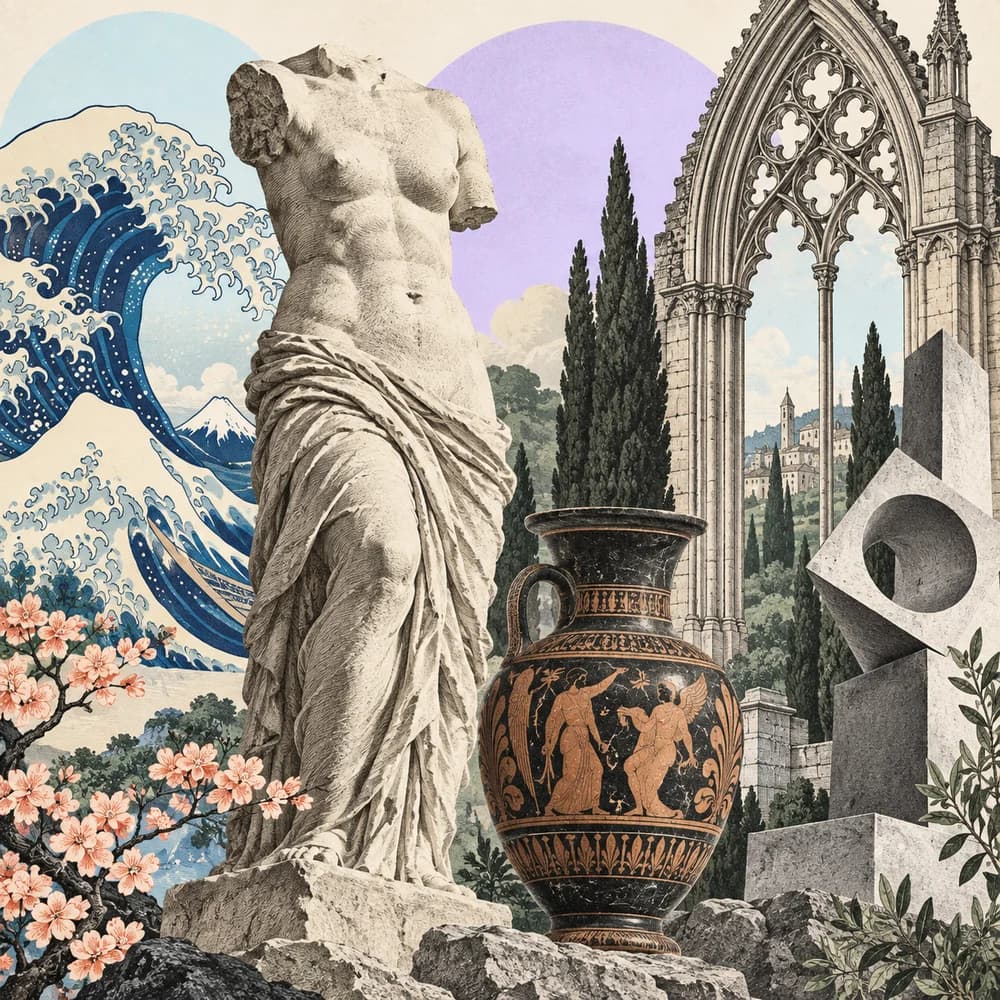
AP Art History Unit 2 covers the art of the ancient Near East, dynastic Egypt, Greece, Etruria, and Rome, spanning roughly 3500 BCE to 300 CE. The single biggest idea is that art in this region served power. Kings, pharaohs, city-states, and emperors used monumental architecture, sculpture, and narrative imagery to claim divine approval and broadcast authority, and each culture borrowed and adapted the visual language of the ones before it. This is the unit where the classical tradition is born, and almost every later unit in the course either builds on it or pushes back against it.
What this unit covers
The ancient Near East: gods, kings, and city-states
- Mesopotamian art belongs to a parade of successive powers (Sumerian, Akkadian, Neo-Sumerian and Babylonian, Assyrian, Neo-Babylonian, and Persian), each stamping its authority onto the same visual traditions.
- Religion and rule blur together. Cosmology shapes how deities are shown, and kings take on divine attributes, as on the Code of Hammurabi stele, where the king receives law directly from the sun god Shamash.
- Ziggurats like the White Temple at Uruk lift worship physically closer to the gods. They are solid stepped platforms topped by a temple, monumental settings for venerating many deities.
- Narrative conventions are invented here. The Standard of Ur divides scenes into horizontal registers and uses hierarchical scale (the king is literally bigger) to organize one of the earliest historical narratives.
- Assyrian lamassu (winged human-headed bulls) and the heavily fortified, increasingly opulent palaces they guarded, plus the Persian apadana at Persepolis, proclaim royal power to anyone who walks in.
Dynastic Egypt: permanence, the afterlife, and a fixed canon
- Egyptian art is built for eternity. Funerary complexes like the Great Pyramids of Giza exist because the ka (spirit) needs a permanent home, and rigid statues like King Menkaura and queen are designed to last forever, not to look momentarily lifelike.
- The Palette of King Narmer locks in the conventions that hold for nearly 3,000 years, including composite view (profile head and legs, frontal torso), registers, and hieratic scale.
- A strict canon of proportions kept royal figures looking timeless and ideal, while lower-status figures like the Seated Scribe could be shown more naturalistically (soft belly, alert face).
- Temple architecture relies on post-and-lintel construction at massive scale, like the hypostyle hall at the Temple of Amun-Re at Karnak, a forest of columns only priests and royalty could enter.
- The Amarna period is the great exception. Under Akhenaton, figures get elongated, curving, almost androgynous bodies, then the old style snaps back after his death (see Tutankhamun's tomb goods and the Last Judgment of Hu-Nefer).
Greece and Etruria: the body, the temple, and the ideal
- Greek sculpture evolves fast. Archaic kouroi like the Anavysos Kouros stand stiff and Egyptian-inspired with the "Archaic smile," then Classical works like Polykleitos's Doryphoros introduce contrapposto (weight-shift) and a mathematical canon of ideal proportions.
- The Athenian Acropolis, especially the Parthenon, is the high point of Classical idealism, with Doric and Ionic elements, refined optical corrections, and a frieze showing the Panathenaic procession that puts Athenian citizens alongside the gods.
- The Hellenistic period (after Alexander) trades calm idealism for drama, motion, and emotion, as in the Winged Victory of Samothrace and the Great Altar of Zeus and Athena at Pergamon.
- Etruscan art absorbs Greek ideas but stays its own thing. The terracotta Sarcophagus of the Spouses shows a couple reclining together at a banquet, and the Temple of Minerva uses a high podium, deep front porch, and rooftop sculpture like Apulu of Veii.
- Greek pottery (black-figure and red-figure techniques) carries mythological narrative on everyday and ceremonial vessels, like the Niobides Krater.
Rome: portraiture, propaganda, and engineering
- Republican portraiture favors verism, brutally honest wrinkles and sagging skin that advertise age, experience, and gravitas (Head of a Roman patrician).
- Imperial art swings to idealized propaganda. The Augustus of Prima Porta borrows the Doryphoros's pose to present the emperor as eternally youthful, divinely descended, and victorious.
- Roman concrete and the arch unlock buildings Greece never could have made, including the Colosseum, the Forum of Trajan, and the Pantheon with its coffered dome and oculus.
- Roman artists openly adapt Greek forms (columns, mythological subjects, idealized bodies) while inventing new ones for new purposes, like continuous narrative on monuments and battle sarcophagi.
How we know what we know
- Unlike prehistory, these cultures wrote things down. Contextual evidence for Greek and Roman art comes from contemporary literary, political, legal, and economic records, which lets art historians make much firmer arguments about purpose and meaning.
- Interpretations still change over time. Theories built from visual analysis and from scholarship in other disciplines get adapted and revised, which is exactly the skill the course wants you to practice.
Unit 2 - Ancient Mediterranean Art, 3500-300 BCE at a glance
|
| Ancient Near East | Glorify gods and kings who claim divine status | Ziggurats, steles, lamassu, fortified palaces | Composite view, registers, hierarchical scale | Standard of Ur, Code of Hammurabi, Lamassu, Apadana at Persepolis |
| Dynastic Egypt | Serve the afterlife and eternal kingship | Pyramids, mortuary and cult temples, tomb goods | Rigid canon, composite view, frontal and timeless | Palette of Narmer, Great Pyramids, Temple of Amun-Re, Tutankhamun's tomb |
| Ancient Greece | Honor gods and celebrate the ideal human | Orders-based temples, freestanding marble and bronze, painted pottery | Archaic stiffness to Classical contrapposto to Hellenistic drama | Anavysos Kouros, Doryphoros, Parthenon, Winged Victory of Samothrace |
| Etruscan | Funerary celebration of life and the dead | Terracotta sarcophagi, painted tombs, podium temples | Animated, smiling, gesturing figures | Sarcophagus of the Spouses, Temple of Minerva, Tomb of the Triclinium |
| Roman | Project state power and civic identity | Concrete architecture, portraiture, public monuments | Veristic (Republic) or idealized propaganda (Empire) | Augustus of Prima Porta, Colosseum, Pantheon, Forum of Trajan |
Why Unit 2 - Ancient Mediterranean Art, 3500-300 BCE matters in APAH
This unit carries one of the largest shares of required works in the course, and it establishes the "classical tradition" that the rest of Western art history converses with for two millennia. It is also where the course's core thinking moves come together for the first time with written evidence to back them up.
- Every big course theme runs through it. Cultural context shapes form (Egyptian permanence), purpose and patron shape content (royal propaganda), and cross-cultural interaction shapes style (Egypt to Greece to Etruria to Rome).
- The formal vocabulary you learn here (contrapposto, registers, the architectural orders, hierarchical scale) is the toolkit you'll use to analyze works in every later unit.
- It models continuity and change over a huge span. You can literally watch the human figure loosen up from Narmer to the Doryphoros to the Winged Victory.
How this unit connects across the course
- Unit 2 picks up where global prehistory leaves off (Unit 1). The jump from undocumented works like Stonehenge to documented ones like the Code of Hammurabi changes how confidently art historians can argue about meaning.
- Greek and Roman forms are the direct ancestors of Early European art (Unit 3). Christian basilicas adapt Roman architecture, and Renaissance artists deliberately revive classical idealism and contrapposto.
- Neoclassicism in Later Europe and the Americas (Unit 4) is a conscious return to Unit 2. Knowing the Doryphoros and the Parthenon makes works like Jacques-Louis David's paintings and Greek-revival architecture instantly legible.
- The Persian Empire's art at Persepolis sets up West and Central Asia (Unit 7), where later Persian and Islamic traditions build on the same region's visual legacy.
Timeline
- c. 3500-3000 BCE: The White Temple and its ziggurat rise at Uruk, establishing the elevated temple platform as the Near East's signature sacred form.
- c. 3000-2920 BCE: The Palette of King Narmer commemorates the unification of Upper and Lower Egypt and locks in Egyptian conventions for millennia.
- c. 2600-2400 BCE: The Standard of Ur uses registers and hierarchical scale to tell stories of war and peace, an early historical narrative.
- c. 2550-2490 BCE: The Great Pyramids of Giza are built as royal tombs, the ultimate statement of pharaonic permanence.
- c. 1792-1750 BCE: Hammurabi's law stele pairs written code with an image of divine authorization, fusing law, religion, and kingship.
- c. 1353-1336 BCE: Akhenaton's Amarna period briefly breaks the Egyptian canon with elongated, naturalistic royal figures.
- c. 720-705 BCE: Lamassu guard Sargon II's Assyrian palace at Dur Sharrukin, intimidating visitors with hybrid divine power.
- c. 530 BCE: The Anavysos Kouros shows Archaic Greece absorbing Egyptian rigidity while inching toward naturalism.
- 447-432 BCE: The Parthenon is built on the Athenian Acropolis, the peak of Classical idealism and civic pride under Pericles.
- c. 450-440 BCE: Polykleitos's Doryphoros codifies ideal human proportions and contrapposto in a written canon.
- c. 190 BCE: The Winged Victory of Samothrace embodies Hellenistic drama, with wind-whipped drapery and theatrical placement.
- 118-125 CE: The Pantheon's concrete dome and oculus show Rome turning borrowed Greek vocabulary into engineering no one had seen before.
Key people and groups
- Hammurabi: Babylonian king whose law stele shows him receiving authority from the god Shamash, fusing divine and royal power.
- Sargon II: Assyrian ruler whose fortified palace at Dur Sharrukin used lamassu and reliefs to project intimidating royal might.
- Darius and Xerxes: Persian kings whose apadana (audience hall) at Persepolis staged imperial power through processional reliefs of tribute-bearers.
- Hatshepsut: Female pharaoh whose terraced mortuary temple legitimized her unusual rule through scale, setting, and traditional imagery.
- Akhenaton: Pharaoh who upended Egyptian religion and art, replacing the rigid canon with the curving, elongated Amarna style.
- Tutankhamun: Boy king whose intact tomb goods, including the gold inner coffin, reveal royal funerary practice and the post-Amarna return to tradition.
- Pericles: Athenian leader who drove the rebuilding of the Acropolis, including the Parthenon, as a monument to Athenian identity.
- Iktinos and Kallikrates: Architects of the Parthenon, responsible for its refined proportions and optical corrections.
- Phidias: Sculptor who directed the Parthenon's sculptural program, including the Panathenaic frieze.
- Polykleitos: Sculptor and theorist whose Doryphoros and written canon defined ideal proportion and contrapposto.
- Augustus: First Roman emperor, whose Prima Porta portrait turned Greek idealism into imperial propaganda.
Unit 2 - Ancient Mediterranean Art, 3500-300 BCE on the AP exam
This unit's required works show up constantly across both sections of the exam. In the multiple-choice section, you'll see image-based sets that ask you to identify conventions (why is Narmer's body shown in composite view?), connect form to function (why is a ziggurat solid?), and attribute unfamiliar works to a culture or period based on style. Because Greek and Roman styles are so distinctive and so influential, unknown classical works are favorite attribution material.
In the free-response section, Unit 2 works are prime candidates for several question types. Comparison essays often pair a classical work with one from another tradition, asking you to compare purpose, patronage, or how each represents power. Continuity-and-change prompts love this unit because you can trace, for example, how Rome adapts Greek forms or how Greek sculpture transforms from Archaic to Hellenistic. Contextual analysis questions ask you to connect a work's form to its function and setting, like explaining how the Pantheon's dome relates to Roman religion and engineering. Attribution questions give you an unidentified work and ask you to justify a likely culture or period with specific visual evidence, which means you need the style markers in this unit (contrapposto, verism, registers, the orders) at your fingertips. Always anchor claims in specific visual evidence plus context, not just identification.
Essential questions
- How do rulers use art and architecture to claim divine sanction and legitimize power, and how do those strategies change across cultures?
- Why does the representation of the human body shift from timeless and conventional (Egypt, Near East) to idealized and naturalistic (Greece) to individualized (Rome)?
- How does cross-cultural borrowing work, and what does it mean when Rome copies Greece or Greece learns from Egypt?
- How does written evidence change what art historians can argue about a work's purpose and meaning?
Key terms to know
- Ziggurat: A solid, stepped temple platform in Mesopotamia, raising a shrine closer to the gods.
- Register: A horizontal band used to organize figures and narrative scenes in an orderly sequence.
- Hierarchical scale: Making the most important figure the largest, regardless of realistic proportion.
- Composite view: Showing a figure with profile head and legs but a frontal torso, combining the most recognizable angles.
- Stele: An upright carved stone slab used to commemorate events, mark graves, or display laws.
- Lamassu