7.7 Logistics and transportation

📣Honors Marketing Unit 7 Review
7.7 Logistics and transportation
📣 Honors Marketing
Overview of logistics
Logistics covers the planning, implementation, and control of how goods, services, and information flow from where they're produced to where they're consumed. For marketers, logistics directly shapes customer satisfaction and brand reputation. A company that consistently delivers the right product, on time, in good condition builds trust. One that doesn't loses customers fast.
Effective logistics management creates competitive advantage through lower costs, better service quality, and faster response to market shifts. It also enables global trade by coordinating the movement of goods across international borders.

Top images from around the web for Definition and importance
Components of a Supply Chain | Principles of Marketing [Deprecated] View original
Is this image relevant?
Controlling the Supply Chain | Boundless Business View original
Is this image relevant?
Impact of Logistics Management on Customer Satisfaction: A Case of Retail Stores of Islamabad ... View original
Is this image relevant?
Components of a Supply Chain | Principles of Marketing [Deprecated] View original
Is this image relevant?
Controlling the Supply Chain | Boundless Business View original
Is this image relevant?
Key components of logistics
- Transportation management oversees moving goods through various modes (truck, rail, air, sea)
- Warehousing and inventory control optimizes storage locations and stock levels
- Order fulfillment processes customer orders from receipt through delivery
- Packaging and materials handling protects products and enables efficient movement
- Information management systems track and coordinate all logistics activities in real time
- Reverse logistics handles returns, repairs, and recycling of products
Supply chain management
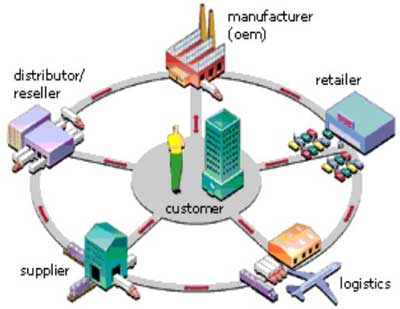
Supply chain management (SCM) is a broader concept than logistics alone. It encompasses the entire network of organizations involved in producing and delivering a product, integrating procurement, production, and distribution into a coordinated system. Where logistics focuses on moving and storing goods, SCM optimizes the flow of goods, information, and finances across every partner in the chain.
Role in marketing strategy
SCM touches nearly every element of the marketing mix:
- Product availability: Ensures products are in the right place at the right time
- Pricing: Manages production and distribution costs, which directly affect what you can charge
- Customer service: Reliable, efficient delivery builds loyalty and repeat purchases
- Market expansion: Efficient distribution networks make it feasible to enter new geographic areas
- Customization: Flexible supply chains support product personalization without massive cost increases
- Brand differentiation: Superior logistics performance (think Amazon's delivery speed) becomes a selling point itself
Supply chain integration
Integration strategies determine how tightly supply chain partners coordinate:
- Vertical integration means controlling multiple stages of the supply chain. Backward integration is when a company acquires suppliers; forward integration is when it acquires distributors or retailers.
- Horizontal integration involves collaborating with partners at the same level (e.g., two manufacturers sharing warehouse space).
- Information sharing across the supply chain improves visibility and decision-making for everyone involved.
- CPFR (Collaborative Planning, Forecasting, and Replenishment) aligns supply chain activities with actual demand signals rather than guesswork.
- VMI (Vendor-Managed Inventory) shifts inventory management responsibility to suppliers, who monitor stock levels and replenish automatically.
- Supply chain risk management identifies potential disruptions (natural disasters, supplier bankruptcy, geopolitical instability) and builds contingency plans.
Transportation modes
Choosing the right transportation mode is one of the most consequential logistics decisions a company makes. Each mode offers different trade-offs between speed, cost, capacity, and flexibility. Often the best solution combines multiple modes.
Road vs rail
Road transportation (trucking)
- Offers flexibility in route selection and true door-to-door delivery
- Best suited for short to medium distances and smaller shipment sizes
- Higher cost per ton-mile compared to rail
- Vulnerable to traffic congestion and weather conditions
Rail transportation
- Cost-effective for long-distance, high-volume shipments (coal, grain, automobiles)
- Lower environmental impact per ton-mile than trucking
- Limited flexibility since trains run on fixed routes and schedules
- Requires intermodal transfers (usually to trucks) for final door-to-door delivery
Air vs sea
Air transportation
- Fastest mode for long-distance and international shipments
- Ideal for high-value, time-sensitive, or perishable goods (electronics, pharmaceuticals, fresh flowers)
- Highest cost per unit of weight among all modes
- Limited cargo capacity compared to sea transportation
Sea transportation
- Most cost-effective for large-volume, long-distance international shipments
- Slowest mode, with transit times measured in weeks rather than days
- Offers the highest capacity for both bulk cargo and standardized containers
- Subject to port congestion and weather-related delays
Intermodal transportation
Intermodal transportation combines multiple modes in a single shipment to capture the strengths of each. A common example: goods travel by sea from Asia to a U.S. port, transfer to rail for cross-country movement, then load onto trucks for final delivery.
- Standardized shipping containers make transfers between modes fast and reduce handling damage
- Requires coordinated planning and scheduling across different carriers
- Leverages cost advantages of slower modes (sea, rail) while using faster modes (truck, air) where needed
- Enables door-to-door service at lower total cost than relying on a single mode
Warehousing and distribution
Warehousing and distribution bridge the gap between production and consumption. They allow companies to hold inventory close to customers, manage demand fluctuations, and fulfill orders accurately.
Warehouse types and functions
Different warehouse types serve different strategic purposes:
- Public warehouses offer storage services to multiple companies, useful for businesses that don't need year-round space
- Private warehouses are owned and operated by a single company for its own goods, giving full control over operations
- Bonded warehouses store imported goods before customs duties are paid, deferring tax costs until goods enter the domestic market
- Cold storage warehouses maintain temperature-controlled environments for perishables like food and pharmaceuticals
- Cross-docking facilities focus on rapid transfer of goods from inbound to outbound trucks with minimal or no storage time
- Fulfillment centers specialize in processing and shipping individual customer orders (think Amazon's massive facilities)
Core warehouse functions include receiving and inspecting goods, storage and inventory management, order picking and packing, and value-added services like kitting, labeling, or light assembly.
Distribution center operations
Distribution centers (DCs) serve as hubs for receiving, storing, and shipping products. Modern DCs rely heavily on technology and process optimization:
- Advanced material handling equipment like conveyor systems and automated storage and retrieval systems (AS/RS)
- Warehouse management systems (WMS) for real-time inventory tracking and order processing
- Various picking strategies such as wave picking, zone picking, and batch picking, each suited to different order profiles
- Optimized facility layout and product slotting to reduce travel time for workers
- Quality control checkpoints to ensure order accuracy before shipment
- Returns processing as part of reverse logistics

Inventory management
Inventory management balances two competing risks: holding too much inventory (which ties up cash and incurs storage costs) versus holding too little (which leads to stockouts and lost sales). The goal is maintaining optimal levels to meet customer demand while minimizing total costs.
Just-in-time inventory
Just-in-time (JIT) inventory minimizes stock levels by synchronizing deliveries precisely with production schedules. Instead of warehousing large quantities, materials arrive right when they're needed.
- Reduces carrying costs and improves cash flow significantly
- Requires extremely close coordination with suppliers and reliable transportation
- Toyota pioneered this approach and used it to become one of the most efficient manufacturers in the world
- The major risk: JIT increases vulnerability to supply chain disruptions. If a single supplier fails to deliver on time, production can halt entirely. The COVID-19 pandemic exposed this weakness across many industries.
- Can also increase per-unit transportation costs since shipments are smaller and more frequent
Safety stock vs cycle stock
These are two distinct types of inventory that serve different purposes:
Safety stock is extra inventory held as a buffer against uncertainty. It protects against stockouts caused by unexpected demand spikes or supply delays. The right amount depends on demand variability, supplier lead time, and your desired service level. More safety stock means fewer stockouts but higher holding costs.
Cycle stock is the regular inventory that turns over during normal business operations. It gets replenished in cycles, often calculated using the economic order quantity (EOQ) formula, which balances ordering costs against holding costs. Factors like lot sizes, production runs, and transportation efficiencies all affect cycle stock levels.
Effective inventory management optimizes the balance between these two types. Too much safety stock wastes money; too little cycle stock means you're ordering too frequently.
Last-mile delivery
Last-mile delivery is the final leg of a shipment's journey, from the distribution center to the end customer's door. Despite being the shortest distance, it's often the most expensive and complex part of the entire supply chain. It's also the part customers experience directly, making it critical for satisfaction.
Challenges and solutions
| Challenge | Solution |
|---|---|
| High costs from inefficient routing and multiple stops | Route optimization software and shipment consolidation |
| Failed deliveries requiring costly reattempts | Flexible options like parcel lockers and pickup points, plus real-time tracking |
| Urban traffic congestion causing delays | Off-peak delivery windows and alternative vehicles (bikes, electric vans) |
| Environmental concerns from delivery emissions | Green logistics initiatives and electric/hybrid vehicle fleets |
| Customer expectations for fast, free delivery | Tiered delivery options and subscription services (e.g., Amazon Prime) |
E-commerce impact
The surge in online shopping has fundamentally reshaped last-mile logistics:
- Delivery volumes have increased dramatically, putting pressure on existing infrastructure
- Omnichannel retail requires integrating online and offline logistics (buy online, pick up in store; ship from store)
- Customer expectations for same-day and next-day delivery continue to intensify
- Crowd-sourced delivery platforms like Uber Eats and DoorDash have created new models for local delivery
- Reverse logistics has grown in importance since e-commerce return rates are significantly higher than in-store returns
- Innovative delivery methods, including drones and autonomous vehicles, are being tested to meet growing demand
Reverse logistics
Reverse logistics manages the flow of goods backward through the supply chain, from the customer back toward the manufacturer or disposal point. With e-commerce return rates often reaching 20-30%, this has become a major operational and financial concern.
Returns management
A well-designed returns process protects both customer satisfaction and profitability:
- Establish clear return policies that are customer-friendly but cost-conscious
- Receive and inspect returned items efficiently
- Sort items by condition and determine disposition: resell as new, refurbish, recycle, or dispose
- Use technology to streamline processing and provide customers with return tracking
- Analyze return data to identify patterns (e.g., a product with a high return rate may have a quality or marketing problem)
The challenge is balancing generous return policies (which drive sales) with the real costs of processing returns.
Recycling and sustainability
Reverse logistics increasingly incorporates environmental goals:
- Recycling programs recover products at end-of-life rather than sending them to landfills
- Design for Environment (DfE) principles make products easier to disassemble and recycle from the start
- Valuable materials (metals, plastics) can be recovered from returned or end-of-life products
- Partnerships with specialized recycling firms ensure proper disposal of hazardous components
- These efforts support corporate social responsibility goals and comply with extended producer responsibility (EPR) laws, which hold manufacturers accountable for their products' entire lifecycle
Technology in logistics
Technology is the backbone of modern logistics, driving efficiency, visibility, and automation across the supply chain.
GPS and tracking systems
- Provide real-time visibility of shipment and vehicle locations
- Enable accurate ETA estimates and proactive problem-solving when delays occur
- Improve route optimization, reducing fuel costs and delivery times
- Enhance cargo security by detecting unauthorized movements or route deviations
- Integrate with transportation management systems (TMS) for comprehensive logistics control
- Support regulatory compliance, such as hours-of-service tracking for truck drivers
![Definition and importance, Components of a Supply Chain | Principles of Marketing [Deprecated]](https://storage.googleapis.com/static.prod.fiveable.me/search-images%2F%22Logistics_and_transportation_definition_importance_supply_chain_customer_satisfaction_cost_reduction_global_trade%22-Five-Flows-Graphic.png)
Warehouse management software
A warehouse management system (WMS) is software that optimizes warehouse operations:
- Directs put-away, picking, and packing processes to improve speed and accuracy
- Provides real-time inventory visibility, showing exactly where every item is located
- Integrates with other enterprise systems (ERP, TMS) for seamless information flow
- Supports advanced picking methods like voice-directed picking and pick-to-light systems
- Generates performance metrics and reports for continuous improvement
- Enables automated replenishment triggers and demand forecasting
Cost considerations
Logistics costs directly affect profitability and pricing strategy. Every logistics decision involves trade-offs between service levels and cost efficiency.
Transportation costs
Transportation typically represents the largest portion of total logistics costs. These costs include fuel, labor, vehicle maintenance, and carrier fees, and they vary based on mode, distance, and shipment characteristics.
Strategies for reducing transportation costs:
- Consolidation: Combine smaller shipments into full truckloads or container loads
- Long-term carrier contracts: Negotiate volume discounts with reliable carriers
- TMS software: Use transportation management systems for route optimization
- Modal shifts: Switch to more cost-effective modes where transit time allows (e.g., rail instead of truck for non-urgent shipments)
External factors like fuel prices, government regulations, and carrier market conditions also affect costs and are harder to control.
Inventory carrying costs
Carrying costs represent everything it costs to hold inventory: storage space, insurance, taxes, depreciation, obsolescence risk, and the opportunity cost of capital tied up in stock. These costs are typically estimated at 20-30% of inventory value annually, which adds up fast.
Strategies for reducing carrying costs:
- Just-in-time inventory management
- Improved demand forecasting to avoid over-ordering
- Vendor-managed inventory programs
- Optimized safety stock calculations
These reductions must always be balanced against the risk and cost of stockouts. Running out of a popular product can cost more than the carrying costs you saved.
Global logistics
Global logistics adds layers of complexity that domestic operations don't face. Moving goods across international borders involves navigating different regulations, currencies, languages, and business cultures.
International shipping regulations
- Customs compliance requires proper documentation (commercial invoices, bills of lading, certificates of origin)
- Tariff schedules and international trade agreements determine duties owed on imported goods
- Incoterms (International Commercial Terms) are standardized codes (FOB, CIF, DDP, etc.) that clearly define which party bears costs and risks at each stage of shipment
- Product safety and labeling requirements vary by country and must be met before goods clear customs
- Environmental regulations may restrict shipment of hazardous materials
- Certain goods require export/import licenses (military equipment, controlled substances, some technology)
Cross-border logistics challenges
- Currency fluctuations can erode margins or change competitive pricing overnight
- Language barriers complicate communication with international partners and customs officials
- Longer lead times due to distance, border crossings, and customs processing
- Inventory complexity increases when managing stock across multiple countries with different demand patterns
- Political and economic instability in certain regions can disrupt supply chains unpredictably
- Cultural differences influence business practices, negotiation styles, and customer expectations
- Localization needs may require adapting products, packaging, and labeling for different markets
Logistics performance metrics
You can't improve what you don't measure. Logistics metrics help companies track efficiency, identify bottlenecks, and benchmark against competitors. The two most fundamental metrics are on-time delivery and order accuracy.
On-time delivery
On-time delivery measures the percentage of shipments that arrive within the promised timeframe. It's one of the most visible indicators of supply chain reliability.
Factors that affect this metric include transportation delays, order processing speed, inventory availability, and external disruptions like weather events.
Improvement strategies:
- Real-time tracking with proactive alerts when shipments fall behind schedule
- Building buffer time into delivery promises for unexpected delays
- Partnering with reliable carriers and maintaining backup options
Order accuracy
Order accuracy measures the percentage of orders fulfilled without errors, covering correct items, correct quantities, and acceptable condition upon delivery.
Errors are costly because they trigger returns, rework, and customer dissatisfaction. Factors influencing accuracy include warehouse picking processes, inventory system reliability, quality control procedures, and clear communication of order details.
Improvement strategies:
- Barcode scanning and RFID technology to reduce human error in picking
- Regular staff training and performance monitoring
- Double-check procedures for high-value or critical orders
Future trends in logistics
The logistics industry is evolving rapidly, driven by technological innovation, sustainability pressures, and rising consumer expectations.
Autonomous vehicles
Self-driving trucks and delivery vehicles have the potential to transform transportation logistics:
- Potential benefits: Reduced labor costs (driver shortages are already a major industry problem), improved safety by eliminating human error, 24/7 operation capability, and optimized fuel consumption
- Challenges: Regulatory frameworks are still being developed, public acceptance remains uncertain, infrastructure upgrades may be needed, and cybersecurity risks must be addressed
- Companies like Tesla, Waymo, and TuSimple are investing heavily, with some autonomous trucks already operating on limited highway routes
Drone delivery
Unmanned aerial vehicles (UAVs) are being developed for last-mile delivery of small packages:
- Advantages: Rapid delivery to remote or congested areas, reduced traffic impact, lower operating costs for lightweight deliveries, and access to locations with poor road infrastructure
- Challenges: Regulatory restrictions on airspace usage, limited payload capacity (typically under 5 lbs) and range, weather sensitivity, and privacy concerns
- Amazon Prime Air and Google's Wing are among the companies running pilot programs, though widespread commercial deployment is still limited by regulatory approval and technical constraints
See Fiveable more often in Google
Mark Fiveable as a preferred source and Google is more likely to show you our guides in Top Stories, with a "preferred" badge in AI Mode and AI Overviews.