1.5 Marketing planning process

📣Honors Marketing Unit 1 Review
1.5 Marketing planning process
📣 Honors Marketing
Definition of marketing planning
Marketing planning is the systematic process of analyzing market opportunities, setting objectives, and developing strategies to achieve business goals. Think of it as a roadmap: it tells a company where it wants to go with its marketing, how it'll get there, and how it'll know when it's arrived.
A strong marketing plan integrates all the moving parts of marketing into one cohesive document. It ensures resources are allocated efficiently and that every marketing activity ties back to the company's broader objectives and customer needs.

Top images from around the web for Purpose and importance
Using and Updating the Marketing Plan | Principles of Marketing View original
Is this image relevant?
Putting It Together: Marketing Function | Principles of Marketing View original
Is this image relevant?
The Planning Cycle | Principles of Management View original
Is this image relevant?
Using and Updating the Marketing Plan | Principles of Marketing View original
Is this image relevant?
Putting It Together: Marketing Function | Principles of Marketing View original
Is this image relevant?
Purpose and importance
- Provides clear direction for marketing efforts, guiding both decision-making and resource allocation
- Keeps all departments aligned around common marketing goals, so sales, product, and marketing aren't pulling in different directions
- Encourages a proactive approach to market changes rather than scrambling to react after the fact
- Improves efficiency by prioritizing activities and eliminating ad-hoc, unplanned decisions
- Creates accountability by establishing measurable benchmarks that teams can be evaluated against
Key components
A complete marketing plan typically includes six elements:
- Situation analysis evaluates the current market position and internal capabilities
- Marketing objectives define specific, measurable goals for the planning period
- Target market selection identifies and prioritizes customer segments
- Marketing mix strategies outline product, price, place, and promotion decisions
- Implementation plan details action steps, timelines, and responsibilities
- Monitoring and control mechanisms track progress and allow for adjustments
Each of these builds on the one before it. You can't set good objectives without first understanding your situation, and you can't build a marketing mix without knowing who you're targeting.
Situation analysis
A situation analysis is a comprehensive examination of the internal and external factors affecting a company's marketing performance. It gives you the foundation for every decision that follows in the plan by revealing where you stand, what you're up against, and where the opportunities are.
Internal environment assessment
This is where you look inward at the company itself:
- Resources and capabilities: What does the company have to work with? This includes budget, staff, technology, and expertise.
- Organizational factors: Company culture, structure, and how decisions get made all affect what marketing strategies are realistic.
- Current marketing efforts: Review the existing product portfolio, pricing strategies, and distribution channels to see what's working and what isn't.
- Financial performance: Sales trends, profitability, and revenue growth tell you where the business stands financially.
- Marketing assets: Brand equity, customer loyalty, and existing relationships are intangible but powerful resources.
External environment analysis
Now you look outward at forces the company can't directly control:
- Market conditions: Trends, market size, and growth potential in your industry
- Competitive landscape: Both direct competitors (selling similar products) and indirect competitors (solving the same customer problem differently)
- Economic factors: GDP growth, inflation rates, and interest rates all shape consumer spending
- Technology: New technologies can create opportunities or disrupt entire industries
- Social and cultural trends: Shifts in consumer values, demographics, and lifestyle preferences
- Political and legal factors: Regulations, trade policies, and legal requirements that affect what marketers can and can't do
SWOT analysis
SWOT pulls together everything from the internal and external assessments into a single framework with four categories:
- Strengths: Internal advantages like a strong brand, loyal customer base, or unique selling proposition
- Weaknesses: Internal limitations like outdated technology, limited budget, or gaps in expertise
- Opportunities: External conditions you can capitalize on, such as emerging markets or underserved customer segments
- Threats: External risks like intensifying competition, new regulations, or economic downturns
The real value of SWOT isn't just listing items in each box. It's using the analysis to develop strategies that leverage strengths, address weaknesses, seize opportunities, and prepare for threats.
Setting marketing objectives
Marketing objectives are the specific, measurable goals that your marketing activities are designed to achieve. They bridge the gap between the company's overall business vision and the day-to-day marketing work.
SMART goal framework
The SMART framework is the standard for writing strong objectives. Each letter stands for a criterion your goal should meet:
- Specific: Clearly states what needs to be accomplished. "Increase brand awareness" is vague; "Increase brand awareness among 18-24 year olds in the Midwest" is specific.
- Measurable: Includes a number or metric so you can track progress. For example, "by 15%" or "to 10,000 monthly website visitors."
- Achievable: Realistic given your resources, timeline, and market conditions. Ambitious is good; impossible is not.
- Relevant: Directly supports the company's broader business objectives. A marketing goal that doesn't connect to the business strategy wastes resources.
- Time-bound: Has a clear deadline. "By Q4 2025" or "within six months" gives the team urgency and a finish line.
A complete SMART objective might look like: Increase online sales revenue by 20% among millennial customers within the next 12 months.
Short-term vs. long-term objectives
- Short-term objectives focus on immediate results, usually within a quarter or a year. Examples include hitting a quarterly sales target or launching a specific campaign.
- Long-term objectives address sustained growth over multiple years, like growing market share from 12% to 18% over three years.
- Short-term goals should feed into long-term objectives. Each quarterly win should move the company closer to its bigger strategic vision.
- Both types require flexibility. Market conditions change, and objectives may need to be adjusted while keeping the overall direction intact.
Target market selection
Target market selection is the process of identifying which customer groups to focus your marketing efforts on. No company can effectively serve everyone, so choosing the right segments lets you concentrate resources where they'll have the greatest impact.
Market segmentation
Segmentation divides a broad market into smaller groups that share similar characteristics. There are four main bases for segmentation:
- Demographic: Groups based on age, gender, income, education, or family size. For example, a luxury car brand might target households earning over $150,000 annually.
- Psychographic: Groups based on lifestyle, values, and attitudes. An outdoor apparel company might target eco-conscious adventure seekers.
- Behavioral: Groups based on purchasing patterns, usage rates, or brand loyalty. A coffee chain might create a loyalty program targeting customers who visit 3+ times per week.
- Geographic: Groups based on location, such as urban vs. rural markets or specific regions and climates.
Most effective segmentation strategies combine multiple bases. A company might target urban millennials (demographic + geographic) who prioritize sustainability (psychographic).
Targeting strategies
Once you've identified segments, you need to decide how to approach them:
- Undifferentiated marketing: One offering for the entire market. Works for products with near-universal appeal (like basic utilities), but it's increasingly rare.
- Differentiated marketing: Different offerings tailored to multiple segments. A car manufacturer selling economy, mid-range, and luxury models is using this approach.
- Concentrated marketing: All resources focused on one or a few niche segments. A company making only gluten-free baked goods is concentrating on a specific niche.
- Micromarketing: Customized offerings for individual customers or very small groups. Think personalized product recommendations on an e-commerce site.
The right strategy depends on market attractiveness, company capabilities, and how much competition exists in each segment.

Positioning
Positioning is about establishing how you want customers to perceive your brand relative to competitors. It answers the question: Why should a customer choose you?
- A positioning statement articulates the target audience, the category you compete in, your key benefit, and the reason customers should believe you. For example: For health-conscious parents, [Brand] is the snack company that provides nutritious, great-tasting options because we use only whole, organic ingredients.
- Effective positioning highlights a unique value proposition that differentiates you from competitors, whether through functional benefits (faster, cheaper, more durable) or emotional benefits (makes you feel confident, connected, or secure).
- Every element of the marketing mix (product features, price point, distribution, and messaging) should reinforce the desired position.
- Consistency matters. If your positioning says "premium," but your packaging looks cheap, customers will be confused.
Marketing mix strategies
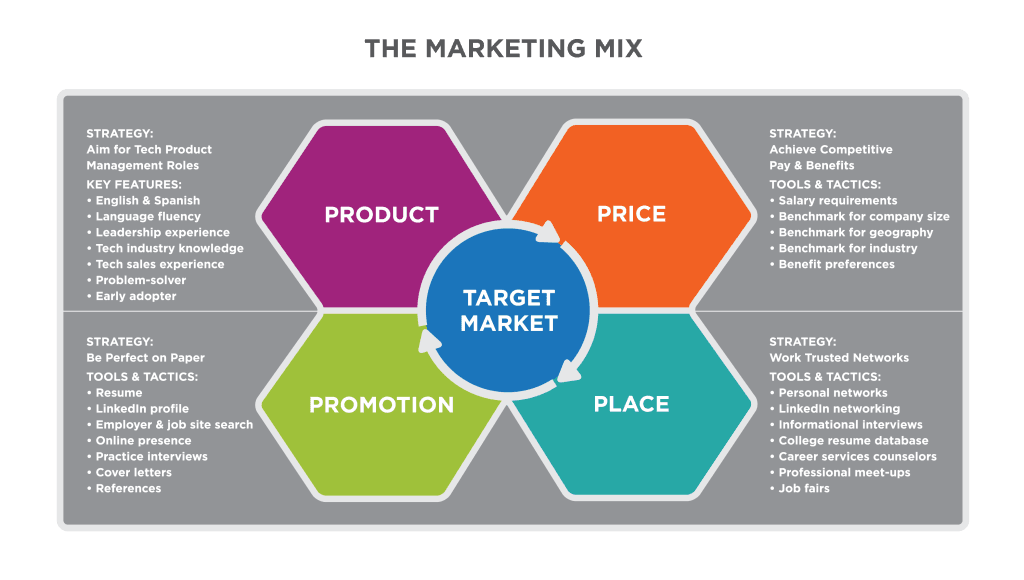
The marketing mix is where strategy becomes tangible. It integrates product, price, place, and promotion (the 4 Ps) into a cohesive set of decisions designed to deliver value to your target market while achieving your marketing objectives.
Product decisions
- Features and quality: What does the product do, and how well does it do it? These should directly address target market needs.
- Product line and mix: Product depth refers to variations within a single line (e.g., different flavors), while product breadth refers to how many different product lines a company offers.
- New product development: Planning for future products and managing existing ones through the product lifecycle (introduction, growth, maturity, decline).
- Branding: Decisions about brand name, brand architecture (how sub-brands relate to the parent brand), and potential brand extensions.
- Support services: Warranties, customer service, and after-sale support that add value beyond the core product.
Pricing strategies
- Pricing objectives set the direction. Market penetration pricing uses low prices to gain market share quickly, while premium pricing sets high prices to signal quality or exclusivity.
- Pricing methods determine how you calculate the actual price:
- Cost-plus: Add a markup to production costs
- Value-based: Price according to what customers believe the product is worth
- Competition-based: Set prices relative to what competitors charge
- Price elasticity matters. If your customers are highly price-sensitive (elastic demand), a small price increase could cause a big drop in sales. If demand is inelastic, you have more pricing flexibility.
- Promotional pricing (temporary discounts, coupons, bundling) can drive short-term sales but should be used carefully to avoid eroding brand value.
Place and distribution
- Distribution channels: Direct (selling straight to consumers through your own stores or website), indirect (using wholesalers and retailers), or omnichannel (combining both).
- Channel intensity determines how widely available your product is:
- Intensive: Available everywhere possible (think Coca-Cola)
- Selective: Available through a limited number of chosen retailers (think mid-range electronics)
- Exclusive: Available only through one or very few outlets (think Rolex)
- Logistics and supply chain: How products physically move from production to the customer, including inventory management and order fulfillment.
- Distribution decisions should reflect your target market's shopping preferences. If your customers buy primarily online, investing heavily in physical retail may not make sense.
Promotion and communication
- An integrated marketing communications (IMC) plan coordinates all promotional activities so they deliver a consistent message across channels.
- The promotional mix includes advertising, public relations, sales promotions, personal selling, and direct marketing. Most plans use a combination.
- Content marketing and social media strategies have become central to reaching and engaging audiences, particularly younger demographics.
- Media selection involves choosing where to place your messages (TV, digital, print, social) and scheduling when they'll run.
- All messaging and creative work should reinforce your positioning and speak directly to your target audience's needs and motivations.
- Budget allocation across promotional activities should reflect where your target market spends its attention.
Budget allocation
Budget allocation determines how much money is available for marketing and how that money gets divided across activities. Even the best strategy fails without adequate funding, so this step connects your plans to financial reality.
Budgeting methods
There are several common approaches to setting the overall marketing budget:
- Percentage of sales: Allocate a fixed percentage of revenue (e.g., 10% of projected sales). Simple to calculate, but it treats marketing as a result of sales rather than a driver of it.
- Competitive parity: Match what competitors are spending. Keeps you in the game but doesn't account for differences in strategy or efficiency.
- Objective and task: Determine what needs to be accomplished, identify the tasks required, and budget accordingly. This is the most strategic method because spending is tied directly to goals.
- Incremental budgeting: Adjust last year's budget up or down based on performance. Easy but can perpetuate past mistakes.
- Zero-based budgeting: Start from zero each year and justify every expense. Thorough but time-consuming.
Resource allocation
Once the total budget is set, you distribute it across specific activities:
- Prioritize initiatives based on their potential impact and alignment with your objectives
- Account for both fixed costs (staff salaries, software subscriptions) and variable expenses (ad spend, event costs)
- Set aside funds for market research and performance measurement so you can track what's working
- Build in contingency funds for unexpected opportunities or market shifts
- Balance investment in proven, current-market activities with exploration of new opportunities
Implementation and execution
This is where the plan moves from paper to action. Implementation translates strategies into specific tasks, assigns them to people, and puts them on a timeline.
Action plans
Action plans break each marketing strategy down into concrete steps:
- Identify the specific tasks required for each initiative
- Define key milestones and deliverables
- Establish performance metrics and success criteria for each task
- Assign the resources needed (people, budget, technology)
- Map interdependencies between activities (what needs to happen before something else can start)
Timeline development
- Create a schedule with clear start and end dates for every marketing initiative
- Factor in seasonal considerations and market timing (you wouldn't launch a winter coat campaign in July)
- Align timelines with budget cycles and resource availability
- Build in buffer time for unexpected delays
- Tools like Gantt charts help visualize how activities overlap and where bottlenecks might occur

Role assignments
- Clearly define who is responsible for each activity
- Identify both internal team members and external partners (agencies, freelancers) involved in execution
- Establish communication channels and reporting structures so everyone knows who to update and when
- Ensure team members have the skills and resources they need for their assigned roles
- Plan for cross-functional collaboration when marketing activities involve other departments like sales, product development, or finance
Monitoring and control
Monitoring and control is the ongoing process of tracking your marketing activities against planned objectives. Without it, you're flying blind. This step ensures you catch problems early and double down on what's working.
Key performance indicators
Key performance indicators (KPIs) are the specific metrics you use to measure success. They should connect directly to your marketing objectives.
- Financial KPIs: Return on investment (ROI), sales growth, revenue per customer, cost per acquisition
- Non-financial KPIs: Brand awareness, customer satisfaction scores, website traffic, social media engagement
- Leading indicators predict future performance (e.g., website traffic often predicts future sales), while lagging indicators confirm past results (e.g., quarterly revenue)
- Each KPI needs a benchmark (where you are now) and a target (where you want to be)
Performance measurement
- Collect data regularly using marketing analytics tools and dashboards
- Hold scheduled performance reviews to compare actual results against objectives
- Look for trends, patterns, and anomalies rather than reacting to single data points
- Incorporate both quantitative data (numbers, metrics) and qualitative feedback (customer comments, team observations)
Adjustments and revisions
- When something underperforms, diagnose why before making changes. Is it the strategy, the execution, or external factors?
- Reallocate resources from low-performing activities to high-performing ones
- Update strategies and tactics as market conditions evolve
- Revisit target market selection or positioning if results consistently miss the mark
- Treat the marketing plan as a living document, not something you write once and file away
Challenges in marketing planning
Common pitfalls
- Misalignment: Marketing objectives that don't connect to overall business goals lead to wasted effort
- Insufficient research: Skipping thorough market research means building strategies on assumptions instead of evidence
- Unrealistic objectives: Goals that sound impressive but aren't achievable given resources and market conditions set teams up for failure
- Underfunding: Allocating too little budget for proper implementation is one of the most common reasons plans fall short
- Rigidity: Failing to adapt when market conditions or customer needs change
- Poor communication: When other departments don't understand or buy into the marketing plan, execution suffers
- Neglecting measurement: Without tracking performance, you can't tell what's working or justify future budgets
Overcoming obstacles
- Build clear communication channels between marketing and other departments from the start
- Invest in solid market research and customer insights before setting strategy
- Use the SMART framework to keep objectives realistic and data-driven
- Design flexible planning processes with built-in review points for adaptation
- Implement robust measurement systems and use the data to make ongoing improvements
- Ensure the marketing team has adequate training, tools, and resources
Technology in marketing planning
Digital tools have transformed how companies plan, execute, and measure marketing. Technology enables faster decisions, better data, and more efficient collaboration.
Digital tools and software
- Marketing automation platforms (like HubSpot or Marketo) streamline campaign execution, email marketing, and lead nurturing
- CRM systems (like Salesforce) centralize customer data and track interactions across the entire customer journey
- Project management tools (like Asana or Trello) keep teams organized with task assignments, deadlines, and progress tracking
- Analytics platforms (like Google Analytics) provide detailed insights on website traffic, user behavior, and digital campaign performance
- Social media management tools (like Hootsuite) allow scheduling, monitoring, and analyzing social media activity across platforms
- AI and machine learning are increasingly used for predictive analytics, helping marketers forecast trends and personalize content at scale
When selecting tools, consider how well they integrate with each other and whether they can scale as the company grows.
Data-driven decision making
- Big data and analytics allow marketers to base strategies on actual customer behavior rather than gut instinct
- A/B testing compares two versions of a marketing element (an email subject line, a landing page) to see which performs better
- Customer segmentation models built from behavioral data can reveal segments you wouldn't identify through demographics alone
- Predictive analytics uses historical data to forecast future trends, customer behavior, and campaign outcomes
- Real-time data enables agile decision-making, letting marketers adjust campaigns while they're still running
- Data quality matters. Inaccurate or inconsistent data leads to bad decisions, so maintaining clean data across systems is essential.
- The best results come from combining data-driven insights with human judgment and creativity, not relying on either one alone.
Ethical considerations
Ethics in marketing planning means ensuring that your strategies and tactics are not only effective but also honest, fair, and responsible. Companies that build ethical practices into their planning process tend to earn stronger customer trust and long-term brand loyalty.
Social responsibility
- Consider how marketing activities affect not just customers but society more broadly
- Develop inclusive marketing strategies that respect and represent diversity
- Ensure all marketing communications are truthful and transparent. Misleading claims may boost short-term sales but damage credibility over time.
- Protect customer privacy and data security, especially as data collection becomes more sophisticated
- Support community initiatives and cause-related marketing where it aligns authentically with brand values
- Balance profit objectives with social and environmental impact
Sustainability in planning
- Factor environmental considerations into product development and packaging decisions (reducing waste, using recyclable materials)
- Develop distribution and logistics strategies that minimize environmental footprint
- Use marketing messages to promote sustainable consumption without greenwashing (making misleading environmental claims)
- Collaborate with suppliers and partners to improve sustainability across the supply chain
- Measure and report on sustainability performance as part of overall marketing accountability
See Fiveable more often in Google
Mark Fiveable as a preferred source and Google is more likely to show you our guides in Top Stories, with a "preferred" badge in AI Mode and AI Overviews.