4.5 Perceptual mapping

📣Honors Marketing Unit 4 Review
4.5 Perceptual mapping
📣 Honors Marketing
Definition of perceptual mapping
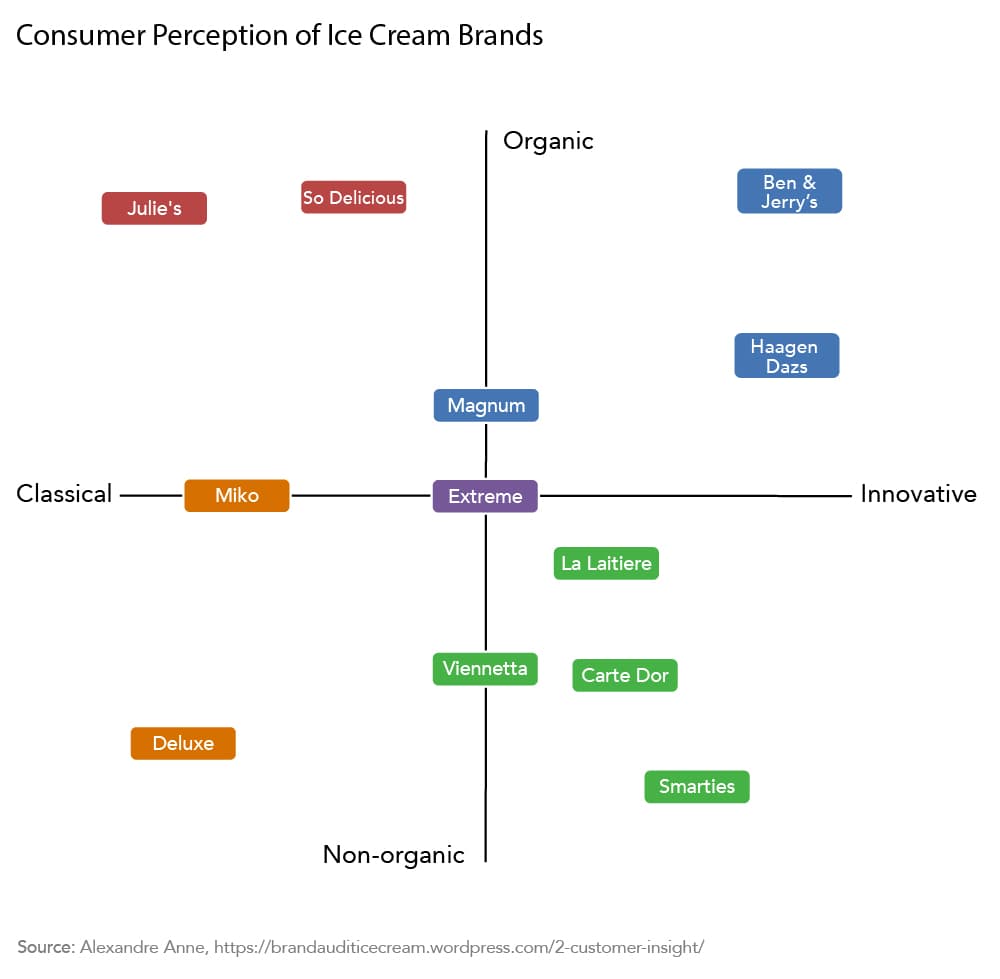
A perceptual map is a visual tool that plots competing brands or products on a graph based on key attributes, showing how consumers actually perceive them. Think of it as a snapshot of the competitive landscape from the consumer's point of view.
This matters because where your brand sits on the map relative to competitors directly shapes your positioning strategy. It can reveal market gaps worth targeting, highlight which competitors you're most similar to (and therefore most threatened by), and guide decisions across product development, pricing, and communications.

Top images from around the web for Product attributes
Perceptual mapping - Wikipedia View original
Is this image relevant?
Reading: The Positioning Process – Introduction to Marketing I (MKTG 1010) View original
Is this image relevant?
Reading: The Positioning Process – Introduction to Marketing I (MKTG 1010) View original
Is this image relevant?
Perceptual mapping - Wikipedia View original
Is this image relevant?
Reading: The Positioning Process – Introduction to Marketing I (MKTG 1010) View original
Is this image relevant?
Components of perceptual maps
Product attributes
These are the characteristics consumers use to evaluate and compare products. They form the axes of your map, so choosing the right ones is critical.
- Tangible attributes: price, size, speed, durability
- Intangible attributes: perceived quality, prestige, trendiness, trustworthiness
- Attribute selection is typically informed by market research, focus groups, or surveys
- The attributes you choose will shape the entire analysis. Pick attributes that don't matter to consumers and the map becomes useless.
Brand positioning
Each brand gets plotted as a point on the map based on how consumers rate it on the chosen attributes.
- Proximity between two brands means consumers perceive them similarly. If your brand sits right next to a competitor, you're fighting for the same perceptual space.
- Distance from the origin (center) reflects how strongly a brand is associated with a particular attribute. A brand plotted far along the "luxury" axis is strongly perceived as luxurious.
- This helps you spot your unique selling proposition and see where you overlap with competitors.
Consumer perceptions
Perceptual maps capture subjective consumer opinions, not objective product specs. A phone with a bigger battery might still be perceived as having worse battery life if the brand has a reputation for poor performance.
- Perceptions are shaped by personal experience, marketing messages, word of mouth, and social influence
- They frequently differ from what the company intends its positioning to be
- Understanding this gap between intended and actual perception is one of the most valuable things a perceptual map can reveal
Types of perceptual maps
Two-dimensional maps
The standard format. Two axes, each representing one attribute, with brands plotted as points in the resulting space.
For example, a map of the car market might use price (low to high) on the x-axis and sportiness (practical to sporty) on the y-axis. You'd quickly see that a Toyota Corolla clusters in the low-price/practical quadrant while a Porsche 911 sits in the high-price/sporty quadrant.
- Easiest to create, read, and present
- Works well for initial analysis and communicating findings to stakeholders
- The tradeoff: two dimensions can't capture every attribute that matters to consumers
Multi-dimensional maps
These incorporate three or more attributes, giving a more complete picture of how consumers perceive the market.
- Can be visualized as 3D graphs or through specialized software that uses color, size, or shape to represent additional dimensions
- More comprehensive but harder to interpret and communicate
- Typically used in deeper research settings rather than presentations to non-technical audiences
Creating perceptual maps

Step 1: Collect data
You need actual consumer perception data. Common methods include:
- Surveys using rating scales (e.g., "Rate Brand X on quality from 1-10") or semantic differential scales (e.g., "cheap ——— expensive")
- Focus groups for qualitative insight into how consumers think about and compare brands
- Online questionnaires for reaching larger sample sizes efficiently
- Social media sentiment analysis for real-time, unsolicited consumer opinions
- Secondary sources like market reports can supplement primary research
Step 2: Select attributes
Not every attribute belongs on your map. The ones you choose should be:
- Relevant to how consumers actually make decisions in this category
- Differentiating across brands (if every brand scores the same on an attribute, it won't reveal anything useful)
- Measurable through your data collection methods
Stick to 2-5 attributes to keep the map interpretable. Consider including both functional attributes (price, features) and emotional ones (prestige, fun). Pilot testing or pre-testing can confirm your attributes resonate with consumers before you commit to the full study.
Step 3: Analyze and plot
- Calculate mean scores for each brand on each selected attribute
- Statistical techniques like factor analysis or multidimensional scaling (MDS) can help reduce many attributes down to the key underlying dimensions
- Plot each brand's position on the map based on its attribute scores
- Cross-check results against qualitative data or expert knowledge to make sure the map reflects reality
Interpreting perceptual maps
Proximity analysis
Look at which brands cluster together. Brands plotted close to each other are perceived similarly by consumers, which means they're in direct competition for the same customers.
- Clusters of brands signal crowded competitive space
- If your brand is too close to a stronger competitor, you may need to differentiate more aggressively
- Brands that sit far apart are perceived as very different, meaning they likely appeal to different segments
Gap identification
Empty spaces on the map represent attribute combinations that no current brand occupies. These gaps can signal opportunity, but not every gap is worth pursuing.
- A gap near where your target consumers' ideal preferences cluster is a strong opportunity
- A gap that exists because no consumer actually wants that combination (e.g., high price + low quality) is not an opportunity
- Always evaluate feasibility, profitability, and barriers to entry before chasing a gap
Competitive positioning
The map gives you a clear read on the competitive landscape:
- Which brands lead on which attributes
- Where competitors are vulnerable (weak on attributes consumers care about)
- How your brand's position has shifted over time if you compare maps from different periods
- What strategic moves could strengthen your position or challenge a competitor's
Applications in marketing

Product development
Perceptual maps can guide what to build next. If the map shows an unoccupied space near where consumer preferences cluster, that's a signal to develop a product with those attributes. Maps also help prioritize which features matter most and inform pricing based on where the product would sit on a perceived value dimension.
Brand repositioning
If your brand is perceived in a way that doesn't match your strategy, the map makes that visible. You can then develop targeted communications to shift perception toward desired attributes. Running perceptual maps over time lets you track whether repositioning efforts are actually working.
Market segmentation
Different consumer segments often cluster around different ideal points on the map. Overlaying segment preferences onto a perceptual map helps you:
- Identify which segments are underserved
- Tailor messaging to match how each segment perceives the category
- Allocate resources toward the most attractive segments
Limitations of perceptual mapping
Perceptual maps are useful, but they have real constraints you should be aware of:
- Oversimplification: Reducing consumer perception to two or three dimensions inevitably leaves out factors that matter
- Assumption of clarity: The technique assumes consumers have well-formed, consistent perceptions of brands, which isn't always the case
- Static snapshot: A map captures one moment in time. In fast-moving markets, it can become outdated quickly
- Attribute bias: If you choose the wrong attributes, the map will produce misleading conclusions
- Perception ≠ reality: The map shows what consumers believe, which may not align with actual product performance
Perceptual mapping vs. other techniques
Perceptual mapping vs. conjoint analysis
| Perceptual Mapping | Conjoint Analysis | |
|---|---|---|
| Focus | Overall brand perceptions and positioning | Consumer preferences for specific features |
| Output | Visual map of market structure | Quantitative data on feature importance and trade-offs |
| Best for | Understanding competitive landscape | Optimizing product design decisions |
| Accessibility | Easy to interpret for broad audiences | More technical, requires statistical expertise |
These two techniques complement each other well. Perceptual mapping shows you where brands sit; conjoint analysis helps you understand why consumers prefer certain feature combinations.
Perceptual mapping vs. factor analysis
Factor analysis isn't really an alternative to perceptual mapping. It's often a step within the perceptual mapping process. Factor analysis reduces a large set of attribute ratings down to a smaller number of underlying dimensions (factors), which can then serve as the axes of your perceptual map. On its own, factor analysis identifies patterns in data but doesn't produce the visual competitive positioning that makes perceptual maps so useful for strategy.
Case studies and examples
These examples show how different industries use perceptual maps with different attribute pairs:
- Automobiles: price (low to high) vs. fuel efficiency (low to high). A Honda Civic and Toyota Prius would cluster in the affordable/fuel-efficient quadrant, while a Land Rover sits in the expensive/low-efficiency space.
- Soft drinks: taste (mild to bold) vs. healthiness (indulgent to healthy). Coca-Cola Classic plots as bold/indulgent; a brand like Honest Tea plots as mild/healthy.
- Smartphones: screen size (small to large) vs. battery life (short to long)
- Hotels: luxury level (budget to luxury) vs. eco-friendliness (conventional to eco-friendly)
- Fashion: style innovation (classic to avant-garde) vs. affordability (budget to premium)
Tools and software
For an honors marketing course, you should know that perceptual maps can be created with a range of tools:
- Basic: Microsoft Excel's scatter plot charts work for simple two-dimensional maps
- Statistical packages: SPSS, R, SAS, and Python (with libraries like Matplotlib and SciPy) handle the underlying statistical analysis, especially for multidimensional scaling
- Visualization tools: Tableau and Displayr create interactive, visually polished maps suitable for presentations
- Specialized software: Perceptual Maps Pro and OriginPro are built specifically for this type of analysis
The choice depends on the complexity of your analysis and your audience. For a class project, Excel or a free tool like R will typically be sufficient.
See Fiveable more often in Google
Mark Fiveable as a preferred source and Google is more likely to show you our guides in Top Stories, with a "preferred" badge in AI Mode and AI Overviews.